|
|
|
|
|
 |
|||
|
|
|
|
|
|
|
|||
| Click Here For Full Artist Print Indexes | Aviation History Archive |
|
Aviation Art Prints  Aviation Postcards Aviation Postcards |
[UP] - Countries - Pilot Signatures - Aviation Artists - Articles and Reports - Aviation Postcards - Original Paintings - Original Drawings |
| More Pages : World War One - World War Two - Modern Era - Spitfire - Lancaster - Mosquito - Typhoon - Tempest - Hurricane - Mustang - Me109 |
| Navigation | |
| Page 5 of 31 | Previous .. Page 5 .. Next |
|
|
|
|
|
|
|
|
|
|
|
|
|
|
|
|
|
|
|
|
|
| Navigation | |
| Page 5 of 31 | Previous .. Page 5 .. Next |
| Text for the above items : |
The Horror and the Glory by Ivan Berryman. (PC) The flight to the Ruhr dams on the night of 16th/17th May 1943 as part of Operation Chastise was fraught with peril as each wave of three aircraft hugged the ground across Holland and into Germany to avoid detection. Having flown particularly low to avoid the flak and searchlights near Dulmen, ED864 (AJ-B) piloted by Flt Lt W Astell sadly hit high tension wires and immediately burst into flames, the aircraft rearing into the air before hitting the ground, it's Upkeep mine exploding moments later, killing all the crew instantly. These were the first victims of the Dambuster raids, the first of eight aircraft that failed to return of the nineteen that took off on this heroic mission. |
The Big Stick by Ivan Berryman (PC) Avro Vulcan B.2 XM648 had a long and distinguished career with 101 Sqn at Waddington, among others, but finally succumbed to the breakers torch in December 1982. |
Victory Above Dover by Ivan Berryman. (PC) Adolf Galland claimed his 16th victory on the afternoon of 25th July 1940 when Spitfires of 54 Sqn were bounced by Messerschmitt Bf.109s of Gallands III/JG26. A fierce battle ensued off Dover during which F/Lt Basil Wonky Way, flying R6707, found himself the subject of the great German aces attention, his stricken aircraft being observed to plunge into the sea after receiving numerous hits from the Bf.109s guns. F/Lt Way lost his life in the crash, presumed drowned. |
Spitfires of No.611 West Lancashire Squadron by Ivan Berryman. (PC) Spitfire Mk.IXs of No.611 Sqn including aircraft FY-F belonging to the Commanding Officer of 611 Squadron, Sqn Ldr Hugo Armstrong, on patrol late in 1942. Armstrong scored a victory in this aircraft on 2nd November 1942, bringing down an Fw190 for his only victory with this squadron. With a total of nine victories, he was awarded the DFC in May 1942, and the Bar to the DFC in January 1943, before being shot down and killed over the English Channel in February 1943. |
The Forgotten V Bomber by Keith Aspinall. (PC) The Vickers-Armstrongs Valiant was a British four-jet high-altitude bomber, once part of the Royal Air Force's V bomber nuclear force in the 1950s and 1960s. The Valiant was the first of the V bombers to become operational, and was followed by the Handley Page Victor and the Avro Vulcan; it was noticeably less advanced than its counterparts. The Valiant has the distinction of being the only V bomber to drop live nuclear weapons. |
Day Ranger to Grove by Ivan Berryman. (PC) On 26th September 1944, F/O George Stewart, and his navigator F/O Paul Beaudet flew a Day Ranger with fellow 23 Squadron Pilot F/O D.L,'Bud' Badley, and his navigator Sgt A A Wilson, to Grove Aerodrome in Denmark, in their FB.VI Mosquito fighter bombers. Arriving abruptly over their target, George spotted a Ju.88 sitting by the perimeter track and at once strafed with his four 20mm cannons. He is flying YP-T (HR 201), and Bud, YP-Z (HR 216), seen in the background. Their sudden appearance and departure drew no return fire and, as they raced back to the coast, George couldn't resist a departing shot at a Freya Radar tower, but got hit by a .303 round in his instrument panel as he flew overhead. Bud, however, received numerous hits on his pass, losing one engine, plus rudder, elevator control and R/T. In a superb display of airmanship, at zero feet, Bud regained control and flew back home to land safely at the emergency airstrip at Woodbridge. George, having plunged into low cloud and therefore lost sight of Bud, was unable to raise him on the R/T and flew on to Little Snoring. George and Paul were awarded DFCs, following their extended operational tour, and Bud an 'Immediate' DFC, by W/C 'Sticky' Murphy DSO and Bar, DFC and Bar, Croixe de Guerre and Palm, Commanding Officer of 23 Squadron, RAF. |
Raid on Wajir by Ivan Berryman. (PC) The second half of 1940 saw repeated attacks by the Regia Aeronautica on Allied airstrips in East Africa, but its aging bomber force proved no match for the Hurricanes and Gladiators that offered a spirited defence. The airstrip at Wajir in Kenya was attacked several times by the Italians, but largely survived, the worst damage being the destruction of a fuel dump on 13th June. Here, a Gloster Gladiator of No.1 SAAF Squadron despatches a Caproni Ca.133, just south of Wajir. |
Fast and Furious by Ivan Berryman. (PC) The outbreak of the Korean War in July 1950 saw the Royal Navy forced to put its newest aircraft procurements to the test, most of them refined developments of many of their WW2 types. Whilst the Supermarine Seafire FR.47s of the Fleet Air Arm were considered to be more effective at high altitude, the role of low-level ground attack fell to the remarkable Hawker Sea Fury whose great speed and manoeuvrability frequently frustrated the opposing MiGs. Here, two FB.11s of 802 Sqn, HMS Eagle, close for a strafing attack on a ground target in August, 1952. |
222 Sqn Meteors over the Forth Bridge by Ivan Berryman. (PC) Three Gloster Meteor F.Mk4s of 222 'Natal' Squadron are depicted on a training sortie over the Forth Bridge in the early 1950s. |
501 Sqn Scramble by Ivan Berryman (PC) Byron Duckenfield and his 501 Squadron wingman struggle to get airborne in their Hurricanes as the spectacle of the scrambling squadron draws a group of passing motorists out of their vehicle to witness the thunderous noise of the aircraft. Additional colour added to enhance this previously black and white image |
QRA Scramble by Ivan Berryman. (PC) A pair of 29 Squadron Lightning F.Mk3s tuck their gear up and head skyward from the Wattisham tarmac in the summer of 1972. |
Menace - Heinkel 219A-7/R2 by Ivan Berryman. (PC) One of the most effective night fighters of WWII, Heinkel's extraordinary 219 'Uhu' (Owl) was designed from the outset as a highly specialized type, originally conceived as a multi-role aircraft, but eventually entering service purely in the nocturnal role. Equipped with the very latest in airborne radar and heavily armed, the 219s became the scourge of the skies against Allied night bombers until it met its match in the form of the night fighter Mosquito. This example is from Stab I/NJG 1, flown by Hauptmann Paul Forster during 1944. |
The Dash for Home by Ivan Berryman. (PC) Drop tanks gone and light on fuel, two Hawker Tempest Vs of 3 Sqn based at RAF Coltishall and its satellite base of RAF Matlask, race at low level across the mist-filled fields of southern England on their way home. Nearest aircraft is JN817 (JF-H) with JN765 (JF-K) slightly ahead. |
Extraction - Afghanistan 2011 by David Pentland. (PC) An SAS team is picked up by a U.S. Army Special Forces Blackhawk helicopter after a successful operation against the Taliban. |
Winter Warriors by Ivan Berryman. (PC) The Winter of 1943-44 saw Hawker Typhoons operating from Tangmere, equipped with 500lb or 1000lb bombs against radar installations and V1 sites in northern France. Wing Commander J R Baldwin is depicted getting airborne with others of his squadron for just such a mission early in 1944, before the squadron moved to Needs Oar Point in readiness for the D-Day landings. |
101st Airborne en route to Normandy by Ivan Berryman. (PC) A Douglas C-47 of the 91st Troop Carrier Squadron, 439th Troop Carrier Group gets away from the Devon airfield of Upottery on 5th June 1944 carrying paratroops of 101st Airborne Division. The company departed from Upottery airbase in Devon, England, and dropped over the Cotentin Peninsula of Normandy, France in the early hours of the morning of June 6th, 1944 at the start of the Normandy invasion. |
Gothas Moon by Ivan Berryman. (PC) Just as the name Zeppelin had become the common term for almost every German airship that ventured over Britain, so the name Gotha became generically used for the enemy bombers that droned across the English Channel during 1917-1918, inflicting considerable damage to coastal ports and the capital. As the massed raids of Bombengeschwader 3 increased, a public inquiry in England brought about the formation of the Royal Air Force as an independent service to counter this new threat and fighters from Europe were brought home to defend against these marauding giants. As a result, heavy losses on the German side meant that daylight raids had to be abandoned and all operations were henceforth conducted by night. Here, a pair of Gotha G.Vs begin to turn for home as searchlights play fruitlessly over distant fires, the grim result of another successful nights work. |
Balloon Buster, 25th January 1918 by David Pentland. (PC) German ace Lt. Fritz Roth of Jasta 23, flying an Albatross D.Va scores his first of three balloons in one days action. By the wars end he had accounted for 20 balloons and 8 Allied Aircraft. |
White-out at Breighton - Tribute to No.78 Squadron by Ivan Berryman. (PC) With the departure of No 1 Group in May 1943, No 4 Group's 78 Sqn Halifaxes arrived at Breighton in Yorkshire from where they would continue to operate until the end of the war. Halifax III LW291 (EY-M) is depicted snowbound in the Winter of 1944, not long before it was lost over Grossmutz whilst taking part on a raid on Berlin on 20th January 1944. Crew of EY-M : Pilot : Flight Sergeant F Moffat RCAF (killed), Navigator : Flying Officer W McGreggor RCAF (killed), Bomb Aimer : Flying Officer R Selman RCAF (killed), Wireless Operator : Flight Sergeant H H Bennett (taken prisoner), Flight Engineer : Sergeant N Legg (killed), Rear Gunner : Sergeant W Ruelhoff (killed, Mid-Upper Gunner : Sergeant J Stewart (killed). |
B-17 Memphis Belle by Keith Woodcock. (PC) The Memphis Belle, a Boeing-built B-17F-10-BO, manufacturer's serial number 3470, USAAC Serial No.41-24485, was added to the USAAF inventory on 15th July 1942 and delivered in September 1942 to the 91st Bombardment Group at Dow Field, Bangor, Maine. She deployed to Prestwick, Scotland, on 30th September 1942, moving to a temporary base at RAF Kimbolton on 1st October, and then finally to her permanent base at Bassingbourn, England, on 14th October. Each side of the fuselage bore the unit and aircraft identification markings of a B-17 of the 324th Bomb Squadron (Heavy); the squadron code 'DF' and individual aircraft letter 'A'. Captain Robert K. Morgan's crew flew 29 combat missions with the 324th Bomb Squadron, all but four in the Memphis Belle. The aircraft's 25 missions were: 7 November 1942 - Brest, France 9 November 1942 - St. Nazaire, France 17 November 1942 - St. Nazaire, France 6 December 1942 - Lille, France 20 December 1942 - Romilly-sur-Seine, France 30 December 1942 - Lorient, France (flown by Lt. James A. Verinis) 3 January 1943 - St. Nazaire, France 13 January 1943 - Lille, France 23 January 1943 - Lorient, France[ 14 February 1943 - Hamm, Germany 16 February 1943 - St. Nazaire, France 27 February 1943 - Brest, France 6 March 1943 = Lorient France 12 March 1943 - Rouen, France 13 March 1943 - Abbeville, France 22 March 1943 - Wilhelmshaven, Germany 28 March 1943 - Rouen, France] 31 March 1943 - Rotterdam, Netherlands 16 April 1943 - Lorient, France 17 April 1943 - Bremen, Germany] 1 May 1943 - St. Nazaire, France 13 May 1943 - Meaulte, France (flown by Lt. C.L. Anderson) 14 May 1943 - Kiel, Germany (flown by Lt. John H. Miller) 15 May 1943 - Wilhelmshaven, Germany 17 May 1943 - Lorient, France 19 May 1943 - Kiel, Germany (flown by Lt. Anderson) |
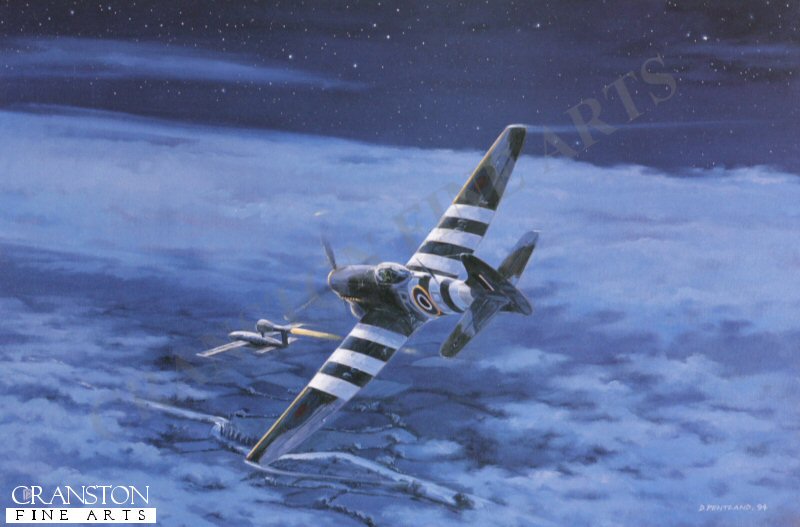
A Buzz for Beamont by David Pentland (PC) Wing Commander Roland Beaumont in his personal Tempest V, intercepted and downed his first V1 Buzzbomb on the night of June 22nd, 1944, over south east England. As Commander of 150 wing and others he went on to shoot down a total of 30 V1 flying bombs, 8 enemy aircraft and 35 locomotives destroyed plus one minesweeper sunk. |
|
Contact Details |
|
Sign Up To Our Newsletter!
This website is owned by Cranston Fine Arts. Torwood House, Torwoodhill Road, Rhu, Helensburgh, Scotland, G848LE Contact: Tel: (+44) (0) 1436 820269. Email: cranstonorders -at- outlook.com
|
|
|