|
|
|
|
|
 |
|||
|
|
|
|
|
|
|
|||
| Click Here For Full Artist Print Indexes | Aviation History Archive |
|
Aviation Art Prints  Aviation Postcards Aviation Postcards  Lancaster Lancaster |
[UP] - World War One - World War Two - Modern Era - Spitfire - Lancaster - Mosquito - Typhoon - Tempest - Hurricane - Mustang - Me109 |
| Navigation | |
| Page 1 of 3 | Page 1 .. Next |
|
|
|
|
|
|
|
|
|
|
|
|
|
|
|
|
|
|
|
|
|
| Navigation | |
| Page 1 of 3 | Page 1 .. Next |
| Text for the above items : |
Tribute to Walter Briegleb by Ivan Berryman. (PC) Walter Briegleb is shown in his Ju88 G.7 4R+BR as he stalks his prey - on this occasion a Lancaster. Flying below their target, his crew would aim upward firing cannon at the inner wing of the bomber, igniting the fuel tanks. For the bomber crews, they were very much defenceless against this type of attack, and often had no idea of the presence of an enemy aircraft in the dark. |
The Hunted and the Hunter by Ivan Berryman. (PC) The attack by Leutnant Walter Briegleb and his crew on Lancaster Mk.III ND960 DX-I of No.57 Sqn early on 22nd May 1944. Flying Me110 with codes D5+BV with his crew of Feldwebel Walter Bräunlich and Bordfunker Feldwebel Brandt, Briegleb flew undetected beneath the bomber and used the deadly 'Schräge Musik' - upward firing cannon - to hit the fuel tanks in the port wing between the fuselage and inner engine. Pulling away, he watched the aircraft burn and could see both gunners in their turrets but no return fire came. He wondered why none of the crew escaped by parachute with the bomber doomed - it disintegrated in the air over the coast of the island of Fyn, Denmark, impacting near Emtekær at 00:44hrs. Flight Lieutenant Arthur Richards (Pilot) Flying Officer William Woodall (Navigator) Pilot Officer Athur Bugden (Flight Engineer) Sergeant Thomas Edwards (Wireless Operator) Flying Officer George Ferguson (Air Bomber) Sergeant Harold Griffiths (Air Gunner) Sergeant Cyril Woodmass (Air Gunner) |
Raid on the Tirpitz by Ivan Berryman. (PC) On 12th November 1944, the mighty Tirpitz was finally destroyed by a combined force of Lancasters from No 9 and No 617 Squadrons. LM220, an aircraft of 9 Sqn is shown here making its run toward the target at approximately 09.40 hours on that fateful day. |
Chadwick's Masterpiece by Ivan Berryman. (PC) When Roy Chadwick first drew the Avro 679 Manchester bomber for the RAF, he could little have known that from this rather lacklustre machine would evolve the classic 683 Lancaster. This painting is not a record of any single event in the Lancaster's illustrious history, rather a portrait of a fine aeroplane and a tribute to the many crews who flew and serviced them. |
Three Home Safely by Ivan Berryman (PC) Three Lancaster bombers break the dawn silence after a night raid in 1943. |
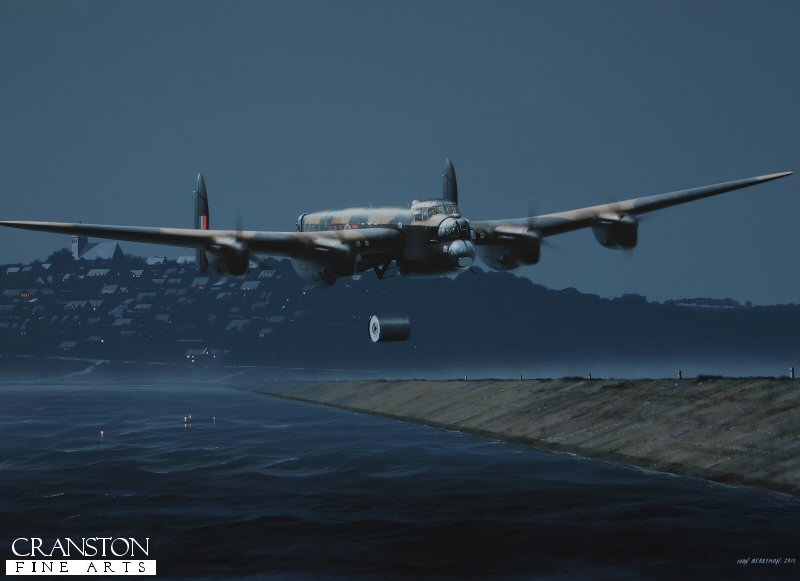
Determined to the Last by Ivan Berryman. (PC) The Lancaster B MkIII of Flt Lt J V Hopgood was the second aircraft to make an attempt at breaching the Mohne Dam on the night of 16/17th of May 1943, ED925(G) (AJ-M) encountering intense flak and 20mm fire from the shore and from the towers of the dam itself. Just moments from the release of the Upkeep bomb, both of Hopgood's port engines took direct hits and burst into flames as other rounds ripped through the starboard wing. Despite these fatal strikes, the brave crew pressed home their attack, but released their bomb just seconds too late to be effective. The bomb bounced over the dam wall, landing on the power station below where it exploded with devastating results. With blazing fuel now engulfing the wing of his crippled aircraft, Hopgood climbed to about 500ft where the wing failed, sending ED925 into a dive from which it would never recover. By jumping clear just moments before impact, two of her crew survived to become prisoners of war. |
The Eder Breaks by Ivan Berryman. (PC) The success of the attack on the Möhne dam on the night of 16th/17th May 1943 meant that the remaining three 617 Sqn Lancasters of the First Wave could turn their attention to the Eder, some twelve minutes flying time away. Wing Commander Guy Gibson first called in Flight Lieutenant D J Shannon, flying AJ-L (ED929G) to make the initial run, but he had great difficulty achieving the correct height and approach, so Gibson now ordered Squadron Leader H E Maudslay in AJ-Z (ED937G) to make his run. Again, the aircraft struggled to find the correct height and direction, so Shannon was again brought in, AJ-L finally releasing its Upkeep on the third attempt. The bomb bounced twice before exploding with no visible effect on the dam. Now Maudslay made another attempt, but released his bomb too late. The mine bounced off of the dam wall and exploded in mid air right behind AJ-Z, the Lancaster limping away, damaged, from the scene, only to be shot down on the way home with the loss of all crew. Finally, Pilot Officer Les Knight was called in for one final attempt. AJ-N (ED912G) released its Upkeep perfectly, the mine bouncing three times before striking the dam slightly to the south. In the ensuing explosion, the dam was seen to shake visibly before the masonry began to crumble and a massive breach appeared. With the Möhne and Eder dams both destroyed and the Sorpe demonstrated to be equally vulnerable, Operation Chastise had been a remarkable success and will stand forever as one of the most heroic and audacious attacks in the history of aerial warfare. |
Crewing Up by Graeme Lothian. (PC) Crew of Lancasters 101 Squadron RAF, stand chatting and drinking cups of tea supplied by the WMCA vans. Delays in Ops for an hour or so allow the crews a chance to light up and have a cup of tea. 101 Squadron based at Ludford Magna were a squadron with a difference, from 1943 the Lancasters were fitted with special radio jamming equipment known as ABC or AirBorne Cigar and carried an eighth crew member known as the special duties operator. Squadron letters were SR and targeted by the Luftwaffe fighters giving 101 Squadron the highest casualty rating in Bomber Command. |
Operation Manna by Ivan Berryman. (PC) During the years of the German occupation of Holland in World War II, more than 20,000 Dutch civilians perished through starvation and lack of basic provisions. Operation Manna was set in motion on Sunday, 29th April 1945 when Lancasters of the Royal Air Force began the first of 2,835 sorties, dropping 6,672 tons of food, to relieve the crisis in the Netherlands. These humanitarian missions continued until 8th May, saving many thousands of civilians from certain death by starvation and malnutrition. Here, Lancaster 4K765, LS-Z of 15 Sqn piloted by Flying Officer Jack Darlow, releases its precious cargo over a sports field north of The Hague. Also in the crew was Alistair Lamb the Rear Gunner. |
No Way Back by Ivan Berryman. (PC) Despite crippling damage to their Lancaster ED925 (G), the crew of AJ-M continued to press home their attack on the Mohne Dam on the night of 16th/17th May 1943. With both port engines ablaze, Flt Lt J V Hopgood forced his blazing aircraft on, releasing the Upkeep bomb just precious seconds too late to strike the dam, the mine instead bouncing over the wall and onto the power station below with devastating results. ED925 attempted to recover from the maelstrom, but the fuel fire was too intense and the aircraft was tragically lost, just two of her crew managing to escape the impact to spend the rest of the war as PoWs. |
Lancaster Attack by David Pritchard. (PC) 12th Janaury 1945 and the Lancatsers of 9 and 617 squadrons are once again taking their deadly cargo of Tallboy bombs over enemy territory. This time it is the turn of the U boat pens at Bergen in Norway. En route home the bombers are bounced by FW 190s of JG5. One of the Luftwaffe Pilots in White1, Heinze Owlowski, believes he has made a fatal attack on Lancaster KC-M piloted by Squadron Leader Tony Iveson. He salutes the crew before doing a victory roll in front of the badly damaged bomber. However, thanks to the bravery and skill of its young pilot the Lancaster would actually make it home to a force land on 3 engines at Dumburgh in the Shetland Isles. A feat for which the Squadorn Leader Iveson recieved his D.F.C. |
Dambusters over the Mohne by Ivan Berryman. (PC) Tracer fire streaks past two Dambuster Lancasters of No.617 Sqn as the decisive Barnes-Wallace bouncing bomb skips towards the dam in the moonlit background. Fire from the already burning buildings lights up the front face of the dam and reflects off the aircraft as they throttle up to make good their escape. |
Gunner's Moon by Ivan Berryman. (PC) On the night of 7th-8th June 1944, a Lancaster of No.207 Sqn piloted by Wing Commander John Grey was part of a force of 112 bombers and 10 Mosquitoes sent to attack a tank storage park near Cerisy-la-Foret. With the D-Day landings just 48 hours old, it was considered too risky to leave the tank park intact, should the Germans try to launch a counter thrust from this position, just 20 miles from the French coast near Bayeux. Shortly after crossing the coast, Greys aircraft was attacked by a JU.88 and both the mid upper gunner Sutherland and tail gunner McIntosh opened fire on their pursuer and sent it down in flames. No sooner had they recovered from this fright when a second JU.88 closed in on them. Again, both gunners combined their fire and destroyed the enemy aircraft in mid air. Grey pressed on to the target where their bombs fell on the enemy tank depot, also destroying some fuel dumps and an important road junction. Returning to the French coast to begin their journey home, they were attacked yet again, this time by a Messerschmitt Bf 110. With machine-like precision, McIntosh and Sutherland opened fire together, claiming their third victim in a single night. For this extraordinary feat, both gunners were awarded the DFC. |
Attack on the Sorpe by Ivan Berryman. (PC) Of the five Lancasters that formed the Second Wave of Operation Chastise, just one aircraft made it to the target, the Sorpe Dam, on the night of 16th/17th May 1943. American pilot Joe McCarthy had been forced to switch to the reserve aircraft due to technical difficulties and subsequently took off slightly later than his less fortunate comrades, all of whom fell either to German flak or to mishaps on their perilous journey. Upon arrival, McCarthy found the view of the dam itself to be unobscured, although mist in the surrounding valleys made it difficult to gauge his approach. As this was not a masonry dam, a different tactic was employed to the Möhne and Eder which involved flying along the length of the dam and dropping the Upkeep bomb, unspun, directly onto it. Their task was made all the more difficult by the fact that their approach necessitated McCarthy bringing AJ-T low over the hilltop village of Langsheid whose Church spire occupied the very point at which the aircraft had to pass to get a good run upon the dam. Undaunted and with great skill, ED825(G) made its run and released the bomb onto the dam, unassisted by the spotlight altimeter device that had proved so useful at the Möhne and Eder as AJ-T had not been fitted with this aid. Nevertheless, the Upkeep struck the dam and exploded as planned, sadly with little effect. McCarthy and his brave crew returned safely to Scampton, their landing made slightly difficult by a tyre that had been damaged by light flak on the return journey. The Sorpe was attacked again in the small hours of the morning when Flight Sergeant Ken Brown's aircraft, AJ-F of the Third Wave arrived, once more striking the dam successfully, but again without breaching it. |
The Horror and the Glory by Ivan Berryman. (PC) The flight to the Ruhr dams on the night of 16th/17th May 1943 as part of Operation Chastise was fraught with peril as each wave of three aircraft hugged the ground across Holland and into Germany to avoid detection. Having flown particularly low to avoid the flak and searchlights near Dulmen, ED864 (AJ-B) piloted by Flt Lt W Astell sadly hit high tension wires and immediately burst into flames, the aircraft rearing into the air before hitting the ground, it's Upkeep mine exploding moments later, killing all the crew instantly. These were the first victims of the Dambuster raids, the first of eight aircraft that failed to return of the nineteen that took off on this heroic mission. |
Not This Time by Ivan Berryman. (PC) Having arrived at the Eder dam, following the successful breaching of the Mohne on the night of 16th/17th May 1943, Wing Commander Guy Gibson put Flight Lieutenant D J Shannon, flying ED929G, to the task of making the first attack, but he had great difficulty achieving the correct height and approach and had to make a number of abortive runs before finally releasing his Upkeep bomb. AJ-L is shown here making his penultimate pass over the Eder wall, his mine still attached. This dam was eventually breached by Pilot Officer Les Knight, flying ED912(G) whose perfectly placed mine caused a massive breach in the south end of the dam. |
Night of Strong Winds by David Pentland. (PC) Berlin, Germany, 24th March 1944. While taking part in what was to be the last major RAF bombing raid on the German capital, Avro Lancaster AS-C of 166 Squadron was unlucky to have both port engines hit by flak. As the crew prepared to bale out, the aircraft again came under fire, this time by an enemy nightfighter. Knocked unconscious by one of the fighters shells, mid gunner Sgt. W.H. Burnell was trapped in the doomed bomber as it fell to the ground from 25,000 ft. Unbelievably he survived and apart from bruising his only injury was a gashed head from the stray shell. |
First Strike by Ivan Berryman. (PC) The Avro Lancaster B MkIII ED932(G), AJ-G, of Wing Commander Guy Gibson was the first aircraft to make an attempt at breaching the Möhne Dam on the night of 16/17th of May 1943 as Operation Chastise got underway. Having already made one 'sighting' run over the target, Gibson turned and began his second run, the flak and 20mm fire from the shore and from the towers of the dam now throwing up a hail of fire. Undeterred, the Upkeep mine was released, skipping across the water as planned, but striking the dam wall off centre with no visible effect. Gibson made several passes over the Möhne, each time escorting the attacking aircraft in an attempt to draw the enemy fire. With the Möhne finally breached, he led the remaining aircraft on to the Eder dam with similar success before returning safely to Manston. |
Teamwork by Ivan Berryman. (PC) The afternoon of 3rd August 1944 saw Lancasters of 15 Sqn assigned to an attack on German V-1 Rocket stores at Bois de Cassan. While over the target the squadron encountered heavy flak. During the return journey, Lancaster LS-P fell behind the rest of the squadron but luckily for the crew, two P-38 Lightnings who had been involved in fighter sweeps, spotted the straggling Lancaster and escorted it back to base at Mildenhall. |
Winter Departure by Keith Woodcock. (PC) A total of ten Lancasters carrying the code KM-X were lost between 17th January 1942 and 28th June 1945, with the loss of a total of 55 crew. |
City of Lincoln by Keith Woodcock. (PC) Avro Lancaster City of Lincoln depicted as she appeared in 1995. |
|
Contact Details |
|
Sign Up To Our Newsletter!
This website is owned by Cranston Fine Arts. Torwood House, Torwoodhill Road, Rhu, Helensburgh, Scotland, G848LE Contact: Tel: (+44) (0) 1436 820269. Email: cranstonorders -at- outlook.com
|
|
|