|
|
|
|
|
 |
|||
|
|
|
|
|
|
|
|||
| Click Here For Full Artist Print Indexes | Aviation History Archive |
|
Aviation Art Prints  Aviation Postcards Aviation Postcards |
[UP] - Countries - Pilot Signatures - Aviation Artists - Articles and Reports - Aviation Postcards - Original Paintings - Original Drawings |
| More Pages : World War One - World War Two - Modern Era - Spitfire - Lancaster - Mosquito - Typhoon - Tempest - Hurricane - Mustang - Me109 |
| Navigation | |
| Page 1 of 31 | Page 1 .. Next |
|
|
|
|
|
|
|
|
|
|
|
|
|
|
|
|
|
|
|
|
|
| Navigation | |
| Page 1 of 31 | Page 1 .. Next |
| Text for the above items : |
Tribute to Frank Carey by Ivan Berryman. (PC) Frank Carey, depicted here in his Hurricane of No.43 Squadron, was one of Britain's top Aces of the war. He scored over 20 confirmed victories as well as several shared or probable claims - these were in Europe during the Battle of France and Battle of Britain, but also later in the war in the east against the Japanese during their invasion of Burma. He was awarded a CBE in addition to his Distinguished Flying Cross with two bars, Distinguished Flying Medal and Air Force Cross. |
Etrich Taube by Ivan Berryman. (PC) The extraordinary Taube (or Dove) was extensively used by the Germans as a reliable, stable observation and reconnaissance aircraft as late as 1916, despite its archaic appearance. The Taube type first flew in Austria in 1909, the brainchild of Dr Igo Etrich and employed the early method of directional control known as differential wing-warping, instead of possessing ailerons and elevators. This version was powered by a Mercedes 6-cylinder inline engine and is a two-seat variant, much favoured by the Germans. |
AEG G.IV by Ivan Berryman. (PC) Although not as well known as the Gotha series of bombers, the Allgemeine Elektricitats-Gessellschaft G.IV acquitted itself well in the closing stages of World War 1, although its limited fuel load restricted it to short range duties and reconnaissance missions. The G.IV was popular with its crews because it was extremely robust and featured such state of the art developments as onboard radios and electrically-heated flying suits and was an easy aircraft to fly. Kampfgeschwader 4 are specially noted for flying their G.IVs up to seven missions a night on the Italian front. |
Oberleutnant Hermann Goring by Ivan Berryman. (PC) Synonymous with both World Wars, the young Hermann Goring scored his first victory on 16th November 1915, shooting down a Maurice Farman over Tahure. A year later, he was injured in combat, but managed to land his bullet-riddled aircraft near a field hospital. Goring steadily increased his score to an eventual 22 victories and is shown here on patrol in his characteristic all-white Fokker D.VII. |
Albacore at Cape Matapan by Ivan Berryman. (PC) A Fairey Albacore of 826 Naval Air Squadron releases its torpedo at the Battle of Cape Matapan, 28th March 1941. With intelligence from deciphered Italian communications aiding them, the British fleet had a distinct advantage from the outset of this battle. However, gaining a torpedo hit on the well protected battleship Vittorio Veneto came at a price - Lt Com Dalyell-Stead and the crew of his Fairey Albacore got close enough to launch their torpedo and damage the battleship, but were killed when their aircraft was brought down by the hail of anti-aircraft fire returned. Ultimately, the battle was a massive British victory with several Italian capital ships sunk, but it was a notable victory for innovation and intelligence, with British ship-borne radar decisive in a night action, and code-breaking by Bletchley Park aiding the British fleet. |
Snappers About by David Pritchard. (PC) On the 15th September, Battle of Britain Day, 1940, Sergeant Pilot Mike Croskell of 213 Squadron flying the C.Os personally coded Hurricane is bounced by a gaggle of Bf109s and Mikes Hurricane is torn apart by Cannon Shells. The injured young pilot is forced to bail out near Maidstone at the dangerously low height of just 200 feet, Luckily for him he landed in a grove of Apple trees and was rescued by an Anti Aircraft Gun crew with just a few cuts and grazes though he has suffered with a bad back ever since. |
Tribute to Pilot Officer Pegge of No.610 Squadron by Ivan Berryman. (PC) Spitfire P9433 DW-E of No.610 flown by P/O Pegge, in which he shot down two Bf.109Es on 12th August 1940. |
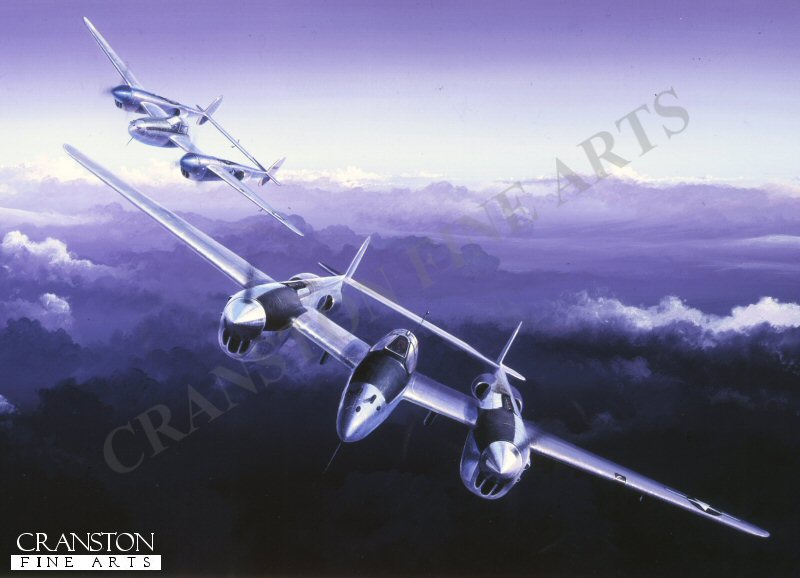
Fork Tailed Devil (Lightning) by Ivan Berryman. (PC) It was during the inter-war period that a reawakening interest in twin engined fighter design prompted several countries to investigate a number of revolutionary concepts, of these only Lockheed's sleek and unconventional P.38 was to be put into large scale production, proving to be a versatile and dominant fighter possessed of extremely long range, good speed and manoeuverability and a formidable armament. When production ceased in 1945, 9,923 examples of the P38 Lightning had been delivered. |
Tribute to Uffz. Werner Hertel, Pfalz D.III by Ivan Berryman. (PC) Flying as a junior pilot alongside notable Aces with Jasta 40, Werner Hertel's Pfalz D.III sported the striking winged dagger emblem as can be seen here. |
USS America by Ivan Berryman (PC) A Vought A-7 Corsair of VA-146 makes its final approach to the sprawling deck of the USS America, (CVA-66) as she skirts Vietnamese waters in company with a little Rock-class missile / command cruiser. The A-7 became the Navys prime weapon toward the end of the war, playing a vital role in the anti-radiation Linebacker Raids. |
Major Arthur Coningham by Ivan Berryman. (PC) Australian by birth and serving with the New Zealand army in the middle east at the outbreak of World War 1, Arthur Coningham joined the RFC in 1917 and was posted to 32 Squadron, flying DH.2s, as depicted here. It was in such a machine that Coningham scored the first of his 14 victories, sending down a German two seater over Ervillers. He survived the war and was made AOC Desert Air Force in 1941 before taking command of 2nd Tactical Air Force until the Second World War's end whereupon he became Air Marshal and was awarded a knighthood. He died in January 1948. |
Fieseler F.156 Storch by Ivan Berryman. (PC) Depicted on a typical night time sortie, this Fieseler Fi.156C was in service in Sarajevo in 1945 with FFS A/B5. The Storch's incredible short take off and landing capability, coupled with its stalky, but robust landing gear, made it an ideal aircraft for covert drops, personnel transport and spotting duties. GA+TR is depicted landing with flaps and leading edge slats extended. |
Tribute to Peter Wykeham-Barnes by Ivan Berryman. (PC) Lattely known as Air Marshal Sir Peter Guy Wykeham, KCB, DSO and Bar, OBE, DFC and Bar, AFC - he is shown here baling out of his stricken Gloster Gladiator of No.80 Sqn over North Africa on 4th August 1940. At the time he would have been known as Peter Wykeham-Barnes - a flying Ace who would go on to score 14 victories plus 3 shared in a wartime career which also saw him fly with No.274 Sqn and command No.73 Sqn, No.257 Sqn and No.23 Sqn. Remaining with the Royal Air Force after the war, he became a test pilot and served with the US Air Force in the Korean War before taking serveral roles in the RAF, culminating in Deputy Chief of Air Staff from 1967 until retirement in 1969. He died in 1995. |
Tribute to the Beaufighter Crews of No.89 Sqn by Ivan Berryman. (PC) Flying from their bases at Bu Amud in Egypt and Benina and Castel Benito in Libya, 89 Sqn's Bristol Beaufighter night fighters were kept busy in the early months of 1943 against Axis intruders who had been forced into night bombing missions by the total air supremacy of the Allied air forces. Here, a trio of Mk 1Fs bask in a glorious evening cloudscape, the nearest aircraft being V8447 (N), the personal aircraft of Wing Commander Dennis David, an ace with 17 victories to his name. |
Shell House Raiders by Ivan Berryman. (PC) Tucked in tight en route to Copenhagen, a wave of Mosquito FB VIs of 21 Sqn and their Mustang Mk.III escorts of 126 Sqn (including top Ace Agorastos John Plagis - 16 victories, on his last mission of the war) approach the Jutland Peninsula after a bumpy crossing of the North Sea on the morning of 21st March 1945. The Mosquitoes went on to carry out one of the most daring and successful raids of the Second World War on the German Gestapo headquarters in the centre of Copenhagen, inflicting irreparable damage to the Shellhus and killing more than 150 Gestapo personnel. |
Raid on Taranto by Anthony Saunders. (PC) The balance of maritime power in the Mediterranean was transformed at a stroke by the British air attack which disabled three Italian battleships in a few minutes. The target was the core of Mussolinis fleet, tucked away in Taranto Harbour, in southern Italy. The attack, codenamed Operation Judgement, took place in bright moonlight by twenty-one Swordfish from the British carrier HMS Illustrious. In the confined space of the harbour, their torpedoes had a devastating impact, at least nine torpedoes struck their targets. In all, seven ships were severely damaged, including the battleship Caio Duilio (left), Littorio (right) and Conte Di Cavour. |
Photo Reconnaissance Mosquito by Ivan Berryman. (PC) One of the most versatile British aircraft of the second world war, the Mosquito was employed in many roles during the war, including as seen here, in photo reconnaissance. |
Tribute to 488 Sqn RNZAF by Ivan Berryman. (PC) Immediately following the Allied invasion of northern France in June 1944, 488 Sqn RNZAF found themselves in the thick of the fighting, keeping enemy intruders at bay, flying mainly at night, a role to which their young pilots aspired and excelled. Among those was Flt Lt G E 'Jamie' Jameson who, together with his navigator Norman Crookes, shot down no fewer than eight enemy aircraft in Mosquito NF.XIII MM466, this particular machine becoming the most successful Mosquito of WWII in terms of aerial victories. Jameson was to be credited with a final total of eleven victories before being repatriated home. |
Focke-Wulf Ta.152 by Ivan Berryman. (PC) This aircraft was the ultimate evolution of the Fw.190 concept, but its introduction to service units in January 1945 meant that this high altitude interceptor arrived too late to make any significant impact on the war. It was, however, a formidable aircraft, capable of speeds up to 760 km per hour. |
Yellow 10 by Ivan Berryman. (PC) The elegant D-13 was the ultimate example of Focke-Wulf's FW.190 to be powered by the Jumo 213EB inverted inline engine and is still widely regarded as one of the finest aircraft to have entered service with the Luftwaffe in WWII. Armed with three 20mm guns, one of them firing through the propeller spinner, this aircraft proved itself to be an effective weapon for Geschwader Kommodore Major Franz Gotz of JG.26, the great ace claiming 63 victories. His machine is depicted in close-up here - "Yellow 10", Werk No. 836017, based at Furstenau in February 1945. |
Tribute to Fl Off Tom Neil by Ivan Berryman. (PC) Flying Officer Tom Neil closes on a Dornier Do.17 on 15th September 1940, just one of four victories confirmed on that day, the others being two Bf.109s and another Dornier shared. He is depicted flying Hurricane Mk1 V7313 of 249 Sqn whilst based at North Weald. |
|
Contact Details |
|
Sign Up To Our Newsletter!
This website is owned by Cranston Fine Arts. Torwood House, Torwoodhill Road, Rhu, Helensburgh, Scotland, G848LE Contact: Tel: (+44) (0) 1436 820269. Email: cranstonorders -at- outlook.com
|
|
|