|
|
|
|
|
 |
|||
|
|
|
|
|
|
|
|||
| Click Here For Full Artist Print Indexes | Aviation History Archive |
|
Aviation Art Prints  Aviation Postcards Aviation Postcards |
[UP] - Countries - Pilot Signatures - Aviation Artists - Articles and Reports - Aviation Postcards - Original Paintings - Original Drawings |
| More Pages : World War One - World War Two - Modern Era - Spitfire - Lancaster - Mosquito - Typhoon - Tempest - Hurricane - Mustang - Me109 |
| Navigation | |
| Page 4 of 31 | Previous .. Page 4 .. Next |
|
|
|
|
|
|
|
|
|
|
|
|
|
|
|
|
|
|
|
|
|
| Navigation | |
| Page 4 of 31 | Previous .. Page 4 .. Next |
| Text for the above items : |
Lone Gladiator by Ivan Berryman. (PC) A Gloster Gladiator MkII of 247 Sqn is depicted patrolling off the Cornish coast in August 1940 during which time this squadron became the only one to operate the Gladiator in the defence of the South of England during the Battle of Britain. |
Tribute to Peter Düttmann by Ivan Berryman. (PC) Peter Düttmann joined 5.JG52 in the spring of 1943, remaining with the unit until the end of the war. In just 395 missions he scored 152 victories - including 9 in a single day - and was awarded the Knight's Cross. Despite his aircraft being shot down or crash landing on 17 occasions, he was never wounded. He is depicted here in Bf.109 G-4 Black 12 of 5/JG52, Russia, May 1943. Peter Düttmann died in 2001. |
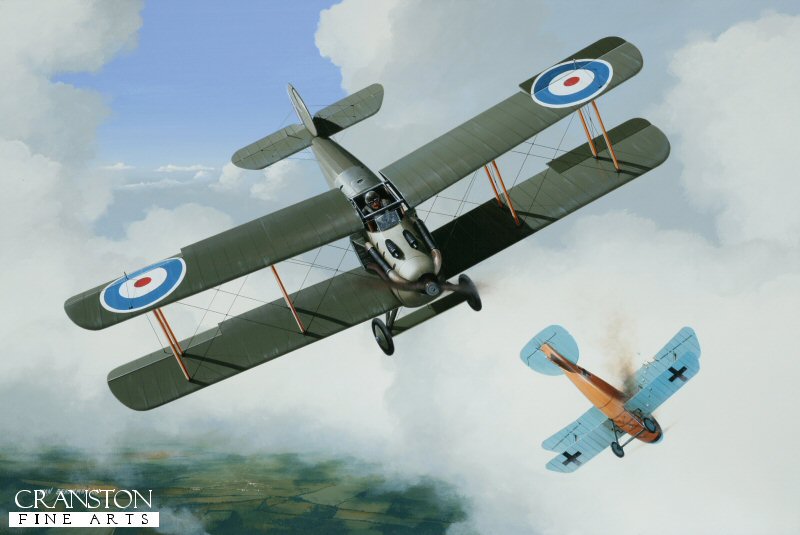
Major Albert Carter by Ivan Berryman. (PC) The Sopwith Dolphin was a radical departure from previous Sopwith design philosophies, embodying a reverse-stagger on the wings, a water-cooled Hispano-Suiza engine and an unusual, but highly popular positioning of the cockpit which gave the pilot unprecedented views. One exponent of this purposeful looking machine was Canadian Major A D Carter who claimed many of his 31 victories flying the Dolphin. He is shown here sending an Albatross to the ground on 8th May 1918 whilst flying C4017. Carter was himself shot down soon after became a prisoner of war. He was killed in 1919 whilst test flying a Fokker D.VII at Shoreham, Sussex. |
Leutnant der Reserve Erwin Bohme by Ivan Berryman. (PC) Albatros C.III C.766/16 was among the most distinctively-painted aircraft of World War 1, its fuselage sides decorated with a dragon motif on the starboard side and a stylised crocodile on the other, both apparently chasing a tiny white biplane. This was the aircraft shared by Erwin Bohme and his observer, Leutnant Ladermacher while serving with Jasta 10 on the Eastern Front in August 1916. Bohme was soon chosen to fly with the great Oswald Boelke with Jasta 2, the latter being tragically killed in a collision with Bohme on 28th October during an aerial combat with DH.2s of 24 Sqn. This tragedy haunted Bohme for many months to come, but he went on to score 24 confirmed victories before falling victim to an FK.8 on 29th September 1917. Their Albatros C.III is shown picking off a Russian Nieuport 12, his first kill on 2nd August 1916. |
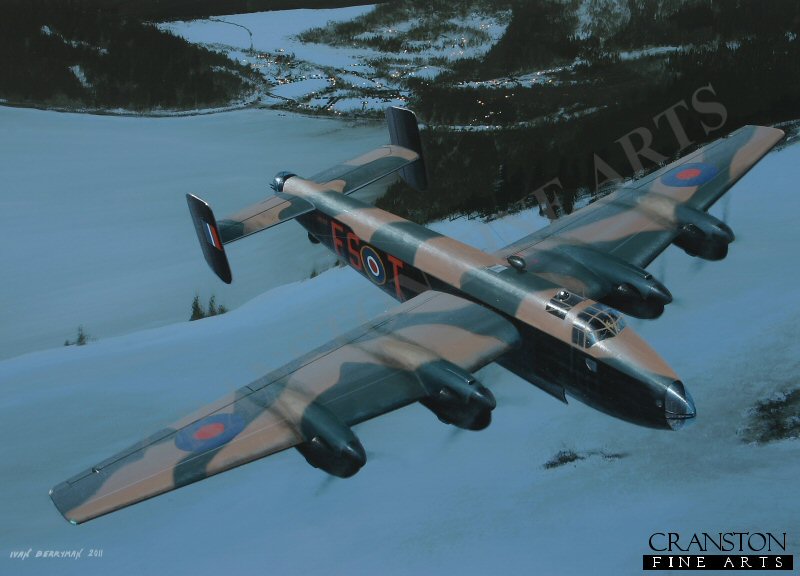
Operation Ebensburg by Ivan Berryman. (PC) Sunday 8th April 1945. Halifax B.II Series 1 (Special) JP254 of 148 Special Duties Squadron, RAF piloted by Pilot officer Bill Leckie is depicted approaching the drop zone near to the Alt Aussee salt mine in the Austrian Alps to drop four SOE agents and their equipment whose mission it was to secure and protect 6,755 items of the world's greatest works of art that had been looted and stored by the Germans as they swept across Europe. With the allied forces closing in, the Germans had planned to blow up the entire store to prevent the artworks from falling into the hands of the liberators. Once on the ground, the four agents linked up with local resistance fighters and the mine and its valuable contents were eventually secured, the explosives made safe and the entire cache taken into the safe keeping of the 80th US Infantry Division as the German occupation of Europe crumbled. |
Mediterranean Fury - Tribute to No.248 Sqn by Ivan Berryman. (PC) Providing vital support to the Pedestal convoy in 1942, No.248 Sqn were in action from their base on the island of Malta when, on 21st August, Sgt Ron Hammond destroyed a probable two aircraft in a single sortie. Flying Bristol Beaufighter T4843 (WR-X), he first dispatched a Ju88 and then found himself on the tail of a Fiat BR.20. Approaching on the enemy's right quarter, Hammond shot up the BR.20's starboard engine, the raking fire ripping through the wing and along the fuselage, eventually tearing off the port tailfin, which spun away, perilously close to his own aircraft. The Fiat was seen to spin out of control, plunging into the sea below. |
The Longest July by Ivan Berryman. (PC) Posted to 64 Squadron on 1st July 1940, the tragically short relationship of Sub Lt F Dawson Paul with the Spitfire was crammed with victories. He immediately shared a Dornier Do17 off Beachy Head and, just four days later claimed a Messerschmitt Bf.109. Further kills were confirmed over the next two weeks, among them five Bf.110s and another Do.17. His final victory was a Bf.109 on 25th, but on this day he fell to the guns of the German ace Adolf Galland. Dawson Paul was rescued from the English Channel by a German E-boat, but died of his wounds five days later as a prisoner of war. |
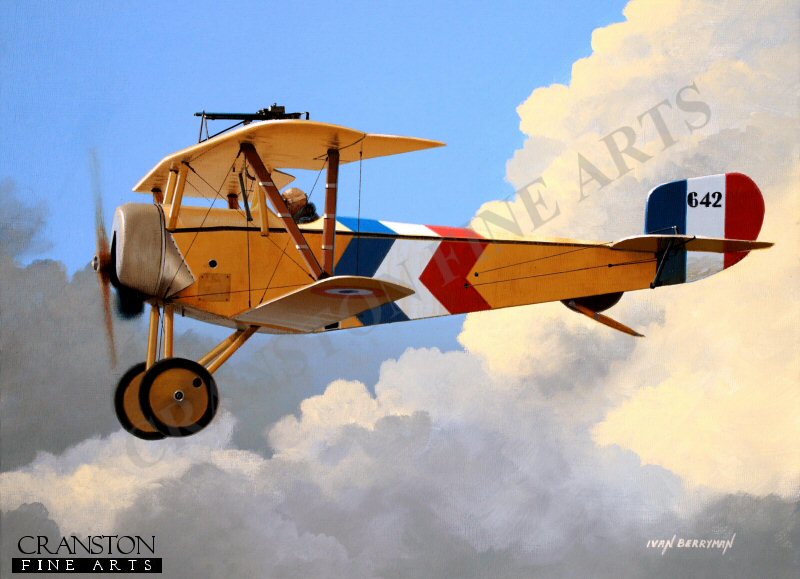
Tribute to Pierre Dufaur de Gavardie by Ivan Berryman. (PC) French Ace Pierre Dufaur de Gavardie claimed a total of six victories - four aircraft and two observation balloons between March and November 1916. He was badly wounded in early 1917 and despite recovering, would not fly in the war again. Pictured here in his Nieuport 11, he flew with Escadrille 12 and was awarded the Croix de Guerre, Legion d'honneur and Medal Militaire. He died aged 76 in 1966. |
Tribute to Capitano Antonio Raffi by Ivan Berryman. (PC) Whilst patrolling over advancing Allied troops east of Metemma, three Gloster Gladiators of K Flight, 1 SAAF Sqn, were attacked by Fiat CR.42s from 412a Squadriglia, led by Capitano Antonio Raffi. All three Gladiators were lost in the action, plus a further two that arrived too late to assist. |
Eagle's Rest by Ivan Berryman. (PC) Messerschmitt Bf.109G-2s of 6./JG 5 sit quietly following a fresh snowfall in March 1943, the aircraft swept down and ready for action, should the call come. Nearest aircraft is that of August Mors, 'Yellow 7', whilst the mount of Heinrich Ehrler, 'Yellow 12' sits nearby. Just three months later, on 12th June, Mors was forced to abandon his stricken machine, baling out over enemy territory. Despite this, he managed to evade capture and was back with his unit only six days later. |
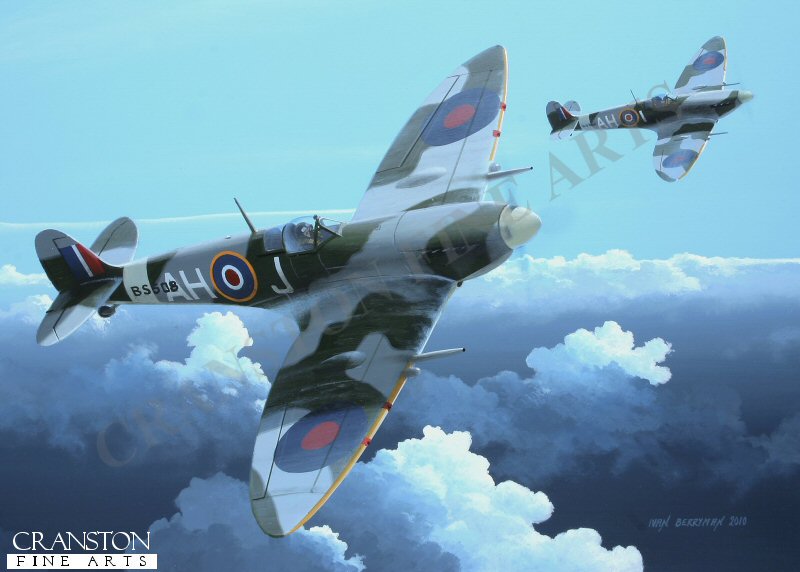
A Norwegian Tribute by Ivan Berryman. (PC) Norwegian pilots, forming 331 and 332 Squadrons, were to prove themselves a brave and formidable force following their formation in 1942. Here, two Spitfire Mk IXCs of 332 Sqn break to starboard, the nearest aircraft being that of Kapt. Finn Thorsager. |
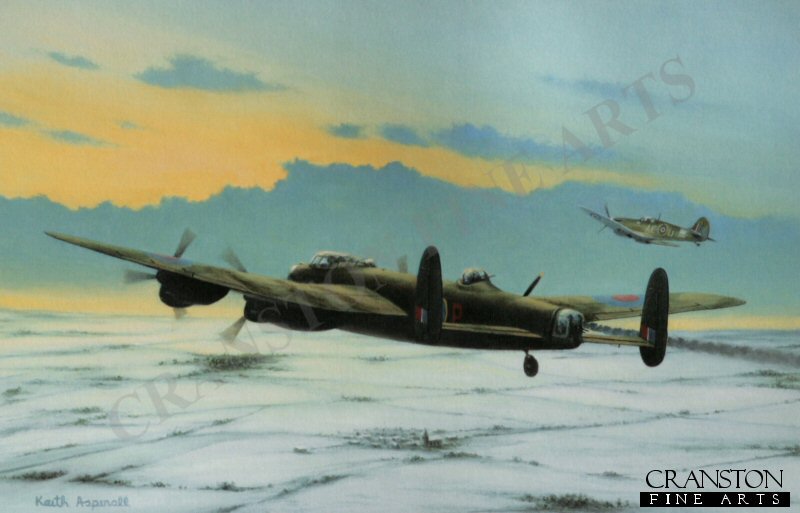
Last One Home by Keith Aspinall. (PC) A sole Lancaster returns over the snow covered fields of England, escorted home by a fighter. A fitting tribute to the air crews of the Lancaster squadrons of World War Two. |
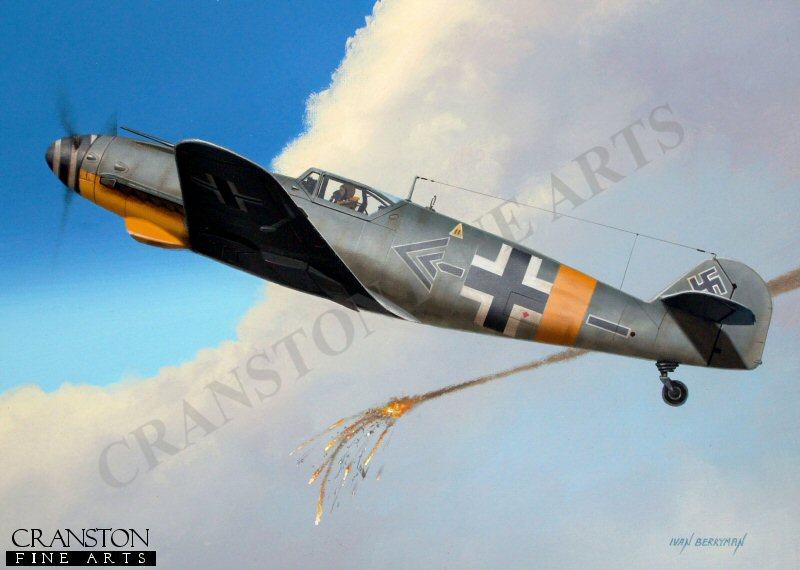
Tribute to Dieter Hrabak by Ivan Berryman. (PC) An Me109 pilot, Dieter Hrabak scored a victory during the Battle of France, 15 more during the Battle of Britain, commanded JG54 and JG52 and survived the war scoring a total of 125 victories. He is shown here flying Bf109 G-6 of JG52, Krakow, Poland in 1944. After the war he was instrumental in rebuilding the German Air Force, retiring in 1970. He died in 1995. |
Tribute to the RFC and RNAS by Ivan Berryman. (PC) Short 184 N2976 of the Royal Naval Air Service and based at Lee-on-Solent is shown in formation with a Sopwith Camel from the Royal Flying Corps base at East Boldre in the New Forest off the coast of Cowes, Isle of Wight, circa August 1918. |
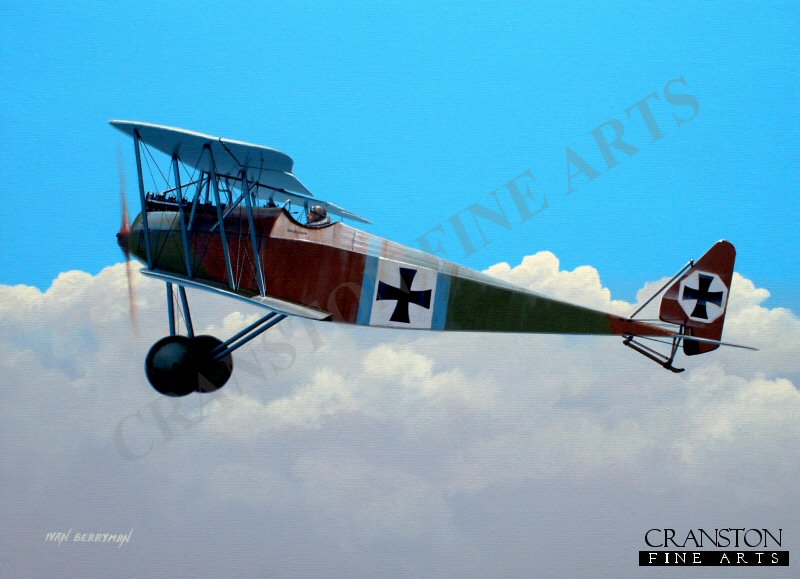
Tribute to Hans-Joachim Buddecke by Ivan Berryman. (PC) Hans-Joachim Buddecke was only the third ace to be awarded the Blue Max (after Max Immelmann and Oswald Boelcke), and was credited with a total of thirteen confirmed victories and many more unconfirmed. Seen here flying with Jasta 4 in a Halberstadt D.V in 1916 on the Western Front, he had previously flown Fokker Eindeckers here, and had served in Bulgaria and Gallipoli. He was shot down and killed in March 1918. |
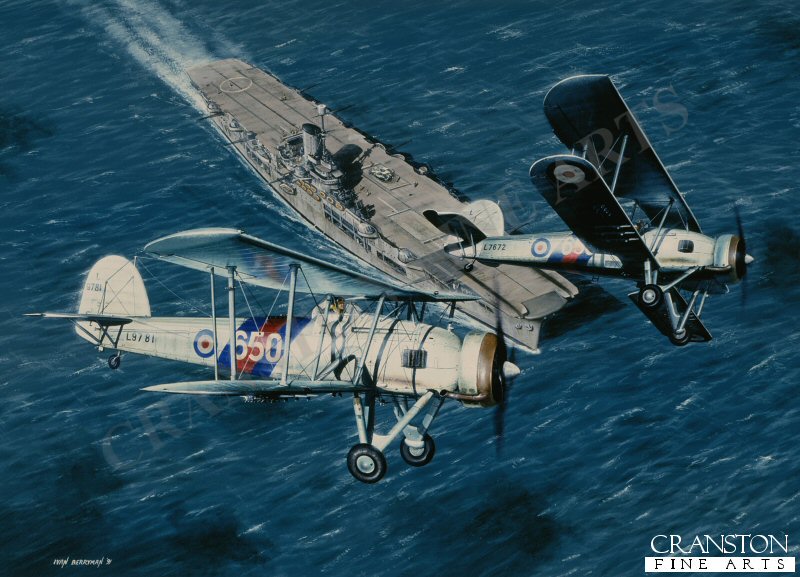
Sea Wings by Ivan Berryman. (PC) A pair of Fairey Swordfish Mk1s of 812 Sqn peel away above the pride of the Royal Navy, HMS Ark Royal, during a pre-war exercise in British waters. L9781 is nearest with L7672 in the background. |
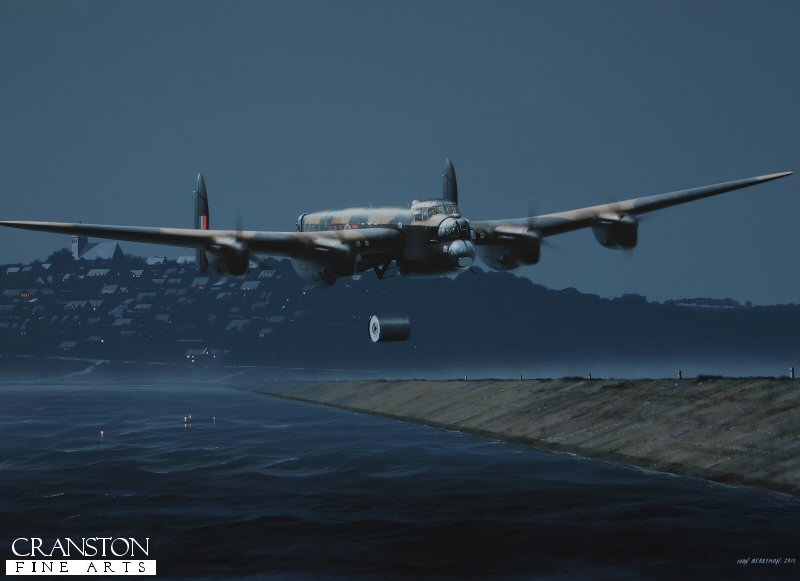
Attack on the Sorpe by Ivan Berryman. (PC) Of the five Lancasters that formed the Second Wave of Operation Chastise, just one aircraft made it to the target, the Sorpe Dam, on the night of 16th/17th May 1943. American pilot Joe McCarthy had been forced to switch to the reserve aircraft due to technical difficulties and subsequently took off slightly later than his less fortunate comrades, all of whom fell either to German flak or to mishaps on their perilous journey. Upon arrival, McCarthy found the view of the dam itself to be unobscured, although mist in the surrounding valleys made it difficult to gauge his approach. As this was not a masonry dam, a different tactic was employed to the Möhne and Eder which involved flying along the length of the dam and dropping the Upkeep bomb, unspun, directly onto it. Their task was made all the more difficult by the fact that their approach necessitated McCarthy bringing AJ-T low over the hilltop village of Langsheid whose Church spire occupied the very point at which the aircraft had to pass to get a good run upon the dam. Undaunted and with great skill, ED825(G) made its run and released the bomb onto the dam, unassisted by the spotlight altimeter device that had proved so useful at the Möhne and Eder as AJ-T had not been fitted with this aid. Nevertheless, the Upkeep struck the dam and exploded as planned, sadly with little effect. McCarthy and his brave crew returned safely to Scampton, their landing made slightly difficult by a tyre that had been damaged by light flak on the return journey. The Sorpe was attacked again in the small hours of the morning when Flight Sergeant Ken Brown's aircraft, AJ-F of the Third Wave arrived, once more striking the dam successfully, but again without breaching it. |
Dawn Descent by David Pentland (PC) A C130 Hercules MK1 from RAF Lynham Transport Wing, delivers a low level Brigade drop of Airbourne forces over Salisbury Plain. The C130 Hercules is the workhorse of the Royal Air Force Air Transport (AT) fleet and is based at RAF Lyneham in Wiltshire, where it is operated by Nos 24, 30, 47 and 70 Squadrons. The fleet totals 50 aircraft and is a mixture of C1/C3 aircraft and the new C-130J aircraft, designated C4/C5. |
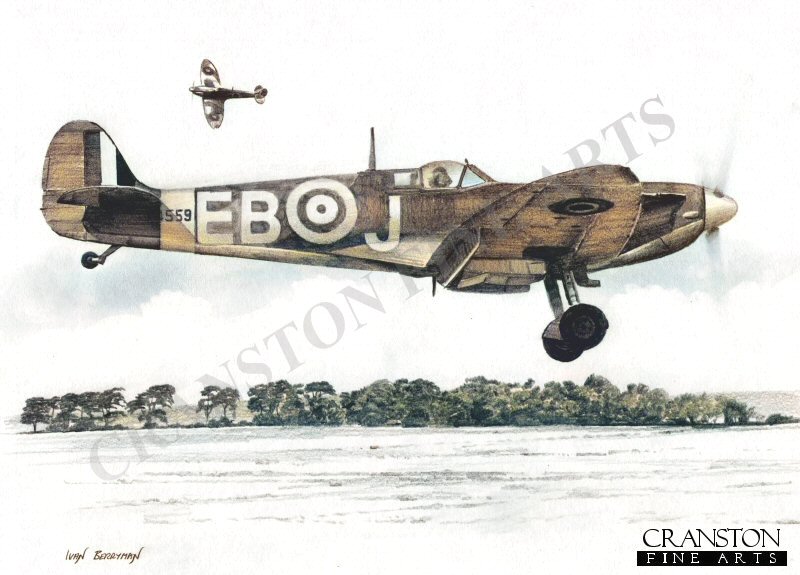
Sqn Ldr Maurice Brown - No.41 Sqn by Ivan Berryman (PC) Spitfire EB-J of Sqn Ldr Maurice Brown at the height of the Battle of Britain. Additional colour added to enhance this previously black and white image |
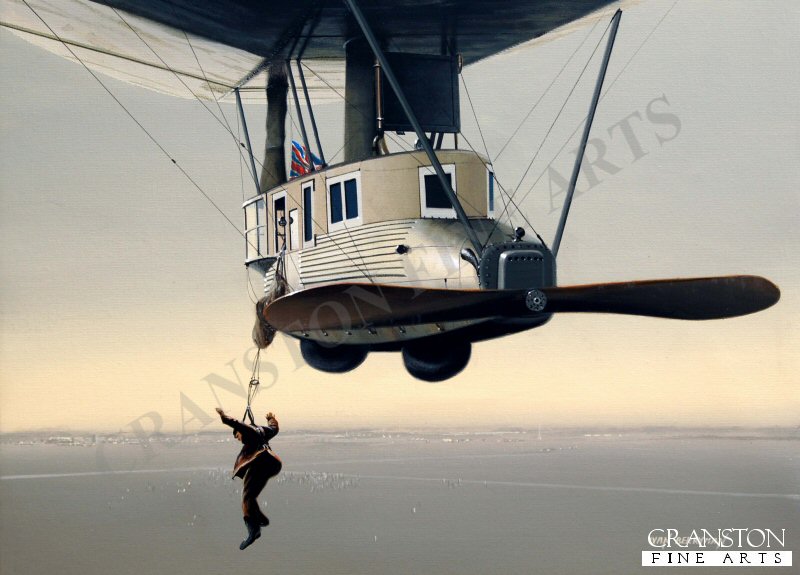
R.34 - Welcome to America by Ivan Berryman. (PC) Mineola, Long Island, USA, 6th July 1919. Major J E M Pritchard parachutes from the forward car of the R.34 to supervise ground handling of the giant airship upon its arrival in the United States. In so doing, Pritchard became the first man to land on American soil after an east-west crossing of the Atlantic by air. The enormous airship, with the nickname 'Tiny', was damaged beyond repair by foul weather in January 1921 and scrapped. |
Caproni Ca.3 by Ivan Berryman. (PC) The Italian Caproni series of bombers were the first to carry out long range missions during World War 1, frequently making round trips of over 150 miles in freezing conditions to deliver their meagre 1000lb bomb load on Austro-Hungarian targets. Here, a pair of Ca.3s return home, their gunners keeping a watchful eye for enemy fighters. The aerial gunners were particularly exposed to the sub-zero slipstream and often found it almost impossible to operate their guns because they were so cold, the rear gunners position being especially unpleasant due to his proximity to the mid engine and propeller that was just inches from his feet. |
|
Contact Details |
|
Sign Up To Our Newsletter!
This website is owned by Cranston Fine Arts. Torwood House, Torwoodhill Road, Rhu, Helensburgh, Scotland, G848LE Contact: Tel: (+44) (0) 1436 820269. Email: cranstonorders -at- outlook.com
|
|
|