|
|
|
|
|
 |
|||
|
|
|
|
|
|
|
|||
| Click Here For Full Artist Print Indexes | Aviation History Archive |
|
Aviation Art Prints  Countries Germany Aircraft Index More Aircraft Initials A to E Countries Germany Aircraft Index More Aircraft Initials A to E  Do17 Do17 |
[UP] - AEG G.IV - AGO C.1 - Albatros - Albatros C.III - Albatros D.I - Albatros D.III - Albatros D.V - Albatros W.4 - Ar196 - Ar234 - Aviatik B.1 - Aviatik D.1 - Brandenburg D.I - Bv222 - Bv238 - Do17 - Do217 - Do335 - Do435 - Do525 |
|
|
|
|
|
|
|
|
| Text for the above items : |
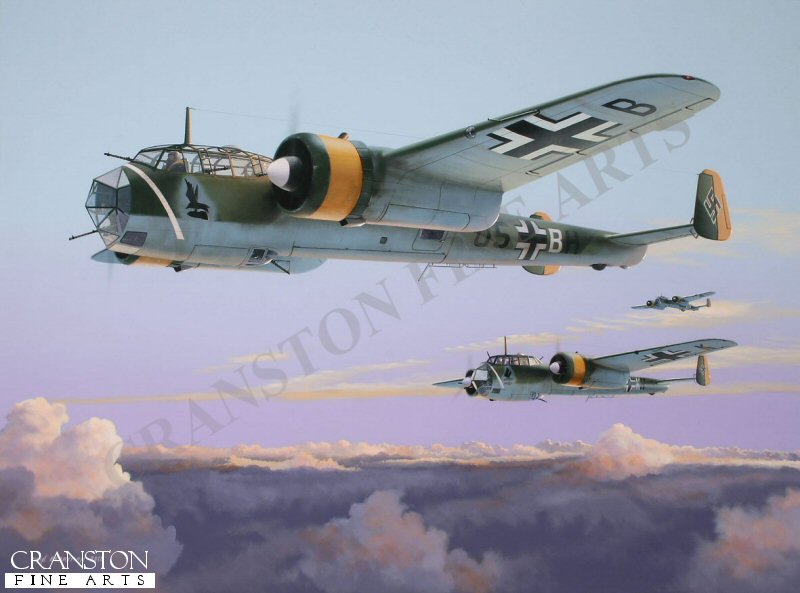
Holding the Line - The Battle of Britain by Nicolas Trudgian. They came across the English Channel at wave top height, their propeller slipstreams leaving wakes on the surface of the water. Nine Dornier Do17Z bombers of 9th Staffel, KG76, detailed to attack the RAF airfield at Kenley as part of Reichsmarshal Goring's prelude to Operation Sealion - the invasion of Britain. Hitler knew that RAF Fighter Command had to be destroyed in the air and on the ground if his plans were to succeed, but the German High Command failed to take into account the resilience of the young Hurricane and Spitfire pilots, and their determination to hold this last vital line of defence. The Dorniers were spotted as they approached the English coast, and Hurricanes were scrambled to intercept. The German bombers cleared the North Downs with feet to spare and spread out into attack formation as they lined up on the hangars at Kenley. As they came in over the airfield Hurricanes of 111 Squadron came diving upon them. Suddenly all hell broke loose. Bombs rained down on to the airfield and buildings went up in flames. One Dornier was brought down and two more, badly damaged by ground fire, were finished off by the Hurricane pilots. Now the chase was on to catch the others before they could escape back to their base in Northern France. Only one of the nine Dorniers that set out would return to base on that 18th day of August, 1940. |
Blenheim Mk.IVF of No.68 Sqn by Ivan Berryman. Bristol Blenheim Mk.IVF of No.68 Squadron. The night-fighter squadron flew Blenheims from mid1941 to early 1942 before converting to Beaufighters. Aircraft WM-Z is shown in combat with a marauding Dornier Do17. |
Against All Odds by Philip West. Geoffrey Wellum joins combat head-on with a Dornier during the Battle of Britain. He was part of a small group of 10 spitfires from Biggin Hill facing 150 plus enemy bombers and fighters. Other friendly fighters joined battle but the defenders were still vastly out numbered, a scene repeated on many occasions in the summer of 1940. On this particular day Geoff scored a Heinkel destroyed, together with a Dornier as a probable. |
5K+AR Sole Survivor by Ivan Berryman. Shortly after mid day on 26th August 1940, a Bolton-Paul Defiant of 264 Sqn claimed a victory that was to make history many decades later. Dornier Do.17Z2, Wk No 1160 of 7/III KG.3 had been part of a raiding force sent to attack targets in Essex. Attacked from below, the Do.17 suffered terminal damage and came to rest in the shallow waters of the Goodwin Sands, near Deal in Kent. Two of her crew died in the incident, but two others survived and became prisoners of war. In June 2013, over seventy years later, 5K+AR was raised from the water to be put on display at the RAF Museum in Hendon, becoming the only example of its type to survive anywhere in the world. |
Revenge of the Raider by Ivan Berryman. The 79 Sqn Hurricane Mk.I P3877 of P/O E J Morris receiving hits from a Dornier 17 on 31st August 1940. Morris was forced to crash land his aircraft and was slightly wounded following the combat. |
The Ubiquitous Raider - Dornier Do.17s of 1 Gruppe KG2 by Ivan Berryman. Serving in a huge variety of roles throughout WW2, the Dornier Do.17's origins lay in a design for a high speed mail plane capable of carrying six passengers. Numerous developments saw it mature into one of the world's most iconic bombers, typified here by these three Do.17Z-2s of 1 Gruppe, KG 2, based at Tatoi in Greece during 1941. |
The Pencil Eraser by Stan Stokes. In 1941 the advancing German forces had obliterated the Soviet Air Force. During the first week of fighting the Luftwaffe had destroyed more than 4000 Soviet aircraft. Huge numbers of aircraft were destroyed hopelessly on the ground, and those that took to the sky were often outclassed by superior equipment flown by more experienced pilots. The decimation of the Soviet Air Force during the fighting in 1941 was shocking, but even more remarkable is the story of the comeback of the Soviet Air Force. The Soviets had been blessed during their history with many excellent aviation designers and engineers. Zhukovsky, Sikorsky, Tupolev, Polikarpov, Mikoyan, Lavochkin, and Gurevich to name but a few. The Germans smashed the pride the nation had in its Air Forces, but the Soviets fought back. Most of the Soviet fighters at the start of the War were obsolete Polikarpov I-153s or I-16s. Some Mig 3s were available, but the Mig 3 was a poor performer at low altitudes, and was too unstable and too lightly armed to tangle with German fighters. The Lavotchkin LA-7 and the Yakovlev Yak-3 were two excellent new fighter designs that gave the Soviets some competitive edge, and an important ground support aircraft was the Il-2 Sturmovik. It is a miracle that the Soviets were able to produce these aircraft in large volumes. Production factories had to be moved east out of the range of German bombers, and the Soviets imported a large number of foreign made aircraft including the Bell P-39 Airacobra. In November of 1943 one of the fiercest aerial combat battles of all time took place. During a battle near the Kuban River, Russian and German aircraft clashed by the hundreds. For the first time since the German invasion in 1941, the Red Air Force prevailed. For the first time the Soviets took the initiative, sending wave after wave of modern new aircraft into combat against the Luftwaffe. In the air the Soviets earned their first victory over the Germans... a sign of things to come. During the Battle of Kursk in mid-1943, the Luftwaffe amassed nearly 2000 aircraft, however the Soviets had more than twice that number. This numerical superiority paid off during the fighting, In Stan Stokes painting a Mig-3 targets a Dornier Flying Pencil. More than 3000 Mig-3s were produced, but the aircraft was effective only in the role of high altitude interceptor or reconnaissance aircraft. At lower altitudes it was outclassed. The Do-17 was a prewar design that first entered service in 1937. The aircraft was enhanced with a 215 and 217 variant. The bomber version had a crew of 4 and was capable of carrying as much as a 9,000 pound bomb loads. With a maximum speed of 320-MPH the Flying Pencil could be elusive. |
The Longest July by Ivan Berryman. Posted to 64 Squadron on 1st July 1940, the tragically short relationship of Sub Lt F Dawson Paul with the Spitfire was crammed with victories. He immediately shared a Dornier Do17 off Beachy Head and, just four days later claimed a Messerschmitt Bf.109. Further kills were confirmed over the next two weeks, among them five Bf.110s and another Do.17. His final victory was a Bf.109 on 25th, but on this day he fell to the guns of the German ace Adolf Galland. Dawson Paul was rescued from the English Channel by a German E-boat, but died of his wounds five days later as a prisoner of war. |
Do17 The Dornier 17 first saw action during the Spanish Civil war (1936-39) where it was faster than the enemies fighters and was nicknamed by the Spanish as Bacalaos which means Cod Fish. Full production started in March 1937 with a variety of variants including DO 17E and DO 17F for use as fast reconnaissance aircraft. During the opening months of world war two the Dornier 17 along with the older He 111 was the main bomber for the Luftwaffe, with three of the bomber groups operating Dornior 17's - KG2, KG3 and KG76. At the outbreak of the war a total of 533 Dornier were in frontline service. The aircraft did well during the Polish campaign - with a speed of 265 mph which was faster than the Polish defenders fighters. But during the Battle of Britian, when faced with the fast Royal Air Force fighters, the Dornier with its light armament was no match. In1940 with the new JU 88 being produced the Dornier was gradually replaced and production of the Do 17 ended in 1940 |
|
Contact Details |
|
Sign Up To Our Newsletter!
This website is owned by Cranston Fine Arts. Torwood House, Torwoodhill Road, Rhu, Helensburgh, Scotland, G848LE Contact: Tel: (+44) (0) 1436 820269. Email: cranstonorders -at- outlook.com
|
|
|