|
|
|
|
|
 |
|||
|
|
|
|
|
|
|
|||
| Click Here For Full Artist Print Indexes | Aviation History Archive |
|
Aviation Art Prints  Countries UK Aircraft Index More Aircraft Initial A to D Countries UK Aircraft Index More Aircraft Initial A to D  Catalina Catalina |
[UP] - Airspeed Courier - Albacore - Anson - Apache - Armstrong-Whitworth FK.8 - Avenger - Avro 504N - Barracuda - Battle - BE2C - Beaufighter - Beaufort - Beverley - Bisley - Blenheim - Bombay - Boston - Boxkite - Brigand - Bristol F2B - Bristol Scout - Buccaneer - Bulldog - Camel - Canberra - Catalina - Chinook - Corsair - Dakota - DC3 - Defiant - DH2 - DH4 - Dolphin - Dragon Rapide |
|
|
|
|
|
|
|
|
|
| Text for the above items : |
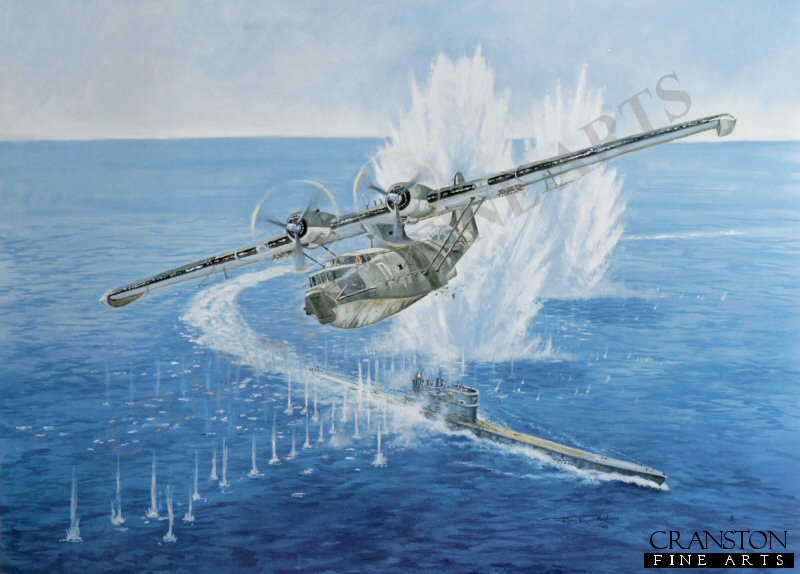
Catalina Attack by John Wynne Hopkins. D for Donald of 270 squadron, Royal Air Force, out of Freetown, West Africa operating in the Atlantic Ocean. It was during routine operation search that D for Donald surprised U515 on the surface and immediately attacked the submarine. U515 in putting up stiff resistance blew a large hole in the hull of D for Donald and the magazine of the starboard side 0.5 twin Browning was hit and the subsequent shrapnel wounded both blister gunners. U515 escaped but was sunk by an American naval hunter group a year later. D for Donald limped back to base and managed to make the beach before it would sink completely. |
On the Prowl by Timothy OBrien. Royal Air Force catalina over flys a Royal Navy Cruiser of Gibraltar while on patrol. |
The Aircraft That Found the Bismarck by Ivan Berryman. In early May 1941, in conditions of strict secrecy because the United States was not yet at war, seventeen pilots of the US Navy had arrived in Britain and been attached to Catalina squadrons of Coastal Command. These experienced PBY pilots were there to assist the Royal Air Force to become familiar with the Catalina, and also to gain operational experience for the US Navy. On 26th May 1941 Catalina Z of No.209 Sqn, commanded by Flying Officer Dennis Briggs RAF, with Ensign Leonard B Smith USN as co-pilot, joined the search for the Bismarck. At 1015 the aircraft was being flown in poor visibility at an altitude of 500ft when Ensign Smith sighted the Bismarck at a range of eight miles. The Catalina was flown towards the contact so that a positive identification could be made and emerged from the cloud only 500 yards from the German ship. The aircraft met a hail of anti-aircraft fire but was able to make its escape. As a result of the sighting report from Catalina Z the Bismarck was again engaged by ships and aircraft of the Royal Navy and was sunk at 1040 on 27th May 1941. Leonard Smith can be considered therefore, the first American to be directly involved in action in World War Two. He was awarded the Distinguished Flying Cross (American) for his actions. |
Black Cat, Indian Ocean, 1944 by David Pentland. A Catalina flying boat of the Royal Air Force shown at anchor in the Indian Ocean at night. |
Sinking of U-Boat 347 by Tim Fisher. Flt. Lt. John Alexander Cruickshank in his consolidated Catalina. Winning his Victoria Cross for sinking U-347. |
Heading for the Convoys by Stephen Brown. RAF Catalinas of 210 Squadron over the West Coast of Scotland in 1944. The Consolidated Catalina PBY-5 proved invaluable to the RAF in its efforts to defend the vital convoys from the threat of enemy submarines, particularly during the Battle of the Atlantic. |
By Dawn's Light by Ivan Berryman. The Consolidated Model 28 PBY Catalina was so successful in its definitive form that it went on to become the most extensively built flying boat of all time. Here, a 210 Squadron Catalina Mk IVA from RAF Sullom Voe, Shetland, has located two weary downed aircrew, drained but grateful after a long night in the North Atlantic swell. |
Catalina Crescendo by Ivan Berryman. No text for this item |
Great Catalina Take-Off by Roy Cross. No text for this item |
Catalina Built by the Consolidated Aircraft Company and designed by Isaax M Ladden. the Catalina first flew on the 28th march 1935. and first flew with the US Navy in October 1936. In 1935 the cost of each Catalina was $90,000 and just over 4,000 were built. The Catalina was used in various maritime roles. but it was designed initially as a maritime patrol bomber. Its long range was intended to seek out enemy transport and supply ships. but was eventually used in many roles including Convoy escort,, anti submarine warfare and search and rescue. In its role as a search and rescue aircraft it probably is best remembered for many thousands of aircrews shot down in the Pacific and less extend in the Atlantic and Mediterranean. The Catalina was the most successful flying boat of the war and even served in a military role until the early 1980's some are still used today in aerial firefighting. |
|
Contact Details |
|
Sign Up To Our Newsletter!
This website is owned by Cranston Fine Arts. Torwood House, Torwoodhill Road, Rhu, Helensburgh, Scotland, G848LE Contact: Tel: (+44) (0) 1436 820269. Email: cranstonorders -at- outlook.com
|
|
|