|
|
|
|
|
 |
|||
|
|
|
|
|
|
|
|||
| Click Here For Full Artist Print Indexes | Aviation History Archive |
|
Aviation Art Prints  Countries UK Aircraft Index More Aircraft Initial A to D Countries UK Aircraft Index More Aircraft Initial A to D  BE2C BE2C |
[UP] - Airspeed Courier - Albacore - Anson - Apache - Armstrong-Whitworth FK.8 - Avenger - Avro 504N - Barracuda - Battle - BE2C - Beaufighter - Beaufort - Beverley - Bisley - Blenheim - Bombay - Boston - Boxkite - Brigand - Bristol F2B - Bristol Scout - Buccaneer - Bulldog - Camel - Canberra - Catalina - Chinook - Corsair - Dakota - DC3 - Defiant - DH2 - DH4 - Dolphin - Dragon Rapide |
|
|
|
|
|
| Text for the above items : |
Zeppelin Gunners by Ivan Berryman. Droning over the coast en route to another night attack on mainland Britain, the Zeppelins top gun platform goes into action as BE.2 fighters wheel around the gas-filled giants, trying desperately to fire their Brock, Pomeroy and Sparklet ammunition into the volatile gasbags that lay beneath the Zeppelins skin. Often freezing cold, always vulnerable, the defensive gunners occupied a tiny, sunken recess on the very top of the airship, shielded from the buffeting winds only by a shallow screen and their thick leather flying suits. Just a handrail and a shallow step lay between them and a vertiginous drop over the rolling sides of their massive craft. Their air-cooled Parabellum MG.14 machine guns did little to repulse their attackers, whilst the great Zeppelins offered themselves as huge, bloated targets for ground artillery as well as the brave pilots of the RFC. |
A Zeppelin over London by Ivan Berryman. From 1915 to 1917, there existed a very real threat of a bombing campaign on mainland Britain as the giant German airships drifted silently and menacingly across the English Channel and the North Sea to deliver their deadly cargo on the towns and cities of the east coast. Countermeasures were soon put into action as powerful searchlights picked out the Zeppelins for the anti-aircraft batteries and RFC pilots to pour their unrelenting fire into the raiders, sometimes with little effect, sometimes with catastrophic results. Here, 2nd Lieutenant Brandons BE.2 climbs for position, its exhaust pipes aglow in the dark, whilst flak bursts all around the massive bulk of the L.33 as she passes over the east end of London on the night of 23 / 24th September 1916. |
Tribute to Louis Strange by Ivan Berryman. Having made his name as a fine fighter pilot, innovator and prankster, Royal Navy pilot Captain Louis Strange took the air in his 6 Sqn BE2c on Christmas Day 1914, flew menacingly low over the German occupied airfield at Lille and bombed it with footballs. |
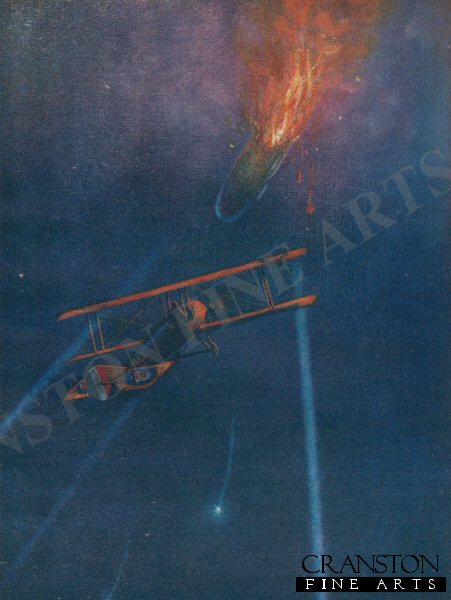
Lieutenant W L Robinson Attacks an Enemy Airship and Brings it Down in Flames by W Avis (P) On the night of September 2nd-3rd 1916. Lieutenant William Leefe Robinson, of the Worcester Regiment and Royal Flying Corps, attacked an enemy airship under circumstances of great difficulty and danger, and sent it crashing to the ground as a flaming wreck at Cuffley, near Enfield. He had been in the air for more than two hours, and had previously attacked another airship during his flight. For this act of most conspicuous bravery he was deservedly rewarded with the VC. |
William Leefe-Robinson by Ivan Berryman. Lieutenant Leefe-Robinsons BE2C, converted to single-seater night-fighter configuration, destroying the German SL11 over Hertfordshire on the night of 2/3 September, 1916. Robinson attacked the SL11 from below, raking it with incendiary fire, before turning and diving past the airship for another attack. As he did so, the airship exploded into flames and crashed into a field near Cuffley, killing all sixteen crew. For this action, Leefe-Robinson was awarded the VC. |
BE2C The early models of the B.E. 2 had already served in the RFC for two years prior to the outbreak of war, and were among the aircraft that arrived with the British Expeditionary Force in 1914. Like all service aircraft of this period, they had been designed at a time when the qualities required by a warplane were largely a matter for conjecture, in the absence of any actual experience of the use of aircraft in warfare. The type that replaced the B.E.2a and B.E.2b in the reconnaissance squadrons of the RFC in 1915 was the B.E.2c, which had also been designed before the war. The most important difference in the new model was an improvement in stability – a genuinely useful characteristic, especially in aerial photographic work, using the primitive plate cameras of the time, with their relatively long exposures. A suitable engine was not available in sufficient quantities to replace the air-cooled Renault – the RAF 1a being essentially an uprated version of the French engine – When bombs were to be carried or maximum endurance was required the observer had to be left behind, so it was still necessary to have him sit over the centre of gravity, in front of the pilot. In this awkward position his view was poor, and the degree to which he could handle a camera (or, later, a gun) was hampered by the struts and wires supporting the centre section of the top wing. In practice the pilot of a B.E.2c handled the camera, and the observer, when he was armed at all, had a rather poor field of fire to the rear, having, at best, to shoot back over his pilot's head. The vulnerability of the B.E.2c to fighter attack became plain in late 1915, with the advent of the Fokker Eindecker. British ace Albert Ball summed it up as "a bloody awful aeroplane". Unable to cope with such a primitive fighter as the Fokker E.I, it was virtually helpless against the newer German fighters of 1916-17. The aircraft's poor performance against the Fokker, and the failure to improve the aircraft or replace it caused great controversy in England, with Noel Pemberton Billing attacking the B.E.2c and the Royal Aircraft Factory in the House of Commons on 21 March 1916, saying that RFC pilots in France were being "rather murdered than killed" This prompted the setting up of two enquiries; one into the management of the Royal Aircraft Factory, and another into the high command of the Royal Flying Corps, the latter headed by a judge. These reports largely cleared both Factory management and the RFC commanders responsible for ordering the B.E.2, but the supervisor of the Factory, Mervyn O'Gorman, was effectively dismissed by a "sideways promotion", |
|
Contact Details |
|
Sign Up To Our Newsletter!
This website is owned by Cranston Fine Arts. Torwood House, Torwoodhill Road, Rhu, Helensburgh, Scotland, G848LE Contact: Tel: (+44) (0) 1436 820269. Email: cranstonorders -at- outlook.com
|
|
|