|
|
|
|
|
 |
|||
|
|
|
|
|
|
|
|||
| Click Here For Full Artist Print Indexes | Aviation History Archive |
|
Aviation Art Prints  Countries Countries  UK UK |
[UP] - UK - US - Germany - Italy - Japan - Russia - Canada - France - Australia - Austria-Hungary - New Zealand - Poland - Belgium - Israel - Czechoslovakia - South Africa - Norway - Switzerland - North Vietnam - Rhodesia - Yugoslavia - Finland - Argentina - East Germany - North Korea - Romania - Netherlands - Malta - Oman - Civilian Aviation |
| More Pages : Aircraft Index - Squadron Index - World War One Print List |
| Navigation | |
| Page 8 of 72 | Previous .. Page 8 .. Next |
| UK Aviation Art Prints, Paintings and Drawings |
|
|
|
|
|
|
|
|
|
|
|
|
|
|
|
|
|
|
|
|
|
| Navigation | |
| Page 8 of 72 | Previous .. Page 8 .. Next |
| Text for the above items : |
Captain Roy Brown engages the Red Baron, 21st April 1918 by Ivan Berryman. Mystery still surrounds just why Manfred von Richthofen risked so much in chasing the novice pilot Wilfred Wop May into Allied-occupied territory on the morning of Sunday, 21st April 1918, but it was to be his last flight, this error of judgement costing him his life. Von Richthofen had broken from the main fight involving Sopwith Camels of 209 Sqn to chase Mays aircraft, but found himself under attack from the Camel of Captain Roy Brown. All three aircraft turned and weaved low along the Somme River, the all red Triplane coming under intense fire from the ground as well as from Browns aircraft. No one knows exactly who fired the crucial bullet, but Manfred von Richthofens aircraft was seen to dive suddenly and impact with the ground. The Red Baron was dead and his amazing run of 80 victories was over. The painting shows Mays aircraft (D3326) in the extreme distance, pursued by DR.1 (425/17) and Browns Camel (B7270) in the foreground. |
Observer / Gunner, Royal Flying Corps 1917 by Chris Collingwood. No text for this item |
The Exterminator by Stan Stokes. By mid-1941 it was clear that Hitlers plans to invade Britain were in disarray. The RAF had fought the Luftwaffe to a standoff, and many of Germanys top pilots had been killed or captured. Not willing to admit defeat in his campaign against Britain, Hitler approved the development of a pilotless terror weapon, the VF-1 Vergeltungswaffe (retaliation weapon). Designed by the Feiseler Company, the small pilotless Fi-103 was at times referred to in Britain as the doodlebug, buzz bomb, or farting fury. These flying bombs were inexpensive to build and were capable of carrying an 1870-pound warhead. The Fi-103 was powered by a ram-jet engine, and utilized three air driven gyroscopes to orient the aircraft. A rudimentary pre-set propeller device was utilized to determine when the VF-1 would land. Lacking the accuracy necessary to make it an effective weapon against military targets these doodlebugs were primarily targeted at large population centers. Therefore, they were primarily used as civilian terror weapons, and the RAF was given the assignment of providing the defense against these terror weapons. Early testing revealed many problems with the VF-1, and it was not until March 1944 that most of these problems had been worked out. The final VF-1 production models were capable of speeds in excess of 400 MPH . The high speed of the VF-1, coupled with its small size and large warhead, made it difficult for the RAF to shoot down these doodlebugs. The doodlebug had strong sheet steel skin which deflected machine gunfire, making it necessary to utilize cannon fire. Cannons had more than twice the range of machine guns, but the attacking fighters had to get in close to hit these small, fast targets. If the pilot got in too close the explosion of the VF-1s heavy warhead often disabled the attacking fighter. An alternative was to deflect the doodlebug by maneuvering alongside it, and then by executing a gentle banking maneuver, flip the VF-1, and disrupt its gyros. Generally, this caused the doodlebug to crash in an unpopulated area with little damage. Less than 10% of the buzz bombs were destroyed in this manner, and this technique was only utilized when the pilot had depleted his ammunition. One of the top buzz-bomb exterminators was Wing Commander Roland Beamont who destroyed 32 doodlebugs during his tour of duty. He flew the Tempest V with 150 Wing, which he commanded. The three squadrons of 150 Wing were credited with destroying 630 buzz bombs between June and August of 1944. The Hawker Tempest was the fastest interceptor available, and provided its pilots a highly stable platform for its four 20mm cannon. The Meteor, the RAFs first jet, was utilized briefly as a buzz bomb interceptor, but with only nine kills, it was withdrawn as being unsuitable for this purpose. As depicted in Stan Stokes painting appropriately entitled The Exterminator, Wing Commander Beamont is depicted flying his Tempest V through the debris created by a successful hit on a buzz bomb in July, 1944. The action takes place southeast of London over the tranquil English countryside. |
Crewing Up by Graeme Lothian. Crew of Lancasters 101 Squadron RAF, stand chatting and drinking cups of tea supplied by the WMCA vans. Delays in Ops for an hour or so allow the crews a chance to light up and have a cup of tea. 101 Squadron based at Ludford Magna were a squadron with a difference, from 1943 the Lancasters were fitted with special radio jamming equipment known as ABC or AirBorne Cigar and carried an eighth crew member known as the special duties operator. Squadron letters were SR and targeted by the Luftwaffe fighters giving 101 Squadron the highest casualty rating in Bomber Command. |
Mosquito Coast by Stephen Brown. Seagulls take flight as the distant drone of Merlin engines starts to rise above the sound of wind and surf on their deserted beach. Overhead Mosquito B Mk IVs of 139 Squadron return low across the North Sea after a successful mission. In moments they will be gone, with only a few miles to navigate before they land at their base at Horsham St Faith in Norfolk. |
Encore by Steve Gibbs. Wellington Mk X Bombers from 104 Squadron Royal Air Force based at Foggia in Italy make a night raid on the Messerschmitt factory at Steyr in Austria on 24/25th February 1944. The raid was by way of a follow-up to the USAAF daylight raid of earlier that day which left the factory badly damaged. Of the 36 Wellingtons that took off from Foggia, only these two found the target. Others, using captured Italian maps later found to be in error, were unable to navigate accurately. Six aircraft were lost in the Alps through flying into mountains where their captured maps indicated incorrect heights. The depicted aircraft, flown by Canadian Flg Off Fred Ashbaugh and navigated by the late Flg Off Dennis Wilburn, returned safely to Foggia after the successful mission. |
Hawker Hurricane Mk I by Philip West. The Hawker Hurricane was Britains most important aircraft in the Battle of Britain, credited with destroying more enemy aircraft than all other forms of defence combined. Flown by Flying Officer Arthur Cowes, the aircraft depicted shows seven kill markings displayed as stripes on the Hornet motif. |
Tribute to the men of the Handley Page Hampdens by Graeme Lothian. Three Hampdens fly low over the English countryside during the early months of the war. The Hampden, nicknamed The Flying Suitcase served with Bomber Command from December 1939 till September 1942, when it was withdrawn from operational service due to heavy losses sustained during day time bombing missions. Although some continued in service with Coastal Command as torpedo bombers, and with the Canadian and New Zealand Air Forces. A total of 1342 were built. |
By Dawn's Light by Ivan Berryman. The Consolidated Model 28 PBY Catalina was so successful in its definitive form that it went on to become the most extensively built flying boat of all time. Here, a 210 Squadron Catalina Mk IVA from RAF Sullom Voe, Shetland, has located two weary downed aircrew, drained but grateful after a long night in the North Atlantic swell. |
Vital Force by Richard Taylor. For perhaps the sixth time today, profoundly outnumbered, the RAFs young fighter pilots will intercept yet another Luftwaffe force as the evil raiders invade their beloved airspace. It is August 1940, and the Battle of Britain is raging towards its ferocious climax over southern England. The sturdy Hawker Hurricane MkIs, bearing the brunt of all the combat flying during the Battle, will account for no fewer than four fifths of the air victories achieved by RAF fighter pilots. The simplicity of its construction enabled the Hurricane to survive heavy punishment in combat, at the same time providing its pilots with a reliable and stable gun platform. Beautiful, distinctive, tough and aggressive, this remarkable fighter, together with its courageous young pilots, earned the undying gratitude of a nation on the verge of defeat and ultimately, an unrivalled position in the annals of air warfare. |
Yorkshire Relish by Keith Woodcock. Halifax bombers are prepared for another mission. |
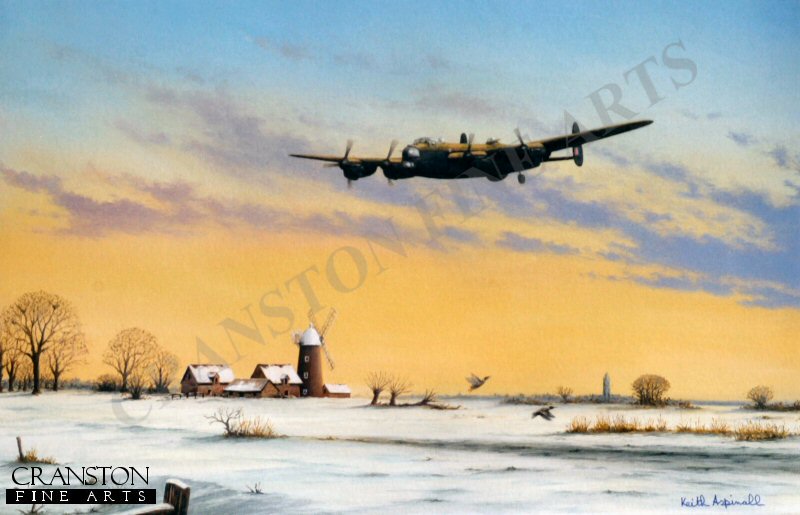
Breaking the Silence by Keith Aspinall. Returning from a night mission, a sole Lancaster returns over the snow covered fields of England. A fitting tribute to the air crews of the Lancaster squadrons of World War Two. |
Inbound to Target - The Dambusters by Robert Taylor. The crews of 617 Squadron that took part in the epic Dambusters raid on the night of 16/17 May 1943 were among the finest in the RAF. They were the elite of Bomber Command, and when they left RAF Scampton that night, the skills of their pilots - some of the finest of the Second World War, would be tested to the limit. First, they must guide their aircraft across heavily defended enemy territory at altitudes often as low as fifty feet, dodging flak, trees, buildings and power lines. And then they must attack their targets with a precision unmatched in the annals of the RAF. Of all the pilots who took to the skies that night, no-one was more accomplished at low-level flying than Flight Lieutenant Mick Martin, and it is his aircraft, Lancaster AJ-P that is the subject of this artwork. In company with Flight Lieutenant John Hopgood in the distance, they follow one of the many canals of Holland, wingtips barely missing the sails of the windmills, en-route to the Mohne Dam. |
Avro Anson by Ivan Berryman. An Avro Anson comes under attack from an Me109. |
Duxford and Shuttleworth by John Wincentzen. No text for this item |
Tribute to Flight Lieutenant Warner of No.610 Sqn by Ivan Berryman. (P) F/Lt Warner was shot down in combat with Bf 109s on 16th August 1940 at 17:15hrs off Dungeness. He was flying Spitfire DW-Z (R6802). |
Supermarine Spitfire MkI by Philip West. High over the southern coast of England in 1940 a Spitfire (Mk 1) of 609 Squadron from Middle Wallop, flown by Flying Officer John Dundas, lies in wait for enemy aircraft (Junkers 87 divebombers) on their way to attack British naval installations at Portland. |
Fairey IIID by Michael Turner. Fairey IIIDs served from 1924 to 1930. It could be used either as a seaplane or landplane, and was employed as both. It mainly served in the Middle East and home waters, but was used for a great number of roles throughout its service. In all, 227 Fairey IIIDs were built. |
One in the Bag by Ivan Berryman A German Albatross D-III sees off a Bristol Fighter among the clouds over the Western Front, early in 1917. The D-III was a massive improvement over the monoplanes of the time, possessing greater manoeuvrability, a higher ceiling and synchronized guns. Many German aces thought this the best fighter of the First World War. |
On the Prowl by Timothy OBrien. Royal Air Force catalina over flys a Royal Navy Cruiser of Gibraltar while on patrol. |
Forming Up by Randall Wilson. (GL) Lancasters - B1 R5689 VN-N 50th Squadron RAF leads a gaggle of Lancs as they gain altitude to form up over the English coast. |
|
Contact Details |
|
Sign Up To Our Newsletter!
This website is owned by Cranston Fine Arts. Torwood House, Torwoodhill Road, Rhu, Helensburgh, Scotland, G848LE Contact: Tel: (+44) (0) 1436 820269. Email: cranstonorders -at- outlook.com
|
|
|