|
|
|
|
|
 |
|||
|
|
|
|
|
|
|
|||
| Click Here For Full Artist Print Indexes | Aviation History Archive |
|
Aviation Art Prints  Countries Countries  UK UK |
[UP] - UK - US - Germany - Italy - Japan - Russia - Canada - France - Australia - Austria-Hungary - New Zealand - Poland - Belgium - Israel - Czechoslovakia - South Africa - Norway - Switzerland - North Vietnam - Rhodesia - Yugoslavia - Finland - Argentina - East Germany - North Korea - Romania - Netherlands - Malta - Oman - Civilian Aviation |
| More Pages : Aircraft Index - Squadron Index - World War One Print List |
| Navigation | |
| Page 5 of 72 | Previous .. Page 5 .. Next |
| UK Aviation Art Prints, Paintings and Drawings |
|
|
|
|
|
|
|
|
|
|
|
|
|
|
|
|
|
|
|
|
|
| Navigation | |
| Page 5 of 72 | Previous .. Page 5 .. Next |
| Text for the above items : |
Op Grapple by John Wynne Hopkins. 2 Mk7 Lynx of 664/661 sqn. AAc, providing Top Cover for an UN PROFOR Convoy in Bosnia Herzegovina. |
Strike Wing Attack - Beaufighter by Frank Wootton. Coastal Command Strike Wings by Neil Wheeler It was not until ten years ago that the first detailed account appeared recording the achievements and sacrifices of the Beaufighter anti-shipping Strike Wings. Surprisingly, these important and, as a whole, very successful activites seemed to have been forgotten in the years immediately after the war. Until 1942 the attack of enemy shipping, particularly that to and from Dutch ports and North German and Scandinavian ports, ahd been carried out in the main by individual attacks by bomber aircraft, at times with considerable losses. The concept of using a Wing of Beaufighters, with two squadrons to suppress enemy anti-aircraft fire and one with torpedoes to sink the ships in the convoy, gradually developed in 1942. Unfortunately, the first strike on 20th November 1942 was disastrous, largely through failure to rendezvous with the fighter escort, the casualties were heavy and the results poor. The Wing was not to operate again until 18th April 1943, and only after a thorough revision of tactics and much training. That strike, which I led, was an unqualified success ans Strike Wings were, so to speak, born. They continued with great success until the end of the war. Initially, the casualties that were suffered were extremely high, particularly in 1943 before the Allies achieved overwhelming air supremacy. But they continued to be high because most were due to the concentrated anti-aircraft fire from the ships in the convoys. I understand that the casualties were about the same as Bomber Command. However, the Strike Wings, as a considerably smaller force in comparison, inflicted far greater losses on the enemy relative to their own. Account of the operation on 21st July 1944 - Philip Brett This was my second operational flight. On my first I had had a three foot hole blown in my tailplane, teaching me that shipping strikes were indeed dangerous. This time I was carrying my first live torpedo and I realised I now had to do in anger what I had done a hundred times in enjoyable practice runs. I was expected to fly at a height of 150 feet and a speed of 180 knots, keeping straight and level until I was within about half a mile of an enemy ship, with cameras recording what I was actually doing when I made my drop. To add to my nervousness we were told that the convoy consisted of nine merchantmen guarded by no less than 31 escort vessels. Fear was forgotten in the concentration needed to fly very low across the North Sea in close squadron formation but it reasserted itself sharply enough immediately the ships appeared. The convoy was as big as promised. The anti-flak squadrons, 455 (Australian) 489 (New Zealand) and 404 (Canadian) began their climb. Our leader, Squadron Leader Robin Burwell, held 144 back, aiming to brings us in to the ships just as the anti-flak aircraft completed their work. On his order - Attack, Attack - we spread out as briefed, choosing individually the biggest targets we could find and setting our travelling light torpedo sights accordingly. The other squadrons had caused havoc. There was smoke everywhere on the sea and in the sky. Explosions were occurring along the whole length of the convoy. I came in like a good new boy, doing just what I had been told. I was aware of a sort of sparkling curtain between me and my target and the pretty tracer curving gracefully towards us, but I was concerned only with speed and height and the need to wait until the ship grew large. My torpedo gone, I could at last ram open the throttles and take violent evasive action as I climbed through the flak from my target and the surrounding escort vessels into the safer sky beyond. As we circled the scene of the attack there were still bursts of heavy flak everywhere above the convoy. Some of the aircraft seemed to be having a second go. Many of the ships below were enveloped in smoke and steam and several were blazing - Bill Boorer, my navigator, thought our merchantman was one of them. We set course for our base, Strubby, in Lincolnshire, and landed in the dark, unscathed. At debriefing everyone told of the severe damage that had been inflicted but no-one could be really sure of who had done what. The next day I heard that, from my aircraft cameras and all the other evidence, my torpedo had been assessed as a hit. |
Night Hunters by Anthony Saunders. In a desperate attempt to save what remained of the once-proud, now ruined city of Berlin, the remnants of the Luftwaffe's beleaguered night-fighter units fought boldly till the end. Short on fuel, spares and ammunition, the pilots of NJG11 faced the impossible task of protecting the shattered capital from the far-reaching arm of the RAF Bomber Command. As the climax of the inevitable defeat approaches, Leutnant Jorg Cypionka of 10./NJG11 engages a powerful incoming force of fast, high-flying RAF Mosquitos from 139 (Jamaica) Squadron (PFF) in one of his unit's few remaining ME262A jets. The Mosquito crews, however, know the dangers of these hotly contested skies over Berlin only too well. From the night of 20/21 February the aircraft of 139 Squadron will run the deadly gauntlet of flak and night-fighters on 36 consecutive night attacks on the city. |
The Hunting Party by Ivan Berryman. Depicting Spitfires of No.92 Squadron, which on their first mission over Dunkirk, encountered six ME109Es and succeeded in shooting down every one of them! Such actions came to symbolise the spirit of the 92nd Squadron which went on to see intense fighting during the Battle of Britain and by the end of 1940 had claimed an astonishing 127 enemy aircraft destroyed. A dramatic and unusual perspective on this classic aeroplane addition to any collection of Spitfire paintings. |
Wellingtons by Keith Woodcock. On a snow covered airfield in winter, ground crew prepare a Wellington for its next mission while a 2nd Wellington is being refueled. |
Bristol Britannia by Ivan Berryman. Often referred to as the 'Whispering Giant', Bristol's sleek Type 175 Britannia represented a milestone in turboprop airliner design, although it was already something of an anachronism by the time it entered service, as the jet age was just getting underway. Nevertheless, 85 Britannias were built before production ceased in 1960, many serving with BOAC, as exemplified by G-ANBG, seen here before being re-registered because superstitious pilots disliked the letters 'NBG', believing them to be an acronym of 'No Bloody Good!'. |
Towards Night's Darkness by Robert Taylor. Sometimes it was five, every so often it might be six, occasionally it was three, but usually it was seven men who flew together as a crew with RAF Bomber Command. They formed the closest of bonds, forged through an anvil of freezing temperatures, deadly flak and prowling night-fighters but, with an average age of only 22, their odds of survival were slim. By 1943 the life expectancy for bomber aircrew was just 5 missions - only one in six were expected to survive their first tour of 30 operations. The chances of surviving a second tour were even slimmer. Of the 125,000 men who flew with Bomber Command during World War II, more than 55,000 were killed. Whilst the 'Few' of Fighter Command had undoubtedly defeated the Luftwaffe during the Battle of Britain, it was the 'Many' of Bomber Command who were to play the pivotal role in delivering to the Allies ultimate victory in Europe. But it came at a terrible cost: on one raid alone - the Nuremberg raid of 30th/31st March 1944 - 543 aircrew were killed, more than Fighter Command lost during the entire Battle of Britain. Robert Taylor's evocative new painting is a moving tribute to these men of Bomber Command. As the setting sun casts a golden glow, a group of Lancasters from 576 Squadron gather into formation after departing from their Lincolnshire base at the start of a raid into Germany in late 1944. The lead aircraft UL-I (LM227) was one of only a handful of Lancasters to complete 100 operational sorties. Between them the pilots of Bomber Command won 23 Victoria Crosses during WWII, and countless others were highly decorated for courage and commitment. Several of these veterans have now joined together to sign this commemorative limited edition to honour all those who served with Bomber Command. They include some of the RAF's most inspirational leaders - men such as James 'Tirpitz&;39; Tait, who was awarded no less than four DSOs to become one of the most highly decorated RAF airmen of WWII. Although sadly no longer with us, we are privileged that he was able to personally sign the prints during his lifetime, creating a truly historic collectors edition. |
Charity by David Pentland Malta, 22nd June 1940. Some 12 days after the air battle for Malta began, the recently raised ad hoc Gladiator flight claimed its first confirmed victory. Flt. Lt. George Burges, and Flg. Off. Timber Woods were alerted to a lone S.79 from 219 Squadriglia on a reconnaissance sortie. They managed to intercept the intruder over Valetta, and although Timber's first attack was unsuccessful, Burges in Charity shot off the Savoia's port engine sending it crashing into the sea at Kalafrana. |
Distant Dispersal by Graeme Lothian. On an RAF airfield in the early evening, a squadron of Lancaster bombers of Bomber Command prepare for another bombing sortie against targets of the German war machine. A fitting tribute to all Bomber Command aircrew who flew in the Avro Lancatser. |
501 Squadron Hurricanes by Ivan Berryman. Group Captain Byron Duckenfield on patrol in Hurricane P3059 of No.501 Squadron during the Battle of Britain. |
Summer of 44 by Nicolas Trudgian. As the Allied invasion of northern France drew nearer, the entire length of southern England had seemingly become one huge army camp. While the local population went about its daily business as best it could, British and American troops massed at every point near the coast in readiness for the imminent crossing of the Channel. Though the RAF fighters of 10 Group were tasked in the Air Defense role, like all RAF squadrons that could be spared, they became involved with the softening up process, a pre-requisite of any large scale landing on enemy occupied territory. Under the leadership of Wing Commander Peter Brothers, 10 Groups Spitfire Wing based at Culmhead was heavily involved flying shipping patrols over the beachhead and Rhubarbs - low-level strikes of opportunity - disrupting enemy movements and communications.Nicolas Trudgians comprehensive painting Summer of 44 recreates with such realism a scene in southwest England just a few days before the Normandy landings in June 1944. Mark IX Spitfires of No. 126 Squadron, returning from combat over France, sweeps low over the local branch line railway station on their way back to Culmhead. Below, as the GWR Prairie tank engine pulls out of the station, American troops are assembling their equipment in readiness for the impending invasion. Adding great atmosphere to his composition, Nick has painted a classically peaceful English landscape, highlighting the unique contrast between war and peace that pervaded Britain during that summer of 44. Published 2000. Only 8 prints of this edition remain. Signed by two of the most outstanding Spitfire Wing Leaders of World War II. |
Now and Then by Peter Westacott. A tribute to Sir Thomas Sopwith and British Aerospace. BAe Harrier GR.5 ZD346 and Sopwith Pup N5195 at the Biggin Hill air fair June 1988. |
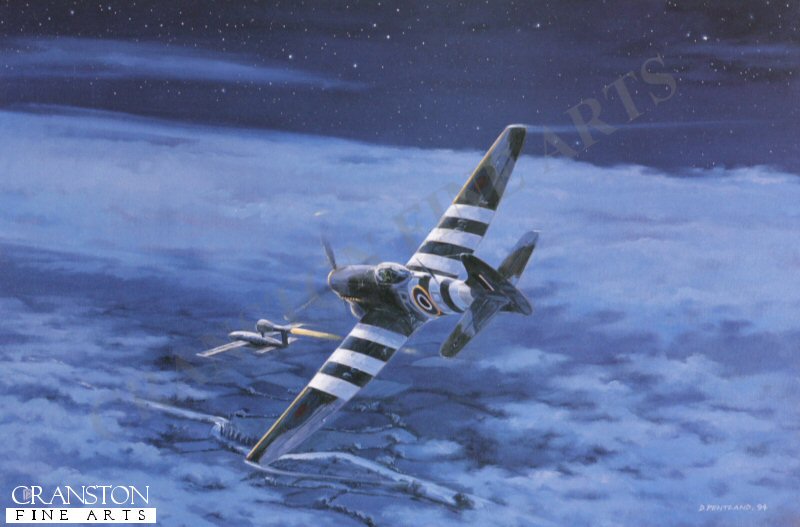
A Buzz for Beamont by David Pentland. Wing Commander Roland Beamont in his personal Tempest V, intercepted and downed his first V1 Buzzbomb on the night of June 22nd, 1944, over south east England. As Commander of 150 wing and others he went on to shoot down a total of 30 V1 flying bombs, 8 enemy aircraft and 35 locomotives destroyed plus one minesweeper sunk. |
Dakota Over Burma by Geoff Lea. No text for this item |
Teamwork by Stuart Brown. Aircraft of the UKs Special Forces flight perform an ALARP exercise on an MoD range at Pendine Sands, Wales. The Air Land Refuel Points (ALARP) can be located on improvised airfields or beaches and normally operate at night with the aid of Night Vision Goggles. The aircraft portrayed are a 47 Sqn Hercules refuelling a 7 Sqn Chinook and a 657 Sqn AAC Lynx. Special Forces personnel provide armed cover. |
Double Pack of Small Battle of Britain Spitfire Prints by Barry Price Pack of 2 Small Prints. Royal Airforce Spitfires at the time of the Battle of Britain |
Home in Time for Tea by Ivan Berryman. (PC) An Avro Lancaster heads west as the sun begins to set, a daylight mission complete as it returns to its home airfield. |
Operation Ebensburg by Ivan Berryman. Sunday 8th April 1945. Halifax B.II Series 1 (Special) JP254 of 148 Special Duties Squadron, RAF piloted by Pilot officer Bill Leckie is depicted approaching the drop zone near to the Alt Aussee salt mine in the Austrian Alps to drop four SOE agents and their equipment whose mission it was to secure and protect 6,755 items of the world's greatest works of art that had been looted and stored by the Germans as they swept across Europe. With the allied forces closing in, the Germans had planned to blow up the entire store to prevent the artworks from falling into the hands of the liberators. Once on the ground, the four agents linked up with local resistance fighters and the mine and its valuable contents were eventually secured, the explosives made safe and the entire cache taken into the safe keeping of the 80th US Infantry Division as the German occupation of Europe crumbled. |
Tribute to Flying Officer Count Manfred Beckett Czernin by Ivan Berryman. Serving with distinction throughout the Battle of Britain, Count Manfred Beckett Czernin's score included 13 confirmed, 2 unconfirmed, 3 probables and 5 damaged. He is depicted here on 25th July 1940, claiming the last of three Messerschmitt Bf.110s that he shot down that day, flying Hurricane V7408 (YB-F) whilst with 17 Sqn. Despite being shot down by Adolf Galland in November, he survived the war and passed away in 1962 having been awarded a DFC, an MC and DSO. |
They Landed by Moonlight by Robert Taylor. To fly a small aircraft at the dead of night, without radio communication or navigational assistance, deep into enemy-occupied territory, was an extremely perilous task. To then land on an unlit remote field, deliver secret agents, collect Resistance leaders, or downed airmen and fly them home without attracting the attentions of enemy night fighters, was appallingly risky work. Yet throughout World War II the prime function of the pilots of the RAFs Special Duties Squadrons was to fly time and again into occupied France, in utmost secrecy, under the cover of darkness. It was acutely dangerous work requiring inordinate flying and navigational skills, and supreme courage. Most suited to these clandestine operations was the rugged Westland Lysander, operations being conducted, weather permitting, during the moons fullest phase. Guided only by torch light, the pilot made a hazardous night landing into an isolated field at a pre-arranged time, trusting that agents on the ground had checked the field for cart tracks and loitering Gestapo. Every mission required ice cool bravery and nerves of steel. |
4 Regiment in the attack, Operation DESERT STORM, Iraq, 26th February 1991. by David Rowlands. The painting shows the three Lynx and three Gazelles from 4 Regiment ordered to assist the Queens Royal Irish Hussars attack objective PLATINUM. Observing the left flank are two Gazelles, XX 395 commanded by Sgt Thompson and flown by Cpl Tween, and XZ 372 commanded by SSgt Daly, flown by Lt Tilley; with Lynx XZ 215, commanded by Capt Avery US Army and his pilot Sgt Isherwood, in support. In the foreground are Lynx XZ 199 commanded by Capt Morley and flown by SSgt Seymour, engaging Iraqi armour, and Lynx XZ 221, commanded by Sgt Maddison and flown by Cpl Long, engaging enemy MTLBs. The aircraft destroyed four enemy tanks and six enemy personnel carriers without loss. The attack was commanded by Major Eustace, from Gazelle XZ 338 flown by Sgt Church, and was the first ever use by the British Army of Lynx TOW missiled in combat. |
|
Contact Details |
|
Sign Up To Our Newsletter!
This website is owned by Cranston Fine Arts. Torwood House, Torwoodhill Road, Rhu, Helensburgh, Scotland, G848LE Contact: Tel: (+44) (0) 1436 820269. Email: cranstonorders -at- outlook.com
|
|
|