|
|
|
|
|
 |
|||
|
|
|
|
|
|
|
|||
| Click Here For Full Artist Print Indexes | Aviation History Archive |
|
Aviation Art Prints  Countries Countries  Germany Germany |
[UP] - UK - US - Germany - Italy - Japan - Russia - Canada - France - Australia - Austria-Hungary - New Zealand - Poland - Belgium - Israel - Czechoslovakia - South Africa - Norway - Switzerland - North Vietnam - Rhodesia - Yugoslavia - Finland - Argentina - East Germany - North Korea - Romania - Netherlands - Malta - Oman - Civilian Aviation |
| More Pages : Aircraft Index - Squadron Index - World War One Print List |
| Navigation | |
| Page 3 of 28 | Previous .. Page 3 .. Next |
| Germany Aviation Art Prints, Paintings and Drawings |
|
|
|
|
|
|
|
|
|
|
|
|
|
|
|
|
|
|
|
|
|
| Navigation | |
| Page 3 of 28 | Previous .. Page 3 .. Next |
| Text for the above items : |
Fastest Victory by Robert Taylor Taking his Hurricane off from Speke, a raiding JU88 crossed the airfield in front of Denys Gillam, who promptly shot it down. It was the fastest air victory of the war, and probably of all time. |
Gotcha by Stan Stokes. World War I was the first major conflict in which the airplane became a practical instrument of war. However, because of the slow speeds, small armaments, limited fuel capacities and light weights of these aircraft many pilots survived being shot down many times. These were the glory days for early aviators with pilots from both sides having tremendous status amongst both their peers and their adversaries. In Gotcha, Stan Stokes has captured the camaraderie and good sportsmanship shown by the military pilots of the time. In a beautiful scene Stokes shows the downed German aviator dripping from the unscheduled bath just inflicted upon him, as a Spad piloted by Eddie Rickenbacker, Americas top ranking ace, passes overhead for a last look. Steam is rising from the engine of the downed Fokker D VII, which was arguably one of the finest fighter planes of World War I. About 700 Fokker D VIIs were produced during the War, and the aircraft was capable of speeds of 125 MPH with a range of 134 Miles. The D VII was constructed with welded tubing and was fabric covered. Most variants were armed with two 7.9 mm machine guns. Rickenbacker, as a very young man, was involved in automobile racing and engineering, and in 1914 he set a worlds speed record of 134 MPH in a Blitzen-Benz racer. Rickenbacker was in England when WW I began, and while there he became interested in Britains progress in aviation. Returning to the States Rickenbacker figured that his expertise in driving race cars should make him a great pilot, but the best he could do was get himself assigned as General Pershings personal chauffeur. In August 1917 Rickenbacker finally got his wish and was transferred to the Army Air Corp, and by 1918 he was assigned to combat duty. Although bothered by an ear infection which led to his hospitalization in Paris for two months in 1918, Rickenbackers achievements were impressive. In the month of October 1918 alone, he was credited with ten kills, Rickenbacker is pictured by Stokes flying a Spad S.13 which was the best French-built fighter of the War. The S.13 was produced in large numbers (8,472) and was capable of 138 MPH with a range of 250 miles. The Spad S.13 was armed with twin 0.303 inch machine guns. Rickenbackers squadron was nicknamed the Hat in the Ring gang. After the War Rickenbacker had a very successful business career, and he served as Chairman of Eastern Airlines. |
High Five by Ivan Berryman. Hans-Ekkehard Bob claims his fifth victory, over a Bristol Blenheim, on 26th June 1940 in his Me109 of 3./JG21. |
Ramrod by Robert Taylor During operation Ramrod 792 on April 25, 1944, leading his Spitfire wing, Johnnie Johnson had a long-running combat with an FW190. Robert Taylor shows the last moments of the duel which ended in victory for the Allied Air Forces leading fighter Ace. |
Tribute to Generalleutnant Adolf Galland by Ivan Berryman. One of the all time great fighter aces, Adolf Galland is depicted flying Bf 109E-4/N of Stab/JG26 in September 1940. Galland flew 705 combat missions during World War Two and was credited with a final tally of 104 aerial victories. He survived the war and died peacefully in February 1996. |
Messerschmitt versus Messerschmitt by David Pentland. Belgrade, Yugoslavia, 6th April 1941. While escorting Stukas at the start of the German Balkan campaign, the Me109Es of JG54 were engaged by Me109Es of the Yugoslav air force. During the ensuing melee, ObLt. Hans-Ekkehard Bob claimed his 20th victory. |
Avro Anson by Ivan Berryman. An Avro Anson comes under attack from an Me109. |
Magnificent Courage by Stan Stokes. On April 6, 1916 the RFC formed several new squadrons, including the No. 56 Squadron - Scouts. In March of 1917 the unit received the first of its new SE5s. The aircraft was disappointing to the pilots, being slower than expected, and its new Vickers machine gun with interrupter gear was next to useless. Many modifications ensued in the field, and many SE5s were fitted with Lewis guns located atop the upper wing, and in some cases an additional Lewis was installed which could be fired downward through the cockpit. In early April of 1917 No. 56 was ready to see its first combat action, and the unit headed off to France. About nine months earlier the pendulum of air superiority had swung back to the Germans. The Fokker scourge of 1915 had previously been negated by the deployment of DH2 and FE8 aircraft, but the newer German Albatros and Halberstadt fighters had regained the upper hand. The RFC was once again suffering unsustainable casualties. No. 56 Squadron was immediately pressed into service upon its deployment in France, and over the next several months gave a good account of itself. The Squadrons first victory came on April 22, and went to Albert Ball who would become a high scoring ace. On September 23, 1917 many of No. 56 Squadrons pilots would become engaged in what would be considered as one of the epic battles of early aerial warfare. At about 5:00 PM in the evening eleven SE5s took off for a routine patrol. There were heavy clouds at 9,000 feet, effectively limiting the ceiling. Several engagements took place prior to James McCudden noticing a lone SE5 from No. 60 Squadron under attack by a German triplane. Unknown to McCudden was the fact that the triplane was piloted by Werner Voss, a top German ace with 48 confirmed victories. During the next several minutes 7 SE5s focused their efforts on attacking Voss triplane. Voss had several opportunities to make a dash for the German lines, but chose to stay and fight. Demonstrating beautiful flying and determination, Voss held the massed SE5s at bay, and managed to inflict damage on each and every one. With maneuvers made so quickly and so unpredictably, none of the SE5 pilots could keep Voss in their gunsights long enough to fire a meaningful burst. Voss managed to damage two of the SE5s enough that they withdrew from the fight, and a red-nosed German Albatros joined in the fray for a short time. At one point in the battle McCudden indicated that the triplane was in the cone of tracer bullets from at least five machines simultaneously. Voss could out climb and outmaneuver all the RFC craft. Minutes later at about 2,000 feet the SE5 piloted by Arthur Rhys Davids managed to catch the German ace in a straight flat dive, and approached to within feet of the triplanes tail, firing a solid burst before pulling out of his dive. Moments later the triplane hit the ground and disintegrated. Later that evening the pilots of 56 Squadron recounted the epic battle speculating as to who might have been the pilot of the German triplane. The next morning General Trenchard sent an aide to 56 Squdron to elicit details of the battle. In this report James McCudden paid the following tribute to Voss, As long as I live I shall never forget that German pilot who single-handedly fought seven of us for ten minutes, and who put some bullets through all our machines. His flying was wonderful, his courage magnificent, and in my opinion he is the bravest German airman whom it has been my privilege to see fight. |
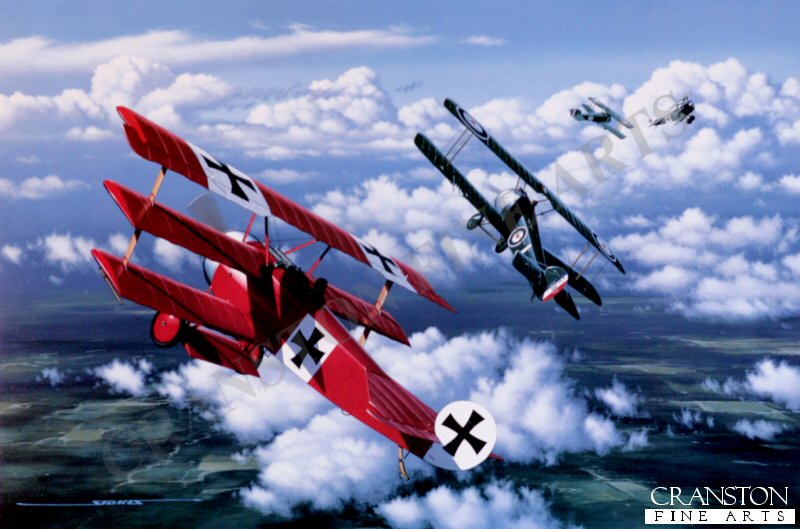
The Ringmaster by Stan Stokes. Born in Prussia to wealthy aristocratic parents, Manfred Freherr von Richtofen, The Red Baron, was to become the top ace of World War I, with 80 confirmed kills, and probably another 40-50 which took place over enemy lines and could not be confirmed. Richtofen was originally a cavalry officer, but with great persistence he was transferred to the air arm. After a brief period on the eastern front Richtofen was transferred to the western front in August 1915. His first confirmed victory was recorded in September 1916 and by November he recorded eleven kills, including Major Lance Hawker, the top British fighter pilot. With his keen reflexes and eyesight he quickly ascended, and by June 1917 Richtofen took control of a unit near Coutrai. This unit became known as Richtofens Circus. By July the ringmaster had his fifty-seventh victim. Despite his successes Richtofen shunned publicity and became increasingly withdrawn. Richtofen was wounded in combat and spent three weeks in the hospital recuperating. After his return to duty Manfred became a vocal proponent of the Fokker triplane. The bright red paint scheme utilized on one of Richtofens aircraft is what earned him the nick-name, The Red Baron. Richtofens brother, Lothar, was also an ace with forty victories to his credit. By April of 1918, aided by Americas entry into the War, Germany was facing overwhelming numbers of enemy aircraft, and many with performance capabilities the equal to, and in some cases superior to, their own. The Germans mounted a final desperate offensive, and on April 21,1918 The Red Baron finally fell victim to the perils of combat. Although there is considerable controversy over the Red Barons demise, it appears that Richtofen was either killed by Captain Arthur Brown, a Canadian flying with the RAF, or was shot down by Australian machine gunners while evading Captain Brown. Richtofen was provided a full military funeral by the Allies, and on the evening following his funeral a single RAF fighter dropped a small package containing photos of the funeral onto the Circus headquarters. By Wars end the Circus was credited with the destruction of 644 aircraft, but 56 of its airmen had been killed, 32 seriously wounded, and 6 captured. Richtofen is pictured in July of 1917 tangling with Sopwith Camels in the skies over Belgium. Flying his beloved Fokker triplane, the infamous Red Baron is shown positioning his aircraft for yet another victory. |
Gothas Moon by Ivan Berryman. Just as the name Zeppelin had become the common term for almost every German airship that ventured over Britain, so the name Gotha became generically used for the enemy bombers that droned across the English Channel during 1917-1918, inflicting considerable damage to coastal ports and the capital. As the massed raids of Bombengeschwader 3 increased, a public inquiry in England brought about the formation of the Royal Air Force as an independent service to counter this new threat and fighters from Europe were brought home to defend against these marauding giants. As a result, heavy losses on the German side meant that daylight raids had to be abandoned and all operations were henceforth conducted by night. Here, a pair of Gotha G.Vs begin to turn for home as searchlights play fruitlessly over distant fires, the grim result of another successful nights work. |
Incident over Mannheim by Ivan Berryman. On the night of 12th September 1944, Lancaster NF958 (LS-M) of No.15 Sqn was lost in the skies above Mannheim when it was attacked by the Messerschmitt Bf.110G-2 of Ofw Ludwig Schmidt of II/NGJ 6, the bomber receiving hits to the bomb bay which ignited the incendiaries still in their racks. Five of the crew bailed out and were taken prisoner of war once captured. The pilot, F/O Norman Overend RNZAF, did not escape the aircraft. Flt Sgt Harry A Beverton was seen to leave the stricken Lancaster but was not seen again. Crew of Lancaster LS-M : F/O Norman Overend RNZAF Sgt Barry J Howarth (survived) Sgt George B Thomson (survived) Flt Sgt John D Jones (survived) Flt Sgt Robert P E Kendall (survived) Flt Sgt Harry A Beverton Sgt I Spagatner (survived). |
Sink the Bismarck by Geoff Lea. Shows the action on 26th May 1941 by Swordfish from HMS Ark Royal on the German battleship Bismarck. Fresh from her triumphant encounter with HMS Hood, Bismarck was struck by Swordfishs torpedo which jammed her rudder and was finished off by the home fleet on 27th May 1941. |
Ju88A-4 and Crew by Ivan Berryman. The crew of a Junkers 88A-4 of KG.30 about to board their aircraft. |
Oberleutnant Ernst Udet by Ivan Berryman. Wearing one of the most distinctive colour schemes of World War One, Germanys second highest scoring ace after Manfred Von Richthofen was the charismatic Ernst Udet with 62 victories to his credit. His brightly coloured Fokker D.VII carried the initials of his girlfriend (LO) on the side of his aircraft and the inscription Du Noch Nicht! (Not You Yet!) on the upper tail surfaces. Udet was badly wounded in September 1918 and did not fly in combat again, but survived the war, only to commit suicide in 1941. |
Captain Andrew Beauchamp-Proctor by Ivan Berryman. Standing just five feet two inches tall, Andrew Beauchamp-Proctor had to have his SE5a specially modified to accommodate his small stature, but the diminutive South African was a giant in the air, claiming a total of 54 victories before the end of the war, many of them observation balloons which made him one of the top balloon-busting aces of the RFC. But many aircraft fell to his guns, too, as here when on 21st August 1918 he claimed an Albatros C-Type as victory number 34 whilst flying D6856 of 84 Squadron. |
Wounded Swallow by Ivan Berryman. Walter Schuck was already credited with 198 victories before he converted to the revolutionary Me.262 Schwalbe (Swallow), an aircraft which he quickly mastered, scoring a further 8 kills in quick succession. On the 10th of April 1945, however, Schuck himself became the victim, shot down by P51 Mustang of American Joe Peterburs. The German ace survived by bailing out of his stricken jet, but badly injured both ankles on landing, the war ending before he was able to return to flying duties. |
Jet Ace by Brian Bateman. (P) Walter Schuck claims one of two P-51 Mustangs shot down as his first two victories in his new Me262 jet fighter. Flying with JG7, Walter Schuck claimed his first two victories in the jet on 24th March 1945, and eventually went on to claim eight jet victories, and over 200 enemy aircraft in total. |
Mountain Wolf by Nicolas Trudgian Set in a spectacular mountain scene, Nicolas Trudgians print records the last days of air combat as World War II drew to a close. The most feared of the Luftwaffes remaining units were those equipped with the remarkable Me262 fighter jet, but they were vulnerable to attack during take-off and landing. Commanding JV-44, General Galland countered the threat by employing Fw190 Dora 9s to fly top cover. Nicolas Trudgians painting depicts the colourful Fw190 of Hptm Waldermar Wubke of JV-44 as he prepared to scramble Red Three at Ainring airfield in may 1945. Published 2000. Signed by two Luftwaffe Knights Cross holders who flew the Fw190D-9 operationally during World War II. |
The Vikings Legend by Robert Tomlin. The Lockheed F-104 Starfighter was undoubtedly one of the most remarkable aircraft of the famous Century Series of American jet fighters. Sold to so many Air Forces around the world, it featured strongly in the inventories of most European countries but none more so than West Germany. A difficult learning curve gave the aircraft a bad reputation but once mastered it proved a formidable interceptor. The ultimate proof that the machine had been tamed was given from 1983 to 1986 by the German Navy Display Team The Vikings who thrilled crowds throughout Europe by demonstrating the surprising agility of the Starfighter in spectacular fashion. This picture commemorated their achievements and gives The Vikings their rightful place in the history of Aeorbatic Display Teams. |
Fear Nothing by Anthony Saunders. The Battle of Britian - 28th August 1940. The Battle of Britain is at its height but the threat of invasion is still a deadly reality. As the country waited, grim and expectant, for Hitlers Operation Sealion to be put into action, Blenheims of 105 Squadron make another strike against German troop barges assembling in the northern French port of Boulogne. Overhead, escorting Hurricanes of 501 Squadron engage in a savage tussle with Me109s of JG3 as the Luftwaffe pilots attempt to disperse the attacking British bombers. During the encounter three Me109s of JG3 were shot down for no British loss. |
Ltn Fritz Kempf by Ivan Berryman. The Fokker DR.1 Triplane (213/17) of Fritz Kempf swoops on a pair of unsuspecting Sopwith Camels whilst on patrol over the Western Front in 1917. Kempfs practise of having his name painted across the top wing of his aircraft was supplemented by the taunt Do You Remember Me? on the mid wing. His aircraft is depicted in the colours worn by Jasta Boelcke of the Imperial Air Service. |
|
Contact Details |
|
Sign Up To Our Newsletter!
This website is owned by Cranston Fine Arts. Torwood House, Torwoodhill Road, Rhu, Helensburgh, Scotland, G848LE Contact: Tel: (+44) (0) 1436 820269. Email: cranstonorders -at- outlook.com
|
|
|