|
|
|
|
|
 |
|||
|
|
|
|
|
|
|
|||
| Click Here For Full Artist Print Indexes | Aviation History Archive |
|
Royal Air Force
Aviation Art Prints  Aviation Artists Stan Stokes Aviation Artists Stan Stokes  British Aviation British Aviation |
[UP] - US Aviation - British Aviation - German Aviation - Other Countries |
| More Pages : Barracuda - Beaufighter - Blenheim - Camel - Defiant - DH2 - Gladiator - Harrier - HP42 - Hurricane - Lancaster - Mosquito - Nieuport Scout - Seafire - Spitfire - Sunderland - Swordfish - Tempest |
| Navigation | |
| Page 2 of 2 | Previous .. Page 2 |
|
|
|
|
| Navigation | |
| Page 2 of 2 | Previous .. Page 2 |
| Text for the above items : |
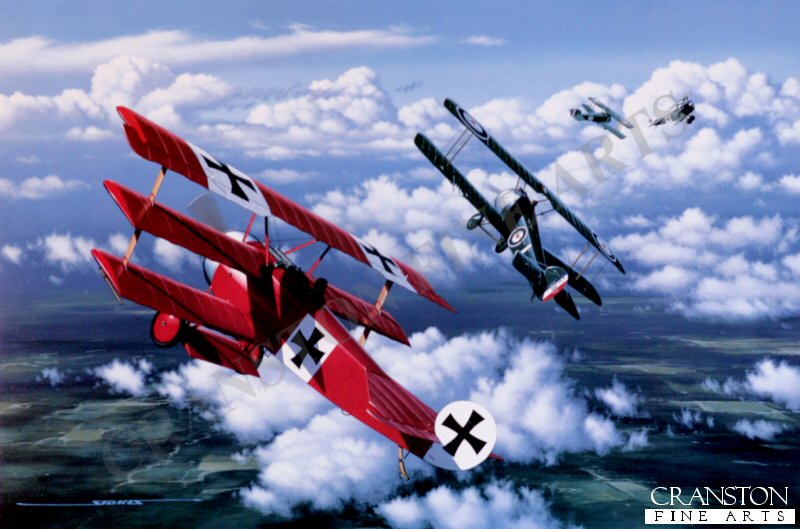
The Ringmaster by Stan Stokes. Born in Prussia to wealthy aristocratic parents, Manfred Freherr von Richtofen, The Red Baron, was to become the top ace of World War I, with 80 confirmed kills, and probably another 40-50 which took place over enemy lines and could not be confirmed. Richtofen was originally a cavalry officer, but with great persistence he was transferred to the air arm. After a brief period on the eastern front Richtofen was transferred to the western front in August 1915. His first confirmed victory was recorded in September 1916 and by November he recorded eleven kills, including Major Lance Hawker, the top British fighter pilot. With his keen reflexes and eyesight he quickly ascended, and by June 1917 Richtofen took control of a unit near Coutrai. This unit became known as Richtofens Circus. By July the ringmaster had his fifty-seventh victim. Despite his successes Richtofen shunned publicity and became increasingly withdrawn. Richtofen was wounded in combat and spent three weeks in the hospital recuperating. After his return to duty Manfred became a vocal proponent of the Fokker triplane. The bright red paint scheme utilized on one of Richtofens aircraft is what earned him the nick-name, The Red Baron. Richtofens brother, Lothar, was also an ace with forty victories to his credit. By April of 1918, aided by Americas entry into the War, Germany was facing overwhelming numbers of enemy aircraft, and many with performance capabilities the equal to, and in some cases superior to, their own. The Germans mounted a final desperate offensive, and on April 21,1918 The Red Baron finally fell victim to the perils of combat. Although there is considerable controversy over the Red Barons demise, it appears that Richtofen was either killed by Captain Arthur Brown, a Canadian flying with the RAF, or was shot down by Australian machine gunners while evading Captain Brown. Richtofen was provided a full military funeral by the Allies, and on the evening following his funeral a single RAF fighter dropped a small package containing photos of the funeral onto the Circus headquarters. By Wars end the Circus was credited with the destruction of 644 aircraft, but 56 of its airmen had been killed, 32 seriously wounded, and 6 captured. Richtofen is pictured in July of 1917 tangling with Sopwith Camels in the skies over Belgium. Flying his beloved Fokker triplane, the infamous Red Baron is shown positioning his aircraft for yet another victory. |
Those Nagging Mosquitoes by Stan Stokes. Although fifty years has passed since the end of WW II, the de Havilland Mosquito, or Mossie, is still held in high admiration by the crews which flew this wonderful aircraft. Built in a number of variants, the Mosquito served in a number of roles including fighter, bomber, trainer, transport, night fighter, and reconnaissance aircraft. Prior to WW II the de Havilland Company had built a good reputation for building highly streamlined, very fast aircraft, utilized for racing. The Company submitted a design proposal in 1939 for an all new twin-engined aircraft, primarily built of wood, which would be capable of 400 MPH with its twin Merlin engines. Late in 1939 the Air Ministry ordered a prototype, and in March of 1940 an initial fifty production aircraft were ordered. The Mosquito was built utilizing a one-piece, two-spar wing. Spruce and plywood were utilized extensively. The aircraft performed admirably in its initial tests and the first combat mission took place in September, 1941. Some of the early Mosquitoes were produced in a bomber variant. Early Mosquitoes were painted in a unique blue-gray camouflage. One of the first squadrons equipped with the Mosquito was number 105. In September of 1942, 105 squadron sent four of its aircraft on a daring daylight low level raid to bomb the Gestapo Headquarters in Oslo, Norway. This successful mission was lead by RAF Squadron Leader George Parry. The mission was important because the Gestapo Headquarters housed vital dossiers on Norwegian resistance personnel, and the resistance had requested the mission to boost morale. The Mosquitoes were unexpectedly attacked by two Fw-190s as they approached the target. One of the aircraft (piloted by F/Sgt. Carter) was hit and crashed while attempting a forced landing on a lake. One of the Fw-190s struck a tree during the chase, and crash landed in a mountainous area. Stan Stokes, in his striking painting, appropriately titled Those Nagging Mosquitoes, depicts the three returning aircraft of 105 Squadron flying fast and low over a fjord in Norway. Because the Mossie utilized speed as a way to avoid enemy fighters, several minor modifications were made to coax every additional MPH possible out of the aircraft. Other modification were made to some aircraft which allowed them to carry a 4,000 pound bomb. The Mosquito was also produced under license in Canada utilizing Packard-manufactured Merlin engines. The Mosquito B Mk IX utilized a pair of 1,680 HP Merlin 72s and the prototype attained a speed of 437 MPH. Other Mossies were modified to utilize a bulbous ventral radar dome. The Mosquito was produced until 1950. More than 7,700 aircraft were built. The aircraft remained in service with the RAF until 1963. Only a few restored examples of this versatile aircraft remain in existence. |
The Brits Get Burned by Stan Stokes. Twenty-four hours prior to the Japanese attack on Pearl Harbor Japanese fighters near the Gulf of Siam shot down a RAF Catalina flying boat. The RAF aircraft had stumbled across the Japanese Southern Expeditionary Fleet proceeding to Malaya with a powerful invasion force. With many of its carriers approaching Pearl Harbor, the Japanese invasion force was dependent on land-based air cover. The Japanese Navys 22nd Air Flotilla had relocated to bases in French Indochina. Also within range were Army aircraft flying out of the Saigon area. The Japanese had several hundred aircraft at their disposal. On the British side there was a collection of approximately 150 mostly obsolete and poorly maintained aircraft including Brewster Buffalos, Vildebeast torpedo bombers, Blenheim light bombers, and Hudson patrol aircraft. The British had reinforced their naval forces in the area in November with the arrival of Force Z. Force Z included the old battle cruiser Repulse and the new state-of-the-art battleship Prince of Wales. It had also included the aircraft carrier Indomitable, but that ship had unhappily run aground in the West Indies. Force Z was sent north, under radio silence, to seek out the Japanese invasion force. Guided by some reports from a submarine, a force of 53 Japanese aircraft from the 22nd Air Flotilla took off on a mission to intercept the British force. Flying twin-engine G3M Nell and G4M1 Betty bombers, mostly armed with torpedoes, the Japanese pilots flew southwards through darkness and heavy clouds. Finally spotting something, the aircraft proceeded to attack position, but realized at the last minute that they were preparing to attack Admiral Ozawas flagship. About the same time, Force Z made contact with two scout planes launched from Ozawas cruisers. Disappointed that they had lost any element of surprise, the British force turned back. The next day the force was spotted by Japanese reconnaissance aircraft and their position was established for another attack force of nearly 100 aircraft. The Repulse was attacked first by a low level bombing run by Nells. Two waves of torpedo bomber attacks then followed. Captain Tennant, the ships commander twisted and swerved his ship, managing to dodge all the torpedoes. A third wave resulted in a single torpedo hit; exposing the old ship to nine more torpedo bombers. Four more torpedoes struck home, and the Repulse rolled over and sunk. The Prince of Wales was attacked by an initial wave of nine torpedo bombers, and suffered two hits. Mortally wounded she was attacked by a second wave of torpedo bombers. This time 4 more torpedoes struck home. She capsized and sank a few hours after the Repulse had preceded her. The demise of the Repulse and the Prince of Wales marked the end of the Battleship Era. Never again could powerful ships feel any security as long as unopposed enemy airpower was in range. |
Canadian Heroes by Stan Stokes. James Edgar (Johnnie) Johnson was the Royal Air Forces top fighter ace in Europe with 38 confirmed victories during the War. Johnson was called up in 1939 following his training with the RAF Volunteer Reserve. Having been hospitalized for much of the Battle of Britain, Johnsons first serious action was in mid-1941 when he often flew with Douglas Baders section. Johnson was promoted quickly and was awarded the Distinguished Flying Cross following his fifth victory in 1941. In early 1943 Johnson was put in command of a wing of the Royal Canadian Air Force. Flying the high-performance Supermarine Spitfire Mark IX, Johnson achieved 18 victories in seven months of flying. Many of Johnsons victories were achieved against the Messersmitt Bf-109. Promoted to Group Captain in early 1945, Johnson was put in command of the 125 Wing for the duration of the War. The Supermarine Spitfire is the only Allied fighter to have been continuously produced from before 1939 to after 1945. In total more than 22,000 of these splendid aircraft were built. The chief designer of the Spitfire was R.J. Mitchell, a brilliant engineer who joined the Supermarine company in 1916, and by 1920 was its chief engineer. Mitchell fashioned a number of high performance maritime aircraft, culminating with the sleek S series of float planes. This is the float plane which ultimately won permanent possession of the coveted Schneider Trophy for Britain, and established a new world speed record in excess of 400 MPH in 1931. In that same year the Air Ministry issued a specification for a new high-performance day/night fighter. Mitchells design, the Type 224, lost out in the competition to the Gloster Gladiator biplane. In 1936 the new Rolls Royce Merlin engine was fitted to a prototype 224, and the Spitfire was born. Achieving a speed of 396 MPH, the RAF was impressed, and initial orders for the first Spitfires were placed. Sadly, R.J. Mitchell succumbed to cancer in 1937 at the age of only 42. With the onset of the War, Spitfire production soared, and the aircraft was steadily improved. The Mark IX, as depicted in Stan Stokes painting entitled Canadian Heroes, first entered service in July 1942. The Mark IX was identifiable because of its four-bladed prop and its twin radiators. Introduced partially in response to Germanys introduction of the Focke Wolfe FW 190, the Mark IX was produced in greater numbers (5,665) than any other particular Spitfire model. As depicted in Stokes painting Johnnie Johnson has just attained another victory over a Bf-109 while flying with the Royal Canadian Air Force in 1944. The painting is dedicated to the many Canadians which served with the RAF during the War. |
|
Contact Details |
|
Sign Up To Our Newsletter!
This website is owned by Cranston Fine Arts. Torwood House, Torwoodhill Road, Rhu, Helensburgh, Scotland, G848LE Contact: Tel: (+44) (0) 1436 820269. Email: cranstonorders -at- outlook.com
|
|
|