|
|
|
|
|
 |
|||
|
|
|
|
|
|
|
|||
| Click Here For Full Artist Print Indexes | Aviation History Archive |
|
Camel
Aviation Art Prints  Aviation Artists Stan Stokes British Aviation Aviation Artists Stan Stokes British Aviation  Camel Camel |
[UP] - Barracuda - Beaufighter - Blenheim - Camel - Defiant - DH2 - Gladiator - Harrier - HP42 - Hurricane - Lancaster - Mosquito - Nieuport Scout - Seafire - Spitfire - Sunderland - Swordfish - Tempest |
| Camel Aviation Art Prints, Paintings and Drawings |
|
|
| Text for the above items : |
Fast and Furious by Stan Stokes. Thomas Sopwith was a distinguished British aviator who organized the Sopwith Aviation Company. Sopwith produced an aircraft which won the coveted Schneider Trophy race. With the start of WW I, Sopwith Aviation shifted its focus to military aircraft, and was to become one the major suppliers to both the Royal Air Corps and the Royal Naval Air Service. In October of 1914 two Sopwith Tabloids flew a 200-mile round trip strike against the airship sheds at Dusseldorf and Cologne. The Sopwith Strutter firmly entrenched Sopwith as a producer of quality-built aircraft. The Strutter was a precursor of the Sopwith Pup, which would serve as the Royal Navys first carrier aircraft. The first production Pup was delivered to the Royal Navy in 1916. Most Pups were powered by a 80-HP Le Rhone radial engine, which gave the Pup a top speed of 115-MPH and an endurance of three hours. Many Navy Pups were modified to utilize a tripod mounted Lewis gun which could be fired forward or upwards through a cutout in the upper wing. Sopwith Pups were also utilized on battlecruisers. In fact, a Pup launched from the HMS Yarmouth downed the Zeppelin L.23 in August of 1917. The Royal Navys HMS Furious was the first dedicated aircraft carrier in the world. The Furious was initially laid down as a battlecruiser, but the design was modified during construction to include a flying deck forward of the main bridge. This configuration allowed aircraft to be launched as the Furious steamed into the wind. An attempt at recovery by having aircraft side slip on to the deck proved ineffective with one of the early attempts resulting in the death of the pilot, Squadron Commander E. H. Dunning, who had made the worlds first successful carrier landing on a ship underway only days earllier. The Royal Navy decided to further modify the Furious by adding a second deck aft of the bridge. The fore and aft decks were connected by a narrow ramp on either side of the funnel and bridge, and this permitted aircraft to be to moved between the two decks. Sets of longitudinal wires were set across the aft deck, and were designed to catch the skids of the Sopwith Pups during landings. Recovering aircraft was still tricky, and a rope barrier was erected aft of the mainmast to prevent aircraft which overshot from crashing into the superstructure of the ship. The first carrier-based naval air strike in history was carried out against the Zeppelin hangars at Tondern by the Furious on July 19, 1918. Seven Sopwith Camels, each carrying two 50-pound bombs were utilized for this mission. This important moment in the history of naval aviation is captured magnificently in Stan Stokes highly detailed painting entitled Fast and Furious. |
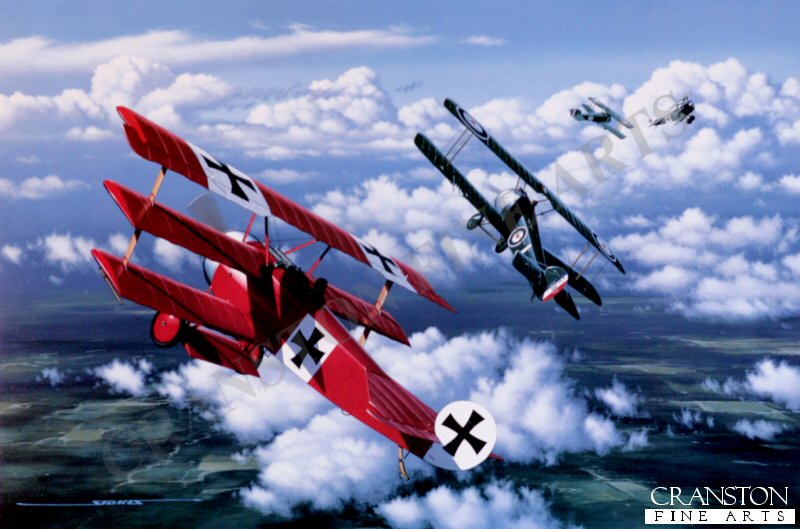
The Ringmaster by Stan Stokes. Born in Prussia to wealthy aristocratic parents, Manfred Freherr von Richtofen, The Red Baron, was to become the top ace of World War I, with 80 confirmed kills, and probably another 40-50 which took place over enemy lines and could not be confirmed. Richtofen was originally a cavalry officer, but with great persistence he was transferred to the air arm. After a brief period on the eastern front Richtofen was transferred to the western front in August 1915. His first confirmed victory was recorded in September 1916 and by November he recorded eleven kills, including Major Lance Hawker, the top British fighter pilot. With his keen reflexes and eyesight he quickly ascended, and by June 1917 Richtofen took control of a unit near Coutrai. This unit became known as Richtofens Circus. By July the ringmaster had his fifty-seventh victim. Despite his successes Richtofen shunned publicity and became increasingly withdrawn. Richtofen was wounded in combat and spent three weeks in the hospital recuperating. After his return to duty Manfred became a vocal proponent of the Fokker triplane. The bright red paint scheme utilized on one of Richtofens aircraft is what earned him the nick-name, The Red Baron. Richtofens brother, Lothar, was also an ace with forty victories to his credit. By April of 1918, aided by Americas entry into the War, Germany was facing overwhelming numbers of enemy aircraft, and many with performance capabilities the equal to, and in some cases superior to, their own. The Germans mounted a final desperate offensive, and on April 21,1918 The Red Baron finally fell victim to the perils of combat. Although there is considerable controversy over the Red Barons demise, it appears that Richtofen was either killed by Captain Arthur Brown, a Canadian flying with the RAF, or was shot down by Australian machine gunners while evading Captain Brown. Richtofen was provided a full military funeral by the Allies, and on the evening following his funeral a single RAF fighter dropped a small package containing photos of the funeral onto the Circus headquarters. By Wars end the Circus was credited with the destruction of 644 aircraft, but 56 of its airmen had been killed, 32 seriously wounded, and 6 captured. Richtofen is pictured in July of 1917 tangling with Sopwith Camels in the skies over Belgium. Flying his beloved Fokker triplane, the infamous Red Baron is shown positioning his aircraft for yet another victory. |
|
Contact Details |
|
Sign Up To Our Newsletter!
This website is owned by Cranston Fine Arts. Torwood House, Torwoodhill Road, Rhu, Helensburgh, Scotland, G848LE Contact: Tel: (+44) (0) 1436 820269. Email: cranstonorders -at- outlook.com
|
|
|