|
|
|
|
|
 |
|||
|
|
|
|
|
|
|
|||
| Click Here For Full Artist Print Indexes | Aviation History Archive |
|
German Air Force
Aviation Art Prints  Aviation Artists Stan Stokes Aviation Artists Stan Stokes  German Aviation German Aviation |
[UP] - US Aviation - British Aviation - German Aviation - Other Countries |
| More Pages : Albatros - Bv238 - Do17 - Fokker D.VII - Fokker Dr.I - Fokker M.5 - Fw190 - Gotha G.IV - Hannover CL.IIIa - He111 - He115 - Ju87 - Ju88 - Me109 - Me110 - Me163 - Me262 - Mistel |
| Navigation | |
| Page 2 of 2 | Previous .. Page 2 |
|
|
|
|
|
|
|
|
|
|
|
|
|
| Navigation | |
| Page 2 of 2 | Previous .. Page 2 |
| Text for the above items : |
Billy Shows Them by Stan Stokes. In the period following WW I, Americas military spending was severely curtailed. The Air Service of the United States Army, which had performed admirably in the latter stages of the War, was treated like an unwanted child. The Air Service had detractors within the regular Army, the Navy, and the Naval Air Service. Rivalry between the Navy and Army was fierce during these times, and competition for the limited amount of funds available for defense spending further intensified matters. Brigadier General Billy Mitchell was one of the senior officers in the US Army Air Service. A veteran of WW I, Billy was an outspoken advocate of the Air Service. Mitchell requested permission to attempt to sink the German dreadnought Ostfriesland in a demonstration off the Virginia coast. The Navy was anxious to discredit the Air Service, and even within the Army itself there were many rooting against Mitchell. Mitchells commanding officer ordered him to attack the Ostfriesland from a minimum altitude of 5000 feet, and to utilize nothing greater than 1000 lb bombs. Mitchells first attempt was not successful, but on his second attempt on June 21, 1921 he disobeyed his direct orders and used 2,000 pounders dropped from low altitude. These bigger bombs shattered the hull plates of the German ship and she sank in about twenty minutes. This infuriated the Navy, which did not anticipate this result, and also resulted in Mitchell being demoted to Colonel. For the attack Mitchell utilized six Curtis MB-2 twin-engine bombers. The MB-2 was developed by Curtis in response to the Armys request in 1917 for a medium-range bomber superior to anything available at that time. The MB-1 first flew in 1918, and in 1919 an improved variant, the MB-2, took to the air. Following the crash of the USN airship Shenandoah, Mitchell publicly criticized Admiral Moffett, head of the Navys Air Service. He also strongly criticized senior Army officers due to the terrible safety record for the Air Service. These remarks lead to the much publicized court marshall of Billy Mitchell. Mitchell was found guilty and stripped of his rank, and suspended from duty for a period of five years. Despite this set back, Mitchell continued to lobby for both a safe and strong independent Air Force. He was convinced that the outcome of the next major world conflict would be determined by air power. Many of Mitchells ideas would ultimately be implemented, and he is generally acknowledged to be the Father of the modern American Air Force. |
Showtime at the Circus by Stan Stokes. Born in Prussia to wealthy aristocratic parents, Manfred F. von Richtofen, The Red Baron, was to become the top ace of World War I, with 80 confirmed kills, and probably another 40-50 which took place over enemy lines and could not be confirmed. Richtofen was originally a cavalry officer, but with great persistence he was transferred to the air arm. After a brief period on the eastern front Richtofen was transferred to the western front in August 1915. His first confirmed victory was recorded in September 1916 and by November he recorded eleven kills, including Major L. Hawker, the top British fighter pilot at that point in time. With his keen reflexes and eyesight he quickly ascended, and by June 1917 Richtofen took control of a unit near Coutrai. This unit became known as Richtofens Circus. By July the ringmaster had his fifty-seventh victim. Despite his successes Richtofen shunned publicity and became increasingly withdrawn. Richtofen was wounded in combat and spent three weeks in the hospital recuperating. After his return to duty Manfred became a vocal proponent of the Fokker triplane. The bright red paint scheme utilized on one of Richtofens aircraft is what earned him the nickname, The Red Baron. Richtofens brother, Lothar, was also an ace with forty victories to his credit. By April of 1918, aided by Americas entry into the War, Germany was facing overwhelming numbers of enemy aircraft, and many with performance capabilities the equal to, and in some cases superior to, their own. The Germans mounted a final desperate offensive, and on April 21,1918 The Red Baron finally fell victim to the perils of combat. Although there is considerable controversy over the Red Barons demise, it appears that Richtofen was either killed by Captain Arthur Brown, a Canadian flying with the RAF, or was shot down by Australian machine gunners while evading Captain Brown. Richtofen was provided a full military funeral by the Allies, and on the evening following his funeral a single RAF fighter dropped a small package containing photos of the funeral onto the Circus headquarters. By Wars end the Circus was credited with the destruction of 644 aircraft, but 56 of its airmen had been killed, 32 seriously wounded, and 6 captured. |
A Big Victory by Stan Stokes. On September 18, 1944 P-51 pilots of the 375th Fighter Squadron of the 361st Fighter Group, based at Little Walden in Essex, were assigned the mission of escorting B-17s on a shuttle mission to Russia. The Mustangs would accompany the bombers to the south of Sweden where they would be picked up by an escort of Russian fighters. Urban Drew, flying a 51-D named Detroit Miss, was one of the USAAF pilots on this mission. Just before breaking off the escort Drew spotted a twin-engine German aircraft flying very low to the water. He broke off with two wingman and went down after the German plane. It turned out to be an He-111, most likely a courier plane from Scandinavia. He opened fire hitting the top gun position, circled around, and with his second burst set the aircraft afire. It tumbled into the Baltic. As Drew and his two wingman climbed back to altitude to rejoin their flight, he looked off to the right and spotted an enormous flying boat moored at a sea plane base on a lake. Drew called to his wingman and said, get lined astern immediately, and we will make one pass, and one pass only... lets see if we can burn and sink this mother. The three Mustangs commenced their attack with the element of surprise to their advantage. The three Mustangs poured about 1200 rounds of 50 caliber ammo into the behemoth, and as the third aircraft pulled up black smoke and flames were pouring from the target. It was not until that moment that anti-aircraft batteries opened fire, but the P-51s were quickly out of range. During the debriefing it was determined that their target was probably a Blohm and Voss BV-222. Years later, in 1974, while Drew was living in London, he was contacted by the British Broadcasting Company (BBC) which wanted to do a documentary. It was only then that Drew found out that the aircraft he destroyed at the Bug Seaplane Base on Lake Schaal was actually the BV-238, the largest aircraft to see service in WW II. Development work on the Blohm and Voss BV-238 began in 1940. This was planned to be a very large overseas transport aircraft, and was powered by six 1900-HP Daimler-Benz inverted V-12 engines. It would be considerably larger than the BV-222 with a wingspan of nearly 200 feet, a height of nearly 44 feet, and an empty weight of more than 110,000 pounds. Although two other aircraft, the Douglas B-19 and the Soviet ANT.20, had longer wingspans, the BV-238 was the heaviest and most powerful aircraft developed during WW II. It was during the testing phase of this aircraft at Lake Schall in 1944 that the BV-238 was strafed and destroyed by a flight of three P-51s lead by Eighth Air Force ace Urban Drew. |
Too Little Too Late by Stan Stokes. Heinz Bar joined JG 51 in 1939 as a non-officer pilot. By August of 1940 he had become the highest scoring non-officer pilot in the Luftwaffe. Although shot down once during the Battle of Britain, Bar survived, and was later transferred to the Eastern Front. He received his commission and by the end of 1941 had chalked up 91 victories. By mid-1942, with 113 victories, he was promoted to Hauptman and made Group Commander of I/JG 77. Flying out of Sicily he participated in the siege of Malta, and later was shifted to North Africa where he obtained another 61 victories. With his health suffering, Heinz was reassigned to Germany, where he flew interception missions against the steady onslaught of Eighth Air Force bombers. With his victory total at 202, Bar was put in command of JG 3 and later III/EJG2, a unit equipped with the Me-262 jet fighter. He obtained 16 victories in March and April of 1945 while piloting the 262, making him the top jet ace of WW II. His record for victories in a jet stands until this day, having been equaled in Korea by Capt. Joseph McConnell. Bars final victory count of 220 made him the eighth highest scoring ace of all time. He was killed after the War in a flying accident. The Messerschmitt Me-262 Swallow, a masterpiece of engineering, was the first operational mass-produced jet to see service. Prototype testing of the airframe commenced in 1941 utilizing a piston engine. General Adolf Galland, who was in charge of the German Fighter Forces at that time, pressured both Goring and Hitler to accelerate the Me-262, and stress its use as a fighter to defend Germany from Allied bombers. Hitler, however, envisioned the 262 as the aircraft which might allow him to inflict punishment on Britain. About 1400 Swallows were produced, but fortunately for the Allies, only about 300 saw combat duty. While the original plans for the 262 presumed the use of BMW jet engines, production Swallows were ultimately equipped with Jumo 004B turbojet engines. The wing design of the 262 necessitated the unique triangular hull section of the fuselage, giving the aircraft a shark-like appearance. With an 18 degree swept wing, the 262 was capable of Mach .86. The 262 was totally ineffective in a turning duel with Allied fighters, and was also vulnerable to attack during take off and landings. The landing gear was also suspect, and many 262s were destroyed or damaged due to landing gear failure. Despite its sleek jet-age appearance, the 262 was roughly manufactured, because Germany had lost access to its normal aircraft assembly plants. In spite of these drawbacks the 262 was effective. For example, on April 7, 1945 a force of sixty 262s took on a large force of Allied bombers with escort fighters. Armed with their four nose-mounted cannons, and underwing rockets the Swallows succeeded in downing or damaging 25 Allied B-17s on that single mission. While it is unlikely that the outcome of the War could have been altered by an earlier introduction or greater production totals for this aircraft, it is clear to many historians that the duration of the War might have been drastically lengthened if the Me-262 had not been too little too late. |
Yellow 14 by Stan Stokes. Hans-Joachim Marseille - Germanys Eagle of the Desert, had a less than auspicious start as a fighter pilot. Having completed his training in the autumn of 1940 he participated in the Battle of Britain while based in western France. Although Marseille was credited with downing eight RAF aircraft, he had a reputation for losing lots of aircraft. In fact he had bailed out of six Bf-109s and during his units transfer to North Africa, the young ace lost another 109. The Bf-109 was one of the most successful fighters of WW II, and was produced in large quantities for a very long production run. Marseilles debonair manner harkened back to the earlier era of WW I when knights of the sky faced death every day on their canvas-covered wings. He was very aggressive, and very often would dive his aircraft into enemy formations without regard for the consequences. Marseilless commanding officer was Capt. Eduard Neumann, and he deserves credit for the maturation of the young pilot. He convinced Marseille that it would take more than luck to become a truly outstanding fighter pilot. Marseille took these observations to heart and began to devote much of his free time to improving his tactics. He practiced shooting from all angles and his flying and shooting skills began to improve. By the summer of 1941 the young ace had attained 18 victories, and by September he had reached 24 by bagging five on one mission. By late in 1941 his score was approaching fifty, and he was awarded the Knights Cross. With it came certain privileges, including his own personal aircraft, Yellow 14. As his victory tally rose his reputation grew on both sides. In Stan Stokes painting Marseille is depicted on a mission on June 3, 1942. Escorting Stukkas against Ben Hacheim. The force was intercepted by RAF fighters and the No. 5 Squadron of the South African Air Force, flying American-made P-40s. Marseille and his wingman, Sgt. Rainer Pöttgen swept into the melee. The South Africans formed a defensive circle, but Marseille got inside it flying incredible slowly and still managing to turn inside the South Africans. He decimated the formation - downing six of the P-40s while utilizing only a small percentage of his ammunition. Marseille was a master of low-speed combat. By June of 42 the aces total had exceeded 100. Recognizing the signs of combat fatigue, Neumann sent Marseille on leave for several months. Back in Germany the dashing and flamboyant Marseille made the party rounds, and attracted more than his share of young women. On September 1, following his return to fighting, Marseille had an unbelievable day when he downed seventeen aircraft, and two days later he was awarded the Diamonds to the Knights Cross. Marseilles victory total reached 158 before he flew his final mission in September of 1942. Bailing out of his smoking inverted 109; he appeared to strike the tail plane. No parachute opened and the Eagle of the Desert fell to his death. He was buried where he fell. |
Attack on the Tirpitz by Stan Stokes. On November 2, 1936 the keel was laid for a new German 35,000 ton-class battleship. On April 1, 1939 the new ship was christened the Tirpitz, and by February of 1941 the giant ship had entered service. The hull of the Tirpitz was 90% welded, and the battleship was very heavily armored, rendering it almost unsinkable in the minds of German naval strategists. In service the Tirpitz actually displaced closer to 53,000 tons. With a crew slightly in excess of 2,000 the ship was capable of making 29 knots. With a range of more than 9,000 miles at a speed of 16 knots, the Tirpitz was certain to take a heavy toll on Allied shipping in the North Atlantic. The Royal Navy and RAF determined that the Tirpitz must never be allowed to become an effective convoy buster, and a multi-year campaign of harassment of the huge German warship was undertaken. In July of 1940, while the ship was still being outfitted, an air attack was launched with little significant damage. After completing its sea trials the Tirpitz was based at the Faettenfjord in Norway. The Tirpitz unsuccessfully attacked two convoys in March of 1942, and itself was attacked by a flight of 12 Albacore torpedo bombers. Three more bombing attacks by Halifax and Lancaster bombers took place in March and April with only marginal success. In July the Tirpitz was moved to Altafjord, and in that month it again attacked a convoy with no success. In October the great ship was sent back to Faeteenfjord for servicing. In 1943 several midget submarine attacks were launched at the battleship, but again with no meaningful impact. No air attacks took place in 1943. In early 1944 the Tirpitz was the target for Soviet bombers, but once again the ship pulled through unscathed. In April of 1944 the Brits once again joined the attack and the Royal Navy sent a large group of 40 Barracudas with about 40 escort fighters to attack the battleship at Kaalfjord. This attack resulted in fifteen hits, generated 400 casualties, and did some serious damage to the upper deck. Follow-up air attacks were called off by bad weather, and it was not until August that three more raids took place. None of these had much impact. In September the Brits changed strategies and commenced attacks on the Tirpitz using 11,000-pound Tallboy bombs. A flight of 32 Lancasters delivered 29 Tallboys to the target in November of 1944. Two direct hits and one near miss were recorded. The great battleships armored deck was pierced by the huge bombs, its magazine exploded, and the ship capsized and sunk with more than 1200 killed. In Stan Stokes painting the attack of April 3, 1944 that was code-named Operation Tungsten is depicted. The Fairey Barracuda despite an ungainly appearance was produced in large numbers (2,500) for use as Royal Navy dive and torpedo bombers. With a crew of 3 and a top speed of only 238-MPH the Barracuda required fighter support during most of its missions to prevent it from becoming an easy target for Axis fighters. |
Canadian Heroes by Stan Stokes. James Edgar (Johnnie) Johnson was the Royal Air Forces top fighter ace in Europe with 38 confirmed victories during the War. Johnson was called up in 1939 following his training with the RAF Volunteer Reserve. Having been hospitalized for much of the Battle of Britain, Johnsons first serious action was in mid-1941 when he often flew with Douglas Baders section. Johnson was promoted quickly and was awarded the Distinguished Flying Cross following his fifth victory in 1941. In early 1943 Johnson was put in command of a wing of the Royal Canadian Air Force. Flying the high-performance Supermarine Spitfire Mark IX, Johnson achieved 18 victories in seven months of flying. Many of Johnsons victories were achieved against the Messersmitt Bf-109. Promoted to Group Captain in early 1945, Johnson was put in command of the 125 Wing for the duration of the War. The Supermarine Spitfire is the only Allied fighter to have been continuously produced from before 1939 to after 1945. In total more than 22,000 of these splendid aircraft were built. The chief designer of the Spitfire was R.J. Mitchell, a brilliant engineer who joined the Supermarine company in 1916, and by 1920 was its chief engineer. Mitchell fashioned a number of high performance maritime aircraft, culminating with the sleek S series of float planes. This is the float plane which ultimately won permanent possession of the coveted Schneider Trophy for Britain, and established a new world speed record in excess of 400 MPH in 1931. In that same year the Air Ministry issued a specification for a new high-performance day/night fighter. Mitchells design, the Type 224, lost out in the competition to the Gloster Gladiator biplane. In 1936 the new Rolls Royce Merlin engine was fitted to a prototype 224, and the Spitfire was born. Achieving a speed of 396 MPH, the RAF was impressed, and initial orders for the first Spitfires were placed. Sadly, R.J. Mitchell succumbed to cancer in 1937 at the age of only 42. With the onset of the War, Spitfire production soared, and the aircraft was steadily improved. The Mark IX, as depicted in Stan Stokes painting entitled Canadian Heroes, first entered service in July 1942. The Mark IX was identifiable because of its four-bladed prop and its twin radiators. Introduced partially in response to Germanys introduction of the Focke Wolfe FW 190, the Mark IX was produced in greater numbers (5,665) than any other particular Spitfire model. As depicted in Stokes painting Johnnie Johnson has just attained another victory over a Bf-109 while flying with the Royal Canadian Air Force in 1944. The painting is dedicated to the many Canadians which served with the RAF during the War. |
A Costly Victory by Stan Stokes. Gunther Rall, who attained 275 confirmed aerial victories, was the third highest scoring ace of all time. In Stans dramatic painting Rall is about to have a mid-air collision with a Lagg-5 during the Battle of Kursk on the Eastern Front. Rall would survive this collision and continue to chalk-up victories until the end of the war. Rall flew about 800 combat missions and missed nearly a year of flying when he suffered a broken back. |
Defiant but Doomed by Stan Stokes. Jagdeschwader 26, or JG 26, was one of the Lufwaffes elite fighter forces. Nicknamed the Abbeville Boys, or the Abbeville Kids,JG 26 gained tremendous notoriety early in the War while operating out of Abbeville in Northern France. Although JG 26 never operated with more than 124 fighter aircraft, the unit dominated its airspace over Northern France and Belgium for more than a two year period. Adolf Galland was one of Germanys top fighter aces of the War, with more than 100 confirmed victories. For most of his flying career Galland was associated with JG 26. By year-end 1940 he had attained 57 victories, and was awarded the Oak Leaves, the highest award of the time. Galland took over command of JG 26 in August 1940 during the Battle of Britain. In Stan Stokes painting, entitled Defiant, But Doomed, Galland is depicted during a mission with the Abbeville Kids on August 28, 1940. Flying low cover for a formation of Heinkel bombers Galland was shocked to see a squadron of 12 Royal Air Force Defiants flying directly below the bombers. The Defiant was a unique British aircraft which was utilized as a daylight fighter incorporating four machine guns enclosed in a top mounted hydraulic turret operated by a gunnery officer. Despite serving admirably during the Dunkirk evacuation, the Luftwaffe had devised tactics which made the Defiant only marginally successful. By utilizing its turret guns RAF 264 Squadron was preparing to decimate the Heinkels with an attack on their vulnerable underbellies. Climbing straight up into the formation Galland broke up the attack. Minutes later he was engaged with the Defiant piloted by 264 Squadron Commander Garvin. Although struck four times by the Defiants machine guns, Galland was ultimately victorious. Gallands JG 26 flew the Messerschmitt Bf-109 (also often referred to as the ME-109) of which over 30,000 were produced. The first large scale production model of the 109 was the E series. Powered by a 12 cylinder water cooled engine the 109e was capable of 360 MPH, and had a ceiling of 33,000 feet. The 109 was very maneuverable and had a very strong airframe capable of sustaining high G maneuvers. Utilizing a low-wing cantilever design, the 109 had retractable landing gear and initially was produced with fuselage mounted machine guns. Galland complained about this configuration and actually modified several of his aircraft to incorporate wing mounted machine guns, which would provide a wider field of fire. A few of these aircraft were utilized during the Spanish Civil War in 1939, and proved vastly superior to anything they faced. The 109, unlike many other fighters which were in service at the start of the War, remained effective for the entire War, and in fact became a de facto standard by which many other aircraft would be judged. Adolf Galland was promoted to General of the Fighter Arm in late 1941, and became preoccupied with fighter tactics for the duration of the War. |
Sirens of Death by Stan Stokes. Ernst Udet, the German WW I ace who visited America in the late twenties, was so impressed with the U.S. Navys Curtis Hawk divebombers that he ordered one for evaluation and study by German aircraft manufacturers. This led to the development of Germanys first divebomber the Henchel 123. By 1935 the German Luftwaffe was developing its first monoplane divebomber which entered production in 1936 as the Ju87 Stuka. The Stuka was to evolve into arguably the most successful single engine Axis divebomber of WW II. Utilizing a nearly vertical dive position the Stuka was stunningly accurate in the days when horizontal bombing was a relatively inaccurate science. The Ju87 was built for functionality and ruggedness. A fixed landing gear and exceptionally strong wing design were incorporated and no attempt was made to minimize protrusions. The Stuka was not designed for speed; it was an aerodynamic nightmare. The Stuka also incorporated a siren which when activated during a dive was designed to inflict psychological damage on the enemy below. The Ju87 was used with tremendous success in the Blitzkrieg attacks on Norway, Poland, Belgium, France, Holland, Yugoslavia, and Greece. Virtually unchallenged in the air during these Blitzkriegs the Stukas took a devastating toll on Allied ground and mechanized forces. Shipping was also vulnerable to the pinpoint attacks of the Stuka, and the Ju87 destroyed more Allied shipping than all other German aircraft put together during WW II. During Hitlers air attacks on Britain the Stukas reputation for invulnerability was shattered. Facing British Hurricanes and Spitfires the slower and less maneuverable Ju87s were destroyed in large numbers, eventually forcing their withdrawal from that conflict. Germanys attempt to develop an improved twin engine divebomber resulted in the introduction of the Messerschmitt 210 which was an unmitigated disaster. As a result, the Stuka remained in production longer than expected and the aircraft played a major role in Germanys surprise attack on Russia. In the first day of combat alone Stukas were credited with the destruction of over 700 Russian aircraft with minimal losses. One of Germanys top aces of WW II was Hans-Ulrich Rudel. Rudel flew over 2,500 combat missions in Ju87s, and was shot down on twelve occasions. Rudel was credited with destroying 519 tanks, 800 vehicles, 150 artillery pieces, one Russian battleship, one cruiser and one destroyer. Rudel was also credited with shooting down nine Russian aircraft in air-to-air combat. In his painting, Stan Stokes captures the German ace in action on the Russian front in 1941. |
Mitchell's Air Armada by Stan Stokes. Germany, concerned over the full brunt of Americas entry into the War, decided in 1918 to launch one last all-out offensive. Germanys air forces were to play an important role in this offensive, but production of new aircraft had lagged behind expectations. With insufficient numbers of aircraft, German military leaders had to hope for technically superior machines to offset their disadvantages in numbers. In early 1918 top aces were brought back from the front to test competing designs. The overall favorite was a Fokker design which would ultimately reach the front as the D.VII. The aircraft was ordered into production immediately. The Germans organized a couple more fighter groups which could be rapidly deployed in those area where they could do the most good. The German offensive, which is generally referred to as the Kaisers Battle, began in the Spring and was focused on the area north of the Somme. British forces were initially overwhelmed by the German offensive. German airpower dominated in the early phases of the offensive. For the first major counter offensive of the War in which American forces would play a major role, Col. Billy Mitchell, Chief of the Air Service, assembled a huge air armada, the objective of which was to wrest toal air superiority from the German forces. Mitchell assembled 28 American squadrons. More than 600 US-piloted aircraft were available to Mitchell in this sector including more than 100 new American-built DH-4s with Liberty engines. In addition Mitchell rested control of several hundred additional aircraft in British, French, and Italian squadrons. Mitchells total force amounted to nearly 1,500 aircraft - the largest air armada ever assembled. In the early days of the counter offensive Mitchells strategy worked brilliantly, as the sheer number of Allied aircraft overwhelmed the Germans. Later, as the fighting continued, the Germans would have some success; especially with their Fokker D. VIIs. In Stan Stokes painting DH-4 bombers of the US 11th Aero Squadron come under attack by Fokker D.VIIs while on their way to another target during the St. Mihiel offensive. The 11th Aero Squadron would be decimated before the end of the offensive, losing all but one its aircraft. Five of the six DH-4s sent to bomb Mars-la-Tour were downed by a flight led by Hermann Becker, a significant German ace. The American built DH-4 was capable of carrying a 450-pound bomb load. Powered with a 416-HP Liberty 12 engine, these aircraft were capable of 125 MPH, and were adequately armed with 4 machine guns. The Fokker D. VIIs were powered with a 175-HP Mercedes engine and were capable of 119 MPH. The Fokkers were typically armed with twin Spandau machine guns. |
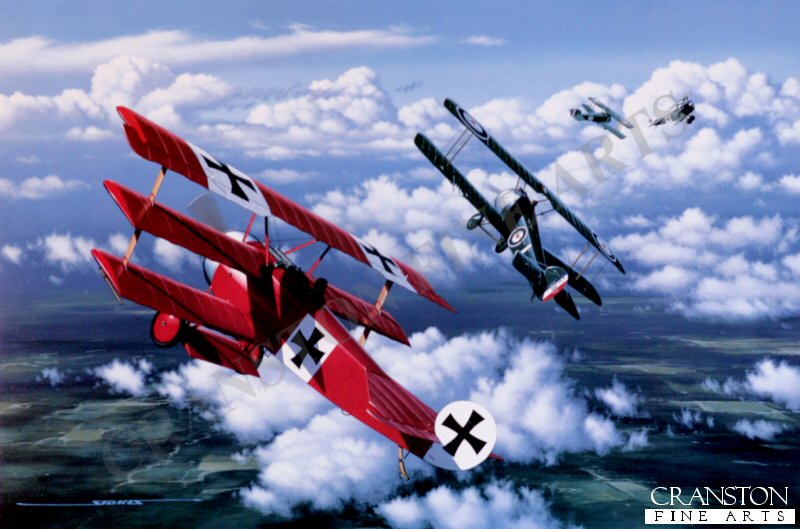
The Ringmaster by Stan Stokes. Born in Prussia to wealthy aristocratic parents, Manfred Freherr von Richtofen, The Red Baron, was to become the top ace of World War I, with 80 confirmed kills, and probably another 40-50 which took place over enemy lines and could not be confirmed. Richtofen was originally a cavalry officer, but with great persistence he was transferred to the air arm. After a brief period on the eastern front Richtofen was transferred to the western front in August 1915. His first confirmed victory was recorded in September 1916 and by November he recorded eleven kills, including Major Lance Hawker, the top British fighter pilot. With his keen reflexes and eyesight he quickly ascended, and by June 1917 Richtofen took control of a unit near Coutrai. This unit became known as Richtofens Circus. By July the ringmaster had his fifty-seventh victim. Despite his successes Richtofen shunned publicity and became increasingly withdrawn. Richtofen was wounded in combat and spent three weeks in the hospital recuperating. After his return to duty Manfred became a vocal proponent of the Fokker triplane. The bright red paint scheme utilized on one of Richtofens aircraft is what earned him the nick-name, The Red Baron. Richtofens brother, Lothar, was also an ace with forty victories to his credit. By April of 1918, aided by Americas entry into the War, Germany was facing overwhelming numbers of enemy aircraft, and many with performance capabilities the equal to, and in some cases superior to, their own. The Germans mounted a final desperate offensive, and on April 21,1918 The Red Baron finally fell victim to the perils of combat. Although there is considerable controversy over the Red Barons demise, it appears that Richtofen was either killed by Captain Arthur Brown, a Canadian flying with the RAF, or was shot down by Australian machine gunners while evading Captain Brown. Richtofen was provided a full military funeral by the Allies, and on the evening following his funeral a single RAF fighter dropped a small package containing photos of the funeral onto the Circus headquarters. By Wars end the Circus was credited with the destruction of 644 aircraft, but 56 of its airmen had been killed, 32 seriously wounded, and 6 captured. Richtofen is pictured in July of 1917 tangling with Sopwith Camels in the skies over Belgium. Flying his beloved Fokker triplane, the infamous Red Baron is shown positioning his aircraft for yet another victory. |
Top Night Fighter by Stan Stokes. Major Heinz Schnaufer, with 121 victories, was the top-scoring night fighter ace of all time. He became a Luftwaffe pilot in 1942 and obtained his first victory in June of that year. By August his victory count had reached twenty-two and he was put in command of the 9th Staffel of the IV/BJG1. On the evening of December 16, 1943 Schnaufer downed four RAF Lancaster 4-engine bombers, and on February 21, 1945 he claimed a total of nine Lancasters in one evening. He received the highest award which could be obtained, the Diamonds to the Knights Cross, upon attainment of his 100th victory. Schnaufer survived the War, but was killed in a motoring accident in 1950. As depicted by Stan Stokes in his dramatic painting entitled Top Night Fighter, Schnaufer, who primarily flew the night fighter version of the Messerschmitt Bf-110 Zerstorer, homes in on an RAF Lancaster heavy bomber. The Bf-110 grew out of Herman Gorings specifications for a multipurpose aircraft capable of penetrating deep into enemy airspace to clear the sky of enemy fighters in advance of German bomber formations. The aircraft would also be utilized as a long range interceptor, and as a ground support and ground attack bomber. The Bf-110 prototype first flew in 1936. The prototype was under powered with its Daimier Benz DB 600A engines. Several months passed before a go ahead was given for large scale production which commenced in 1938. Utilizing improved DB 601 engines, the early production 110s were as fast as any single engine fighter at that time, and had superior fire power. Their biggest apparent weakness was in the areas of armor protection for the crew, and in terms of maneuverability when compared to single seat fighters. The 110 was produced in large numbers and in many different variants. The 110D was the long range model. An additional belly tank was fitted to that aircraft, with several later variants having the more traditional drop tanks. The first serious test for the Bf-110 came during the Battle of Britain. About 300 Bf-110s were involved. They became easy prey for Hurricane and Spitfire pilots, and Bf-109s were often required to assist the 110s in their own defense. On August 15, 1940, which became known as Black Tuesday, the Bf-110s were ravaged by the RAF, and for the month over 100 aircraft were lost. On the Eastern Front the Bf-110 performed admirably in the early stages of Operation Barbarossa. With the Soviet Air Force weakened in the first several weeks of the attack, 110s were effectively utilized in a ground attack role. Ultimately, the Luftwaffe re-equipped a significant number of its 110s as night fighters. The aircraft performed well in this role because it was a good gun platform with sufficient speed to overtake the RAF night bombers. Such night missions were typically carried out with no Allied fighter escort, so the 110 night fighters would not have to engage or elude Allied fighters in this role. |
|
Contact Details |
|
Sign Up To Our Newsletter!
This website is owned by Cranston Fine Arts. Torwood House, Torwoodhill Road, Rhu, Helensburgh, Scotland, G848LE Contact: Tel: (+44) (0) 1436 820269. Email: cranstonorders -at- outlook.com
|
|
|