|
|
|
|
|
 |
|||
|
|
|
|
|
|
|
|||
| Click Here For Full Artist Print Indexes | Aviation History Archive |
|
Aviation Art Prints  Countries UK Aircraft Index More Aircraft Initial M to S Countries UK Aircraft Index More Aircraft Initial M to S  Stirling Stirling |
[UP] - Manchester - Martinsyde G.100 - Maryland - Master - Merlin - Meteor - Mew Gull - Mohawk - Morane Saulnier Type L - Mustang - Nieuport 10 - Nieuport 17 - Nieuport Scout - Nimrod - Phantom - RE8 - S6B - Saro SR45 Princess - Saro SR53 - Saro SRA1 - Scout - SE5a - Sea Fury - Sea Harrier - Sea King - Sea Otter - Sea Vixen - Seafire - Sentry - Shackleton - Short 184 - Skua - Snipe - Sopwith 1.5 Strutter - Sopwith Pup - Sopwith Tabloid - Sopwith Triplane - Spearfish - Stirling - Sunderland - Swift - Swordfish |
| Navigation | |
| Page 1 of 2 | Page 1 .. Next |
|
|
|
|
|
|
|
|
|
|
|
|
|
|
|
|
|
|
|
|
|
| Navigation | |
| Page 1 of 2 | Page 1 .. Next |
| Text for the above items : |
Preparing To Go - Crew of a Short Stirling by Ivan Berryman. The crew of MkIII Short Stirling WP-M of No.90 Squadron RAF prepare for a flight test on the morning of 3rd July 1943. Aircraft BK718, with designation WP-M, of No.90 Squadron RAF was lost over Germany in the early hours of 4th July 1943. Six of the seven crew were lost in the crash, the rear gunner surviving to be taken prisoner. Stirling WP-O was also lost on the same mission, with the loss of all seven crew. The crew of Stirling WP-M, BK718: Sgt Hugh Murray, Flight Engineer - Sgt Robert Freeland, Air Bomber - P/O Geoffrey Smith, Air Gunner - Sgt Oliver Beard, Wireless Operator - P/O Andrew Gilmour, Navigator - F/Lt Robert Platt, Pilot - Sgt I. H. Norris, Air Gunner. |
Outbound from Mildenhall by Ivan Berryman. Short Stirling III EH990 is depicted heading out over the North Sea on the evening of 7th October 1943, on a mine-laying sortie off the Frisian Islands. LS-K was piloted, on this occasion, by Fl/Sg Thomas Robertson Ewen, RAFVR on his first - and sadly only - mission as pilot, his aircraft falling victim to a marauding enemy night fighter. |
Sterling Service by Philip West. The Short Stirling won the distinction as the RAFs first purpose built four engine monoplane bomber. A strong, highly complex design it gained a reputation as a pilots aircraft to fly being agile for a big bomber and demonstrating great character. Well over 2000 Stirlings provided stout service for the RAF in a variety of extremely important roles throughout WW2. |
Guardian Moon by Ivan Berryman. Bomb doors open and ready for the vital drop, Short Stirling III EH990 prepares to lay her deadly cargo of mines off the coast of the Frisian Islands on the night of 7th October 1943. LS-K failed to return from the perilous mission, the aircraft believed to have been the victim of a German night fighter. |
Tribute to the Crews of the Stirling by Graeme Lothian. Outward bound, Stirling III of 199 Squadron based at Lakenheath, Suffolk, heads out on another night of operations in August 1943. EE953, Sqd letters EX - E of 100 group is piloted by F/L Tom Austin DFC who finished his tour by the end of October 1944, winning the DFC with his bomb aimer F/O Jack Lawrence. Nicknamed the Queen of the Skies, the Stirling was the 1st four engined bomber to enter service with the RAF in 1941. The cockpit stood a massive 22.5 feet from the ground and had an operational ceiling of only 12,000 feet, well within the range of the enemy AA guns. By September 1944 other bombers were taking the brunt of the attack to the Germans and the Stirlings were used mainly for glider towing especially for D-day and Arnhem. |
MacRobert's Reply by Ivan Berryman. Short Stirling N6086 MacRobert's Reply of 15 Sqn is shown during the bombing raid on the French Harbour of Brest on 18th December 1941. British bombers had been dispatched to bomb the German battleships Gneisenau and Scharnhorst that were docked there, an action that earned N6086's skipper Fl Off Peter Boggis a DFC. Stirling W7428 is also shown with her port wing ablaze, one of two Stirlings lost on this operation. The subject of the RAF's attention can be seen amid the smoke - Gneisenau in drydock and Sharnhorst alongside. |
Stirling Mine Laying by Keith Aspinall. Stirling Q-OJ of No.149 Sqn is shown minelaying in the Batlic. It was on precisely this type of mission - minelaying in the Baltic that aircraft W7639 (shown) was lost on 8th December 1942. Developing technical problems, the aircraft turned for home, but crashed in Suffolk, killing all seven crew on board. The crew were : P/O J Philp BEM, Sgt W S Hughes, Sgt G E Hills, Sgt C W Higgins, Sgt F Craven, Sgt T H Harris, and Sgt T G Williams. |
Tugs of War (Stirling & Gliders) by Ivan Berryman. Wearing the distinctive black and white identification stripes of the D-Day operations of June 1944, Airspeed Horsa MkII assault gliders, towed by their Short Stirling MkIV tugs of No.620 Squadron, make their way across a moody English Channel en route to Normandy during the tumultuous Operation Overlord. |
Close Encounter by Iain Wyllie. On the 10th of June 1941 en route to Emden, Stirling MG-D of No.7 Sqn was intercepted by two Me-109s. The aircraft piloted by Flying Officer G B Blacklock DFM returned safely to base after shooting down one of the fighters. |
The Long Way Home by Ivan Berryman. (PC) On the night of 12/13th August 1942, Short Stirling RF325 was attacked by a Bf.110 night fighter over the Ardennes in Belgium whilst returning from a bombing raid. Damaged and low on fuel, Sqn Ldr G A Watt nursed his stricken aircraft across the English Channel before making a forced landing at Broadstairs in Kent. This was a scenario faced by hundreds of Bomber Command aircrew throughout World War II and this painting is intended as a tribute to them all, symbolising the loneliness and vulnerability of the heavy bomber as it went about its unenviable task on an almost nightly basis and in the face of impossible odds. |
Teamwork by Philip West. As night falls, Short Stirlings of XV Squadron based at Mildenhall, Cambridgeshire, await their crews for yet another nocturnal mission. One of the almost forgotten Bomber Command aircraft that made a very significant contribution to the war effort. |
Stirling Work by Ivan Berryman. Tribute to the ground crew of Bomber Command. Ground crew inspect and prepare the engines of a Stirling bomber as it is refuelled in preparation for that nights mission. |
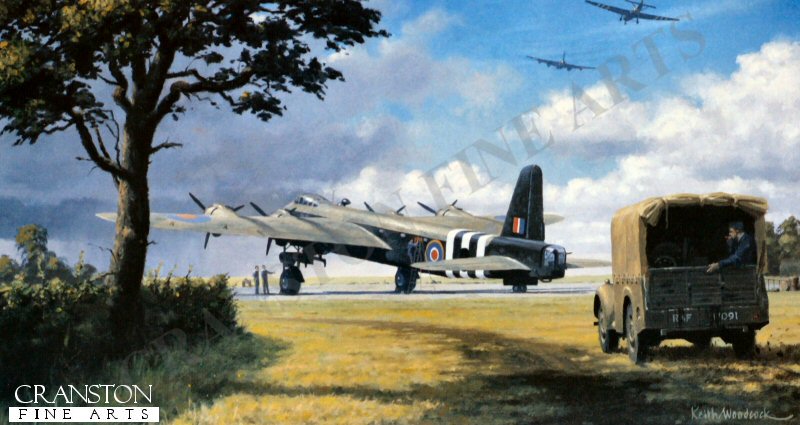
Stirlings Ready by Keith Woodcock. Stirling bombers of 7th Squadron Bomber Command of the Royal Air Force made ready for their next mission by the squadron's ground crew. A fitting tribute to all the ground crews of Bomber Command. |
Stirlings of No.90 Squadron by Ivan Berryman. The Short Stirlings WP-M and WP-O, aircraft numbers BK718 and EH907, fly together en route to Cologne in the late evening of 3rd July 1943. Aircraft BK718, with designation WP-M, of No.90 Squadron RAF was lost over Germany in the early hours of 4th July 1943. Six of the seven crew were lost in the crash, the rear gunner surviving to be taken prisoner. Stirling WP-O was also lost on the same mission, with the loss of all seven crew. The crew of Stirling WP-M, BK718: Sgt Hugh Murray, Flight Engineer - Sgt Robert Freeland, Air Bomber - P/O Geoffrey Smith, Air Gunner - Sgt Oliver Beard, Wireless Operator - P/O Andrew Gilmour, Navigator - F/Lt Robert Platt, Pilot - Sgt I. H. Norris, Air Gunner. |
Short Stirling MkI R9257 MG - C. by M A Kinnear. Aircraft History: R9257 was one of a batch of 150 Mk I Stirlings delivered to the RAF by Short Brothers between January 1942 and January 1943. Initially with Telecommunications Flying Unit, R9257 went to No.7 Squadron, where it eventually became the personal aircraft of Hamish Mahaddie and his crew from 8th February 1943 until he completed his operational tour with the PFF (Path Finder Force) at the end of March 1943. The aircraft then went on to No.1657 Heavy Conversion Unit at Stradishall, before being sent to No.214 Squadron. On 12th August 1943, whilst leaving RAF Chedburgh for a raid against Turin, R9257 swung on take off and the undercarriage collapsed. The aircraft was categorised as damaged beyond repair (DBR). R9257 replaced Hamish and his crews earlier Stirling MK I, R9273 also MG- C which had been attacked six days earlier by a Ju88 nightfighter. After evading the attack, they managed to bring the aircraft home. Next morning, Hamish counted 174 cannon shell holes in the aircraft - which he named C for Colander. Group Captain Thomas G Hamish Mahaddie DSO, DFC, AFC, CzMC: Born in Keith, Edinburgh on 19th March 1911, he joined the RAF as part of the 17th Entry at Halton in January 1928 and trained as a metal rigger, after which he was posted to Cranwell on ground servicing duties. In 1933 he boarded a troopship bound for the Middle East where he joined No.4 FTS at Abu Suier for pilot training. Gaining his wings in 1935, his first air crew posting was to No.55 Squadron at Hinaidi flying Westland Wapitis and on his return to England in 1937, he joined No.77 Squadron flying Whitleys from Driffield. During World War II he completed a tour of operations with No.77 Squadron before moving to Kinloss to instruct with No.14 OTU. On completing another tour, this time with No.7 Squadron (which he joined on 2nd August 1942) at Oakington on Stirlings, he joined HQ Staff of No.8 (Pathfinder) Group and Group Captain Mahaddie finished the war as Station Commander at RAF Warboys, home of PFF Navigation Training Unit. In June 1945 he was appointed to command No.111 Wing in Germany followed by a spell at the Staff College, Haifa in 1947. His postwar duties also included two tours of duty at the Air Ministry, as OC Flying Wing at Binbrook, and also as Station Commander at Sylt and Butzweilerhof in Germany. He finally retired from the RAF in March 1958 and became involved with the film industry as an aviation consultant working on many films including the Battle of Britain - for which he amassed an incredible number of Spitfires, Hurricanes, Messerschmitts and Heinkels. Thomas Hamish Mahaddie passed away on 16th January 1997. |
Stirling - 1940s by Barry Price. No text for this item |
The Night Shift by Philip West. The Short Stirling was the RAFs first four-engined bomber to enter service and it served throughout WWII in many roles including bomber, minelayer, troop carrier and glider-tug. The lack of power produced by its engines severely limited the loads carried by Stirlings. On long-range trips such as Italy, even with a greatly reduced bomb load the aircraft could barely clear the Alps. Despite very large losses due to its operational limitations, those that flew this big, agile aircraft, came to respect and look upon it with it with affection. |
Stirlings by Keith Woodcock. Flight crew prepare to get their Stirling ready for departure on another mission. This superb image is a fitting tribute to the Stirling bomber of Bomber Command and all the crews that flew in and also worked on this magnificent aircraft. |
McRobert's Reply by Geoff Lea. MacRobert's Reply was the name given to a Short Stirling bomber of No 15 Squadron, serial N6086. The Stirling was paid the donation of 25,000 pounds by Lady MacRobert in commemoration of her three sons, all of whom were killed whilst serving with the RAF. The eldest son Alasdair died in a flying accident in 1938, whilst Roderick and Iain were both killed in action during 1941. On October 1941 MacRobert's Reply was handed over to No.15 Squadron at RAF Wyton, with Lady MacRobert attending the naming ceremony. The Stirling had the MacRobert coat of arms painted on the nose, and the code LS-F. The Stirling flew twelve missions between October 1941 and January 1942, before accidentally swinging on take off and colliding with a damaged Spitfire at RAF Peterhead on 7th February 1942. The aircraft was written off. |
Stirling - The Heavy Brigade by Keith Woodcock. The Royal Air Force Short Stirling used by bomber command during World War Two. This aircraft carries the code AA-K of No.75 Squadron. |
Stirlings Outward Bound by Robert Taylor. SOLD OUT (June 2009) |
Stirling The Royal Air Force's first four engined monoplane Bomber, the Short Stirling first flew in May 1939 and entered front line service in August 1940 with no. 7 squadron. Due to its poor operational ceiling the aircraft sustained heavy losses and by mid 1942 the Stirling was beginning to be replaced by the Lancaster. Improved versions of the Short Stirling were built for Glider towing, paratroopers and heavy transport. also from 1943 many of the Stirling's were used for mine laying. A total of 2381 Stirling's were built for the Royal air Force and from this total 641 Stirling bombers were lost to enemy action. Crew 7 or 8: Speed: 260 mph (MK1) 275mph (MKIII) and 280mph (MKV)Service ceiling 17,000 feet Range: 2330 miles. (MK1) 2010 miles (MKIII) and 3,000 miles (MKV) Armament: two .303 Vickers machine guns. in nose turret, two .303 in browning machine guns in dorsal turret , Four .303 Browning machine guns in tail turret. Bomb Load 14,000 Lbs Engines: four 1150 Hp Bristol Hercules II (MK1) four 1650 hp Bristol Hercules XVI (MK111 and MKV) |
|
Contact Details |
|
Sign Up To Our Newsletter!
This website is owned by Cranston Fine Arts. Torwood House, Torwoodhill Road, Rhu, Helensburgh, Scotland, G848LE Contact: Tel: (+44) (0) 1436 820269. Email: cranstonorders -at- outlook.com
|
|
|