|
|
|
|
|
 |
|||
|
|
|
|
|
|
|
|||
| Click Here For Full Artist Print Indexes | Aviation History Archive |
|
Postcards
Aviation Art Prints  Aviation Artists Ivan Berryman Aviation Artists Ivan Berryman  Postcards Postcards |
[UP] - Royal Air Force - Germany - US Air Force - France - Italy - Belgium - Russia - Austria-Hungary - Japan - World War One - Civilian Aircraft - Battle of Britain - Original Paintings - Original Drawings - Postcards |
| Navigation | |
| Page 7 of 26 | Previous .. Page 7 .. Next |
|
|
|
|
|
|
|
|
|
|
|
|
|
|
|
|
|
|
|
|
|
| Navigation | |
| Page 7 of 26 | Previous .. Page 7 .. Next |
| Text for the above items : |
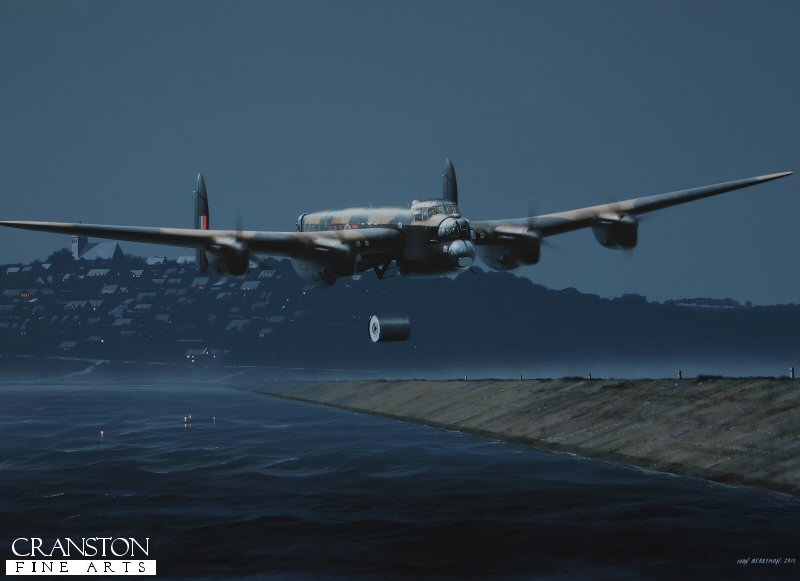
Attack on the Sorpe by Ivan Berryman. (PC) Of the five Lancasters that formed the Second Wave of Operation Chastise, just one aircraft made it to the target, the Sorpe Dam, on the night of 16th/17th May 1943. American pilot Joe McCarthy had been forced to switch to the reserve aircraft due to technical difficulties and subsequently took off slightly later than his less fortunate comrades, all of whom fell either to German flak or to mishaps on their perilous journey. Upon arrival, McCarthy found the view of the dam itself to be unobscured, although mist in the surrounding valleys made it difficult to gauge his approach. As this was not a masonry dam, a different tactic was employed to the Möhne and Eder which involved flying along the length of the dam and dropping the Upkeep bomb, unspun, directly onto it. Their task was made all the more difficult by the fact that their approach necessitated McCarthy bringing AJ-T low over the hilltop village of Langsheid whose Church spire occupied the very point at which the aircraft had to pass to get a good run upon the dam. Undaunted and with great skill, ED825(G) made its run and released the bomb onto the dam, unassisted by the spotlight altimeter device that had proved so useful at the Möhne and Eder as AJ-T had not been fitted with this aid. Nevertheless, the Upkeep struck the dam and exploded as planned, sadly with little effect. McCarthy and his brave crew returned safely to Scampton, their landing made slightly difficult by a tyre that had been damaged by light flak on the return journey. The Sorpe was attacked again in the small hours of the morning when Flight Sergeant Ken Brown's aircraft, AJ-F of the Third Wave arrived, once more striking the dam successfully, but again without breaching it. |
Just-a-Snappin' - Tribute to the 100th Bomb Group by Ivan Berryman. (PC) On 8th October 1943, more than 20 B-17 Flying Fortresses took off from Thorpe Abbotts for a raid on the submarine yards at Bremen. Among the aircraft crossing into Europe by mid-afternoon was 23393 LD-Y named Just-a-Snappin', piloted by Captain E E Blakely and carrying the commander of the operation, Major John B Kidd. Hit by a barrage of flak just as they released their bombs, 7 of the aircaft were taken out and lost. Just-a-Snappin' was also badly damaged, but managed to begin limping home on the two remaining left-side engines. After the flak came the fighters. The gunners of Just-a-Snappin' claimed 12 enemy fighters that day but were officially credited with 9 - even this was a record unsurpassed in the entire war. This painting shows the gunners claiming one of the enemy fighters as they cross the coast of Holland. Over the sea, anything was thrown out to reduce weight - the aircraft struggling to maintain altitude at just above stall speed. They headed for the first airfield they spotted, RAF Ludham in Norfolk. On landing, the shattered plane had no control and slid into the largest of the only two trees on the airfield. When the damage was inspected, more than 800 holes were found in the aircraft. Four of the crew were wounded, with Sgt Lester Saunders later succumbing to his injuries. |
Leutnant Paul Baumer by Ivan Berryman. (PC) Shown in the colours of Jasta Boelke and carrying Baumers personal red / white / black flash on the fuselage, Fokker DR.1 204/17 was the aircraft in which he scored many of his 43 victories. Although the Sopwith Triplane had been withdrawn from service, German pilots frequently found their DR.1s being mistakenly attacked by their own flak batteries and, sometimes, by other pilots. For this reason, in march 1918, Baumers aircraft bore additional crosses on the centre of the tailplane and on the lower wings to aid identification. For some reason, his rudder displayed what appeared to be an incomplete border to the national marking. Nicknamed Der Eiserne Adler -The Iron Eagle - Paul Baumer survived the war, but died in a flying accident near Copenhagen whilst testing the Rohrbach Rofix fighter. He is shown in action having just downed an RE.8 while, above him, Leutnant Otto Lofflers DR.1 190/17 banks into the sun to begin another attack. |
Tribute to the Lockheed C-130 Hercules by Ivan Berryman. (PC) Entering service as far back as 1956, the C-130 Hercules is the longest continuously produced military aircraft and has served with many countries throughout the world. This versatile aircraft has been a military transport, firefighting aircraft, missile platform and humanitarian supply aircraft in a multitude of roles. Among its notable achievements is a record set in 1963 for the largest and heaviest aircraft to land on an aircraft carrier. |
Oberleutnant Ernst Udet by Ivan Berryman. (PC) Wearing one of the most distinctive colour schemes of World War One, Germanys second highest scoring ace after Manfred Von Richthofen was the charismatic Ernst Udet with 62 victories to his credit. His brightly coloured Fokker D.VII carried the initials of his girlfriend (LO) on the side of his aircraft and the inscription Du Noch Nicht! (Not You Yet!) on the upper tail surfaces. Udet was badly wounded in September 1918 and did not fly in combat again, but survived the war, only to commit suicide in 1941. |
The Blackest Friday by Ivan Berryman. (PC) Following intelligence reports that the German destroyer Z.33 was anchored in Forde Fjord, Norway, together with a selection of minesweepers, tugs and trawlers, Beaufighters of 144, 404 and 455 Sqns were at once scrambled to attack the shipping, fully expecting their assault to take the Germans by surprise. Quite the contrary transpired to be true however and the attacking Beaufighters had to fly through a hail of flak and anti aircraft fire to line up on their targets. Moreover, Focke-Wulf 190s of 9/JG 5 joined the melee and a frantic battle ensued. Here, one Beaufighter has become a victim of an Fw.190, whilst a 144 Sqn aircraft tries to make a low level escape, close to the forbidding Fjord rock face. |
Tribute to Hans-Georg von der Marwitz by Ivan Berryman. (PC) Credited with a total of 15 aerial victories, Hans-Georg von der Marwitz is shown here in his distinctive burgundy Pfalz D.III he flew as commander of Jagdstaffel 30 around the spring of 1918. The son of a Cavalry General and commander of Germany's Second Army, he began a military career in the cavalry, before moving to infantry regiments and then training as a bomber then fighter pilot. He survived the war but was killed in an air accident in 1925. |
The Dambusters by Ivan Berryman. (PC) Lancasters of 617 Sqn Dambusters get airborne from their Scampton base at the start of their journey to the Ruhr Valley on the night of 16th May 1943 under the codename Operation Chastise. These are aircraft of the First Wave, led by Wing Commander Guy Gibson, the Second Wave having already departed some ten minutes earlier to negotiate a more northerly route to their targets. On this momentous night, both the Möhne and Eder dams were successfully breached, whilst the Sorpe was also hit, but without serious damage. Of the nineteen aircraft that took part in the mission, eleven returned safely. |
Shell House Raiders by Ivan Berryman. (PC) Tucked in tight en route to Copenhagen, a wave of Mosquito FB VIs of 21 Sqn and their Mustang Mk.III escorts of 126 Sqn (including top Ace Agorastos John Plagis - 16 victories, on his last mission of the war) approach the Jutland Peninsula after a bumpy crossing of the North Sea on the morning of 21st March 1945. The Mosquitoes went on to carry out one of the most daring and successful raids of the Second World War on the German Gestapo headquarters in the centre of Copenhagen, inflicting irreparable damage to the Shellhus and killing more than 150 Gestapo personnel. |
A De Havilland Beauty by Ivan Berryman. (PC) A Mosquito Mk.BIX above the clouds in late 1943. Mosquito B.IX LR503 holds the record for the most combat missions flown by a single Allied bomber in the Second World War, serving 213 sorties. |
Drachen Slayer by Ivan Berryman. (PC) The last Austro-Hungarian offensive on the Italian Front, known as the Battle of the Piave River, started on June 15th 1918 with 57 Austro-Hungarian divisions ranged against 58 Italian, 3 British and 2 French who were entrenched along the whole of the front line from the Asiago Plateau in the Alps, along the Piave river, to the marshes at the eastern end of the Venetian lagoon. After initial successes in crossing the Piave in numerous places and establishing shallow bridgeheads from Montello to the Adriatic, the Austro-Hungarian offensive was brought to an abrupt halt, not least by a change in the weather that brought torrential rain and flooding of the Piave which, fuelled by the melting snow of the Alps, swept away bridges, pontoons, barges, horses and men. As the Austro-Hungarians attempted to supply their forward lines with men, weapons, ammunition and materials, the Italian artillery, consisting of 5,500 cannons and trench mortars continued to pound them, directed by the Drachen observation balloons of the 11° Sezione which were in place close to the Italian coastline. Flik 41J's top ace Hauptmann Godwin von Brumowski, flying his notorious red Albatros D.III (Oef) 135.209 replete with white skulls emblazoned on the fuselage, was on hand however, sending one of the balloons down in flames near Passerella on the fifth day of the offensive, its observer, probably Tenente M Zanini, making his escape by parachute. This was Brumowski's 33rd victory of the war and his 34th was to follow just minutes later when he shared in the destruction of an Italian SAML S.2 that was strafing troops on the ground. |
Tribute to Fl Off Tom Neil by Ivan Berryman. (PC) Flying Officer Tom Neil closes on a Dornier Do.17 on 15th September 1940, just one of four victories confirmed on that day, the others being two Bf.109s and another Dornier shared. He is depicted flying Hurricane Mk1 V7313 of 249 Sqn whilst based at North Weald. |
Third Time Lucky by Ivan Berryman. (PC) Standing his aircraft at the height of just 60 feet above the waters of the Mohne, Flt Lt Maltby braves a hail of anti-aircraft fire just seconds before the release of the bouncing bomb that would at last breach the dam on that historic night of the 16th/17th May 1943. |
Dornier Stablemates by Ivan Berryman. (PC) Two of Dornier's most notable products of the late war period sit together in the evening sun outside one of hangars at Oberpfaffenhoffen. Looking menacing in its night camouflage is a Do.217K1 wearing the markings of KG.2, as yet uncoded, whilst a Do.335 'Pfeil' VG+PH receives some attention in the background. |
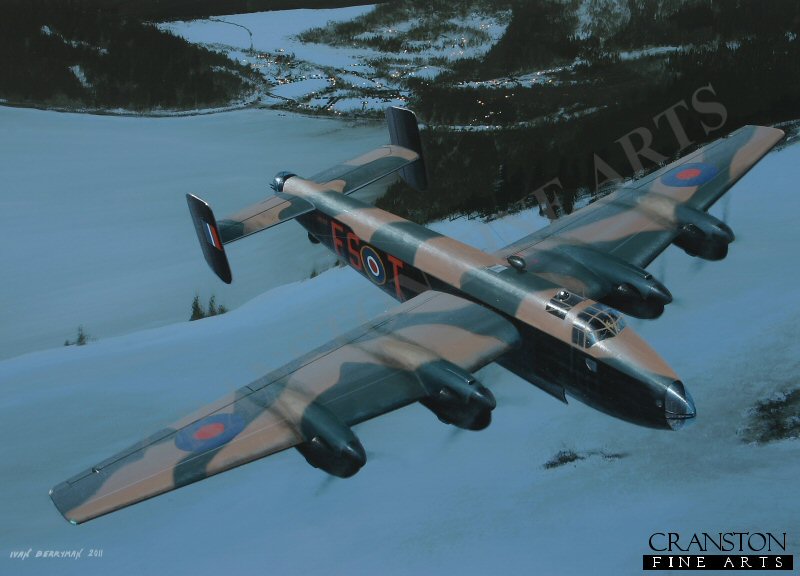
Halifax Mk.III NA337 by Ivan Berryman. (PC) One of 6,176 Halifaxes built during World War II, NA337(2P-X) was shot down over Norway on 23rd April 1945. In 1995 it was recovered from the lake that had been its watery home for fifty years and has now been restored by the Halifax Aircraft Association in Ontario, Canada. |
Tragedy Over the Alps by Ivan Berryman. (PC) On the night of 13th August 1943, Short Stirling EF452 of 218 Sqn was part of a bombing raid to Turino in Italy. As the Squadron cleared the Alps the tail gunner of one of the aircraft mistook EF452 for an enemy fighter and immediately opened fire with great accuracy. The windshield fragmented and was partially blasted away, 3 engines were hit and one had to be shut down. The Navigator was hit and killed, the pilot was severely wounded taking hits in the face, right arm and chest, the bomb aimer and flight engineer were also wounded. The Flight Engineer pulled the slumped pilot off the controls and managed to pull the aircraft out of its dive at approximately 4000 feet. The Bomb Aimer took over the controls and turned south over the Mediterranean for another allied airfield knowing the aircraft wouldn’t be able to climb back over the Alps. Although grievously wounded, the young Pilot assisted the Bomb Aimer as best he could, slipping in and out of consciousness and scribbling notes, as his jaw was broken. The Bomb Aimer managed to crash land with the landing gear up on the airfield at Bone, Algeria. The brave young pilot who refused to be treated, succumbed to his wounds later that afternoon. Pilot Flight Sergeant Arthur Louis Aaron DFM was awarded the Victoria Cross, whilst RCAF Bomb Aimer Flight Sergeant Alan William Jessup Larden was awarded the Conspicuous Gallantry Medal (Flying) and Flight Engineer Sergeant Malcolm Mitchem was awarded the Distinguished Flying Medal. |
Operation Ebensburg by Ivan Berryman. (PC) Sunday 8th April 1945. Halifax B.II Series 1 (Special) JP254 of 148 Special Duties Squadron, RAF piloted by Pilot officer Bill Leckie is depicted approaching the drop zone near to the Alt Aussee salt mine in the Austrian Alps to drop four SOE agents and their equipment whose mission it was to secure and protect 6,755 items of the world's greatest works of art that had been looted and stored by the Germans as they swept across Europe. With the allied forces closing in, the Germans had planned to blow up the entire store to prevent the artworks from falling into the hands of the liberators. Once on the ground, the four agents linked up with local resistance fighters and the mine and its valuable contents were eventually secured, the explosives made safe and the entire cache taken into the safe keeping of the 80th US Infantry Division as the German occupation of Europe crumbled. |
Tribute to Ivan Kozhedub by Ivan Berryman. (PC) Considered the highest scoring Soviet and Allied Ace of World War Two, Ivan Kozhedub is credited with more than 60 victories in less than two years from July 1943 to April 1945. Seen here late in the war flying his Lavochkin La-7, he is also notably the first Soviet pilot to claim an Me262 jet. Awarded the Hero of the Soviet Union three times, he stayed with military aviation and served in the Korean War. He died in 1991, aged 71. |
Tragedy at the Eder by Ivan Berryman. (PC) Following the successful attack on the Mohne dam on the night of 16th/17th May 1943, three Lancasters of 617 Sqn turned their attention to the Eder, some twelve minutes flying time away, accompanied by Wing Commander Guy Gibson to oversee the next attack. After several aborted attempts to obtain the correct height and direction for their bomb run by Flight Lieutenant Shannon (AJ-L) and Squadron Leader H E Maudslay (AJ-Z), Gibson called in Maudslay to try again. During his second approach, he released his Upkeep bomb too late. It struck the top of the dam wall and bounced back into the air where it exploded right behind Maudslay's aircraft, lighting up the entire valley and causing considerable damage to the aircraft that had dropped it. Despite what must have been crippling damage, AJ-Z did manage to limp away from the scene and begin the return journey, but Maudslay and all his crew were sadly lost when their aircraft was shot down by flak at Emmerich-Klein-Netterdn. The Eder was finally successfully breached by Pilot Officer Les Knight's aircraft, ED912(G), AJ-N, which returned safely. |
Tribute to Gen. Stanislaw Skalski by Ivan Berryman (PC) A damaged Heinkel He111 rolls onto its back as Gen. Stanislaw Skalski claims another victim for 501 Sqn on 30th August 1940. With eight confirmed victories, plus one damaged, Skalski had become an ace by 5th September, but was shot down by Me109's on this day over Canterbury, suffering burns in the incident. |
The Falcon of Feltre by Ivan Berryman. (PC) Flying the recalcitrant Aviatik D.1 115.32, Oberleutnant Frank Linke-Crawford is depicted scoring his 21st victory over a Bristol F2.b of 139 Sqn on 10th May 1918 close to the Montello in northern Italy. Having served with Flik 41J under Hauptmann Godwin von Brumowski, Linke-Crawford was promoted to the command of Flik 60J where he was credited with a further 14 victories, bringing his total to 27 at the time of his unfortunate death in this same aircraft on 31st July 1918. |
|
Contact Details |
|
Sign Up To Our Newsletter!
This website is owned by Cranston Fine Arts. Torwood House, Torwoodhill Road, Rhu, Helensburgh, Scotland, G848LE Contact: Tel: (+44) (0) 1436 820269. Email: cranstonorders -at- outlook.com
|
|
|