|
|
|
|
|
 |
|||
|
|
|
|
|
|
|
|||
| Click Here For Full Artist Print Indexes | Aviation History Archive |
|
Spitfire
Aviation Art Prints  Aviation Artists Gerald Coulson Royal Air Force Aviation Artists Gerald Coulson Royal Air Force  Spitfire Spitfire |
[UP] - Lancaster - Spitfire - Hurricane - Mosquito - Typhoon - Shackleton - Wellington - Sunderland - Hunter - Hawk - Tornado - Lightning - Jaguar - Lysander - SE5 - Sopwith Camel - Blenheim - Halifax - Swordfish |
| Spitfire Aviation Art Prints, Paintings and Drawings |
|
|
|
|
|
|
|
|
|
|
|
|
|
|
|
|
|
|
|
| Text for the above items : |
Low Level Encounter by Gerald Coulson. A Spitfire and an Me109 locked in battle pass a downed He111 low over the English countryside. |
Scramble by Gerald Coulson. A telephone rings at a typical flight dispersal: a call from Operations sends pilots and ground crew running for aircraft ready fuelled and armed. A mechanic starts the engine of the spitfire in the foreground and it explodes into life, blasting out blue exhaust gases, the slipstream flattening the grass and kicking up dust. A young sergeant pilot with feelings a mixture of fear and excitement, runs for his machine. The painting captures the tense atmosphere of a much repeated action from these crucial events of the Battle of Britain, as Spitfires of No.66 Squadron scramble. |
Spitfire Magic by Gerald Coulson. No text for this item |
Battle of Britain, Manston, 12th August 1940 by Gerald Coulson. A surprise dive bombing attack at 12.45pm as Spitfires of 65 squadron were taking off. 148 bombs were dropped on the airfield and hangars. The entire squadron got airborne with one exception, its engine was stopped by the blast from one of the bombs. |
In the Sunlit Silence by Gerald Coulson. Spitfire Mk1As of 92 Squadron. |
The Magic of Flight by Gerald Coulson. No text for this item |
Troubleshooters by Gerald Coulson. Sold out at publisher. We have the last 120 remaining prints. |
Chariots of Fire by Gerald Coulson. Chariots of Fire depicts Spitfires of 610 squadron (County of Chester) engaging Messerschmitts 190E of the Luftwaffe over the South Coast of England, August 1940. |
First Light by Gerald Coulson. In Gerald Coulsons fine study First Light, Mk Vb Spitfires of 92 Squadron climb out of Biggin Hill at the outset of an early morning patrol on a cold winters morning in February 1941. Leaving the mist behind as the first beams of light streak across the heavens, they will turn to the east and steel themselves to meet the enemy, high in the dawn sky. |
Evening Flight by Gerald Coulson. No text for this item |
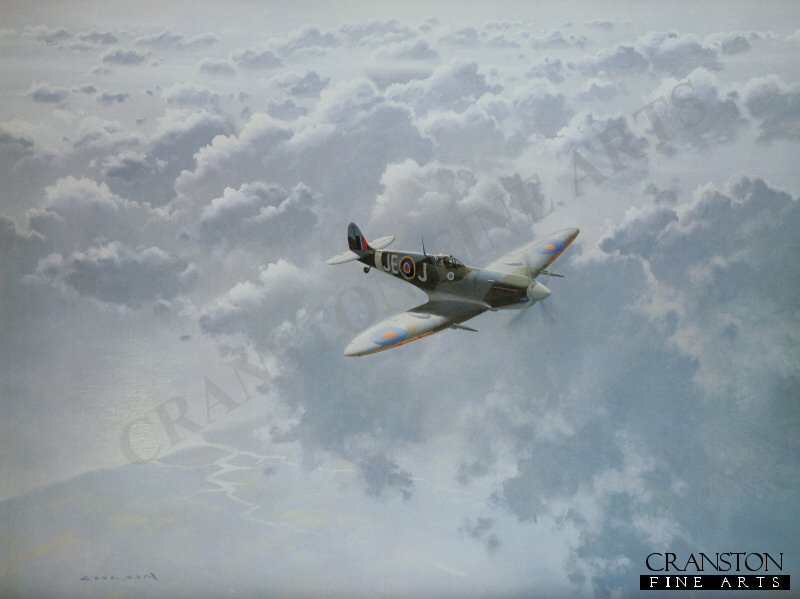
Dawn Sortie by Gerald Coulson. With its sleek, graceful design, instantly recognisable by its thin, aerodynamically advanced elliptical wings, the Supermarine Spitfire was the creation of R. J. Mitchell, an aeronautical creative genius. His fighter was to become not only the most important Allied aircraft of World War II, but the most famous British fighter in history. Mitchells design for the Spitfire was so fine that everyone who ever saw it, flew it, or fought in it was captivated for eternity. When American Eagle Squadron ace Jim Goodson transferred from Spitfires to fly his 4th Fighter Group P-47 Thunderbolt, he said it was like moving from a sports car to a truck. I fell in love with her the moment I was introduced. I was captivated by her sheer beauty; she was slimly built with a beautifully proportioned body and graceful curves just where they sohuld be; so said Lord Balfour, Britains under Secreatry of State for War in 1938, not of his wife but of the Spitfire. A sentiment echoed by generations of aviators and enthusiasts ever since. In the hands of an experienced pilot it was nearly invincible, and even legendary Luftwaffe leader Adolf Galland, when asked by Goering what he needed to overcome the RAF, replied: Give me a squadron of Spitfires!. Gerald Coulsons majestic painting captures a pair of Spitfire Mk1s at dawn high above the clouds over southern England in late 1940. An iconic tribute from the artist to the greatest fighter aircraft of all time. |
Evening Patrol by Gerald Coulson. During the early part of World War II the coastline of Britain was constantly under threat, particularly the busy shipping lanes of the North Sea. As well as carrying out bombing raids on strategic coastal targets and ports such as Luftflotte 5s attack on the north-east in August 1940, allied shipping was regularly attacked at sea as the Luftwaffe tried to disrupt supplies. The RAF played a vital part in protecting these supplies, escorting fishing fleets and shipping convoys, as well as long range patrols over the sea, seeking enemy activity and intercepting high altitude reconnaissance aircraft. These patrols were often long and arduous with pilots running the gauntlet of, if shot down, ditching into the sea. Often pilots would survive being hit and baling out, only to succumb to the freezing and hostile waters of the North Sea. Often fighter squadrons being rested during the Battle of Britain, would be moved to northern locations such as Acklington and Leconfield, and carry out coastal and sea patrols before returning to the more intense fighting in the south. Flying over the Humber Estuary as the sun is setting, pilots of 610 Sqn return their MKII Spitfires to Leconfield after a convoy patrol late in 1940. |
High Spirits 1940 by Gerald Coulson. The new boy follows the more experienced squadron pilot, learning the manoeuvres which will be so important in the months to come. The two Spitfires fly over the southern coast which will soon become the air battlefield on which the face the German bomber and fighter squadrons during the Battle of Britain. |
Rhapsody in Blue by Gerald Coulson The 70th Anniversary of the Spitfire 1936-2006. Geralds majestic study of Spitfire prototype K5054, resplendent in its new all-blue paint scheme, is seen banking high above the clouds during an early test flight in March 1936. As the little fighter lifted off Eastleigh airfield into the early spring sunshine, Summers knew immediately that Supermarine had created a thoroughbred. Powered by a 900hp Rolls Royce Merlin engine, the prototype at once displayed superb handling qualities and performance, achieving almost 350mph in level flight. Thus was born the Spitfire, the most famous British aircraft of all time. The Spitfire was to become the most important single type Allied aircraft of World War Two, was built in greater numbers than any other Allied fighter, and remianed in production throughout the war. Its superb design allowed the airframe to be continually developed and by the end of the war, now with twice the engine power, Mitchells little fighter had won its place in history. Adored by its pilots, in experienced hands the Spitfire was invincible in close air-to-air combat. |
Quartet by Gerald Coulson. The inspiration for this subject was principally the setting. A low sun turning the tops of towering cumulus to a soft ochre against a backdrop of azure. Through breaks in these massive clouds can be seen a landscape beginning to fade, greens and yellows changing to liquid blues and mauves. All that is now required to complete the picture are the lines of a beautiful aeroplane, provided here by four Spitfires on No.66 Sqn. The aircraft shown are LZ-M, LZ-N, LZ-K and LZ-X. LZ-X was flown by H R Dizzy Allen throughout the Battle of Britain. |
Harvest 1940 by Gerald Coulson. A Heinkel HeIII come to rest in a cornfield as the victorious Spitfire pilot circles the downed aircraft. |
Birth of a Legend by Gerald Coulson. The prototype Spitfire on its maiden flight on 5th March 1936. |
Mitchell's Masterpiece by Gerald Coulson. The Rolls Royce Merlin C Engine of Spitfire prototype K5054 is put through its paces in between early test flights at Eastleigh Aerodrome in March 1936. |
Johnny Comes Home by Gerald Coulson. Johnnie Johnson, the RAFs highest-scoring fighter pilot of World War II flies his Spitfire F MkIXE back to base in Kenley. |
|
Contact Details |
|
Sign Up To Our Newsletter!
This website is owned by Cranston Fine Arts. Torwood House, Torwoodhill Road, Rhu, Helensburgh, Scotland, G848LE Contact: Tel: (+44) (0) 1436 820269. Email: cranstonorders -at- outlook.com
|
|
|