|
|
|
|
|
 |
|||
|
|
|
|
|
|
|
|||
| Click Here For Full Artist Print Indexes | Aviation History Archive |
|
WW1 British Aviation Art Print List
Aviation Art Prints  Countries UK Countries UK  World War One Print List World War One Print List |
[UP] - Aircraft Index - Squadron Index - World War One Print List |
World war One Royal Flying Corps and Royal Air Force Fighters and Bombers, These early Bi Plane and tri Planes flown by these young Courageous Pilots are shown in a large number of Signed Limited edition aviation art prints Shown listed here. Most of these are only available direct form our websites. |
| Navigation | |
| Page 2 of 7 | Previous .. Page 2 .. Next |
|
|
|
|
|
|
|
|
|
|
|
|
|
|
|
|
|
|
|
|
|
| Navigation | |
| Page 2 of 7 | Previous .. Page 2 .. Next |
| Text for the above items : |
Tribute to Oliver 'Boots' LeBoutillier by Ivan Berryman. 'Boots' LeBoutillier was an American flying Ace credited with 10 victories in World War One. Having crossed into Canada and subsequently flying for the British, he is seen here in his Sopwith Triplane N5459 of 9 Naval Squadron in France in 1917 in which he scored 3 victories. In April 1918 he was involved in the dogfight in which Manfred von Richthofen - the infamous Red Baron - was shot down and killed. He was awarded the British Distinguished Flying Cross and after the war performed barnstorming and skywriting and gave flying lessons to Amelia Earhart. He appeared in many Hollywood movies as a stuntman, and for his rescue of a crashed pilot in Colorado he received the Silver Medal of Valor, the highest decoration of the Civil Air Patrol. LeBoutillier died in 1983 aged 88 after a life in aviation. |
Moonlight Renegade by Stan Stokes. On July 2, 1900 Count Ferdinand von Zeppelin piloted his first rigid-framed, lighter-than-air ship over Lake Constance in Germany. Seventeen years later, on June 16, 1917, Zepellins latest creation, the L-48, was readied at Nordholz, Germany for its first combat mission. The huge L-48 was one of the newest and most technically advanced German airships. Powered by five 250 HP Maybach engines, the great airship could carry 6,000 pounds in bombs, and was manned by a crew of nineteen. For this maiden mission the commodore of the North Sea Airship Division, Victor Schutze, would be joining the L-48s skipper Kapitain-lieutenant Franz George Eichler. Early in the afternoon the L-48 commenced its mission along with several other airships from the Nordholz base. The great Zeppelin would cruise at 60 MPH at 5,000 to 10,000 feet and would ascend to approximately 20,000 feet when approaching its target. This altitude would provide an effective defense against both anti-aircraft or British fighters. RAF Captain Robert Saundby, had returned from the front, to be put in charge of a very small RFC squadron at Oxford Ness. June 16 was a cloudless night, perfect for a Zeppelin attack., and at 11:15 PM Saundby launched his two active aircraft equipped with incendiary machine gun bullets. As he gazed up at the stars at 1:00 AM Saundby was startled to see a huge zeppelin outlined by searchlights only a few miles away. Awakening two of his mechanics, Saundby instructed them to fire up his single-seat DH2 fighter. Although obsolete and not equipped for night fighting, Saundby, who had never flown at night, got the little pusher-propeller fighter in the air, and began a long ascent. After fifteen minutes of flying Saundby spotted the L-48, which was by now attracting anti-aircraft fire which was exploding several thousand feet below the great airships altitude. For an hour or so, Saundby tried to coax every bit of altitude out of his little DH2, but he could not get in range. At around 3:00AM the L-48 completed its bombing runs, and the Captain set a due north course. With dawn only an hour away, Captain Eichler was anxious to get out of British airspace. A report from an observation airship which had accompanied the strike force that evening indicated favorable winds at 13,000 feet. Captain Eichler gave the orders to descend. Meanwhile, Captain Saundby who had fought the cold and wind while tailing the L-48 for nearly three hours, was startled to see the great airship descending. Pushing his DH2 to the limit, Saundby emptied 8 canisters of incendiaries at the L-48. Recognizing the attack the L-48 dumped ballast, and immediately began to ascend. Saundbys last few round met their target and the L-48 erupted. Saundby felt the surge of heat and light, and struggled to keep his little craft under control. Within minutes the L-48s maiden mission was over, as Saundby circled the 750 foot long fireball which had come down at Westford. Amazingly, two of the L-48s crewmembers survived, the only people to ever survive a zeppelin which had been ignited. One of these survivors, Kapitanlieuntenant Meith wrote a letter describing the L-48s fateful misssion, providing much of the historical basis for this incident. |
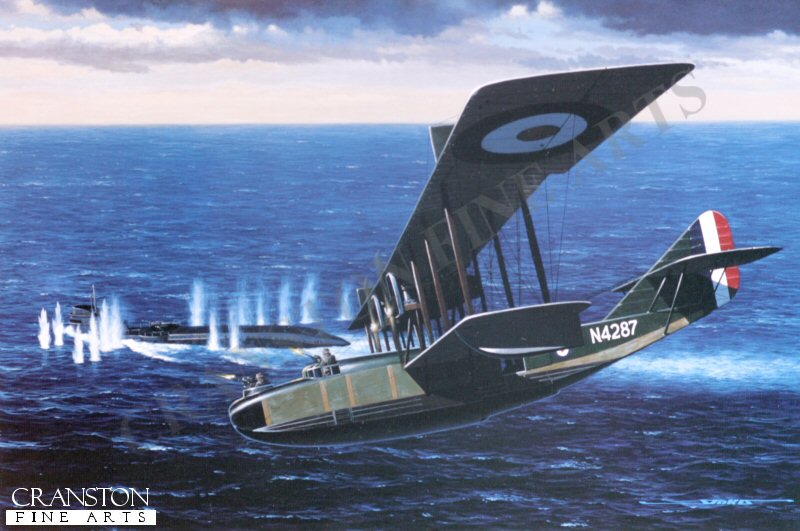
You Cant Always Hide by Stan Stokes. During WW I there were two successful designers of flying boats; the American Glen Hammond Curtiss and the Englishman John Cyril Porte. A flying boat differs from a seaplane in that a seaplane is a modified land-based aircraft, whereas a flying boat has the hull of a boat. Glen Curtiss had built the first U.S. designed seaplane and had introduced a flying boat in 1912. John Porte, who was born in 1883, had served with the Royal Navy for several years prior to dedicating himself to aviation. He went to America in 1913 to work with Curtiss. In 1913 a British publisher and aviation enthusiast, Lord Northcliffe, had established a $50,000 prize for the first to cross the Atlantic in a hydroaeroplane. Curtiss built an aircraft, the twin-engine America, for Rodman Wanamaker, the wealthy American department store owner that was supposed to challenge for the big prize. However, the design was ineffective, and a frustrating period of modifications was undertaken. When the Great War started Porte immediately returned to England accepting a commission in the Navy. He persuaded the Admiralty to purchase Curtiss flying boats, and he organized a group at the Felixstowe Naval Air Station to study flying boat design. The Curtiss H.12 Large America flying boat was flown out of Felixstowe and Great Yarmouth on anti-submarine and anti-Zeppelin patrols. The H.12 had an endurance of 6-hours, with a maximum speed of 85-MPH. During their patrol duties the H.12s sank three German submarines and downed two Zeppelins. Working closely with Curtiss, Portes work resulted in a superior hull design for a flying boat, and the use of more powerful engines. Named after the Naval Air Station where they were designed, this series of Felixstowe flying boats were superior machines. The most important of the designs was the F.2A that went into production in 1917. It was a twin-engine model with two powerful Rolls Royce engines. The F.2A had a top speed of 95-MPH and a ceiling of 10,000 feet. It could also stay aloft for up to ten hours with the use of extended tankage. Felixstowes would typically carry a pair of 230-pound bombs mounted under the lower wings. The aircraft was well armed with as many as four machine guns installed. The biggest of all the Felixstowe designs was the five-engine Fury, a 15-ton giant that appeared in 1918. The Flying boats proved their worth during WW I. They had victories against enemy U-boats, Zeppelins, and seaplanes. |
Christmas Greetings from the RFC, North Italy, 25th December 1917 by David Pentland. On Christmas Day at 0745 hours, Maj.Barker and Lt Steve Hudson of No.28 Squadron, staged an unauthorized raid on the German aerodrome at San Fior, even dropping a holiday greeting - To the Austrian Flying Corps, with Christmas greetings from the RFC, along with liberal machine gun fire and twenty-pound Cooper bombs. |
Turner's Defence by Robin Smith. This painting was commissioned by Chris Davey, the aviation fiction author, for the cover of his latest novel Turner's Defence. The image depicts Will Turner chancing upon a German Zeppelin early one morning over the coast of England. The book is the third in a series of fictional novels chronicling the life and times of a young pilot in the early years of aviation. |
Leutnant Josef Mai by Ivan Berryman. Victory No 26 for Josef Mai was a 64 Squadron SE5.A on 5th September 1918, here falling victim to the guns of the aces zebra-striped Fokker D.VII 4598/18 of Jasta 5. By the end of the war, his total had risen to 30 aircraft destroyed, Mai himself collecting a number of decorations, among them the Iron Cross 1st and 2nd class. Surviving the Great War, it is believed that he became a flying instructor for the Luftwaffe during World War II, finally being laid to rest in 1982, aged ninety four. |
Captain Arthur Henry Cobby by Ivan Berryman. Arriving in France in 1917 with little or no air gunnery training behind him, Captain Arthur Harry Cobby went on to become the Australian Flying Corps highest scoring ace with 29 victories to his credit, five of them observation balloons. He is shown here in Sopwith Camel E1416 of 4 Sqn AFC (formerly 71 Sqn AFC) having downed one of his final victims, a Fokker D.VII on 4th September 1918. Cobby survived the Great War and served in the RAAF during the inter war period and World War Two, eventually leaving the service as Air Commodore CBE. He died in 1955. |
Vickers Gunbus FB5 by Tim Fisher. This aircraft entered service with the RFC in February 1915. Nicknamed the gunbus, it was the first British aircraft to be designed as a fighting machine from the start. The plane was armed with a single .303 inch Lewis machine gun, fired by the observer. It was only a short period of time before it was outclassed by German aircraft carrying synchronised forward firing machine guns. |
Captain Andrew Beauchamp-Proctor by Ivan Berryman. Standing just five feet two inches tall, Andrew Beauchamp-Proctor had to have his SE5a specially modified to accommodate his small stature, but the diminutive South African was a giant in the air, claiming a total of 54 victories before the end of the war, many of them observation balloons which made him one of the top balloon-busting aces of the RFC. But many aircraft fell to his guns, too, as here when on 21st August 1918 he claimed an Albatros C-Type as victory number 34 whilst flying D6856 of 84 Squadron. |
Magnificent Courage by Stan Stokes. On April 6, 1916 the RFC formed several new squadrons, including the No. 56 Squadron - Scouts. In March of 1917 the unit received the first of its new SE5s. The aircraft was disappointing to the pilots, being slower than expected, and its new Vickers machine gun with interrupter gear was next to useless. Many modifications ensued in the field, and many SE5s were fitted with Lewis guns located atop the upper wing, and in some cases an additional Lewis was installed which could be fired downward through the cockpit. In early April of 1917 No. 56 was ready to see its first combat action, and the unit headed off to France. About nine months earlier the pendulum of air superiority had swung back to the Germans. The Fokker scourge of 1915 had previously been negated by the deployment of DH2 and FE8 aircraft, but the newer German Albatros and Halberstadt fighters had regained the upper hand. The RFC was once again suffering unsustainable casualties. No. 56 Squadron was immediately pressed into service upon its deployment in France, and over the next several months gave a good account of itself. The Squadrons first victory came on April 22, and went to Albert Ball who would become a high scoring ace. On September 23, 1917 many of No. 56 Squadrons pilots would become engaged in what would be considered as one of the epic battles of early aerial warfare. At about 5:00 PM in the evening eleven SE5s took off for a routine patrol. There were heavy clouds at 9,000 feet, effectively limiting the ceiling. Several engagements took place prior to James McCudden noticing a lone SE5 from No. 60 Squadron under attack by a German triplane. Unknown to McCudden was the fact that the triplane was piloted by Werner Voss, a top German ace with 48 confirmed victories. During the next several minutes 7 SE5s focused their efforts on attacking Voss triplane. Voss had several opportunities to make a dash for the German lines, but chose to stay and fight. Demonstrating beautiful flying and determination, Voss held the massed SE5s at bay, and managed to inflict damage on each and every one. With maneuvers made so quickly and so unpredictably, none of the SE5 pilots could keep Voss in their gunsights long enough to fire a meaningful burst. Voss managed to damage two of the SE5s enough that they withdrew from the fight, and a red-nosed German Albatros joined in the fray for a short time. At one point in the battle McCudden indicated that the triplane was in the cone of tracer bullets from at least five machines simultaneously. Voss could out climb and outmaneuver all the RFC craft. Minutes later at about 2,000 feet the SE5 piloted by Arthur Rhys Davids managed to catch the German ace in a straight flat dive, and approached to within feet of the triplanes tail, firing a solid burst before pulling out of his dive. Moments later the triplane hit the ground and disintegrated. Later that evening the pilots of 56 Squadron recounted the epic battle speculating as to who might have been the pilot of the German triplane. The next morning General Trenchard sent an aide to 56 Squdron to elicit details of the battle. In this report James McCudden paid the following tribute to Voss, As long as I live I shall never forget that German pilot who single-handedly fought seven of us for ten minutes, and who put some bullets through all our machines. His flying was wonderful, his courage magnificent, and in my opinion he is the bravest German airman whom it has been my privilege to see fight. |
Last But One by Ivan Berryman. In the skies just west of Amiens on 20th April 1918, the celebrated German ace, Manfred von Richthofen, the Red Baron, flying his famous all-red Fokker DR.1 Triplane 425/17 and accompanied by other DR.1s of his notorious Flying Circus, encountered Sopwith Camels of No.3 and No.201 Squadrons and a fierce aerial battle ensued. Two Sopwith Camels were to fall to the Red Baron's guns that day, the first of them being Major Richard Raymond-Barker, shown here flicking his aircraft to the right to avoid the German's fire. Raymond-Barker was almost immediately shot down, his burning aircraft being consumed by fire on impact. Just minutes later, Second Lieutenant David Lewis was caught and despatched, these two British scouts being the last ever victims of Baron von Richthofen. |
Dawn Dog Fight, Mick Mannock VC by Graeme Lothian. High above the trenches in April 1918, 74 Squadron engage the famed JG 1 led by the renowned ace baron von Richthofen in his distinctive bright red DR 1. Edward Mick mannock flying a SE5.a diving down top engage another Fokker Dr1 as the red baron flies past momentarily catching each others eyes. The new CO of 74 squadron, major Grid Caldwell MC (bar) New Zealands top ace can be seen above entering the dog fight. But it would be Mannock who would go on to great fame. with 61 confirmed victories and to win the VC, DSO (bar) and MC (bar) After 74 squadron he replaced Billy Bishop of CO 85 Squadron on the 3rd July 1918, scoring 46 victories in the Se5.a He was killed by ground fire near Lestram, France on the 26th July 1918. his Victoria Cross being gazetted on the 18th July 1919. The red baron CO of the Richthofen's Flying circus didn't survive the month, also killed by ground fire on the 21st April, he was buried by the Allies with full military honours. |
Tribute to 8 Naval Squadron by Ivan Berryman. In this painting, the Sopwith Triplane N5468 named ANGEL of No.8 Naval Squadron is depicted around the time it was flying from St. Eloi in France in the summer of 1917. This aircraft clocked up more than 150 flying hours here before being sent to a training squadron at the end of the year. During this time, Captain Charles Jenner-Parson claimed at least two victories in this aircraft. |
British Ace Albert Ball c.1917 by Chris Collingwood. No text for this item |
Sergeant John H Jones and pilot Captain W G Mostyn, Bristol F2b Fighter claiming a Luft-Verkehrs-Gesellschaft LVG by Ivan Berryman. Of similar configuration, but usually outclassed by its British contemporary, the Bristol F2b, the Luft-Verkehrs-Gesellschaft LVG was essentially a strong and stable observation aircraft that served widely during World War 1. On 21st May 1917, this example became the victim of the guns of Sergeant John H Jones, contributing to his eventual tally of 15 victories. Here, his pilot that day, Captain W G Mostyn, has already had a squirt using his forward-firing Vickers gun before manoeuvring their 22 Sqn machine into position for Jones to finish the job with his twin Lewis guns. |
Tribute to James G Struthers RNAS by Ivan Berryman. The airship was formidable as an anti-submarine weapon in the latter stages of World War One. The British formed patrols guarding the coasts of the British Isles and significantly reduced the toll on shipping that the German U-boats were taking. Here, the C or Coastal Class airship C-9, commanded by Flight Commander (later Major) James G Struthers has discovered and successfully bombed another victim - one of seven in total he claimed during he war. C-9 was the most successful airship of her class, flying over 2,500 hours and covering 68,201 miles in her four year career. Her commander, James G Struthers, was awarded the Distinguished Flying Cross and two Bars. |
Handley Page 0/400s by Ivan Berryman. For so large a machine, production of the Handley Page 0/400 was considerable with over 400 examples being delivered by the time of the Armistice in 1918. Its first missions were carried out during April of that year, operating both during daylight and by night. Here, three machines are being readied for a sortie. As final checks are completed on the nearest aircraft, some last minute engine maintenance is being carried out on a similar machine in the middle distance. The furthest example is being towed, with its vast wings folded, to the dispersal. |
Lieutenant-Colonel Raymond Collishaw by Ivan Berryman. Raymond Collishaw is shown heading B-Flight of No.10 Naval Squadron in 1917, comprised of five Sopwith Triplanes that became known as the Black Flight - all flown with great success by Canadian pilots. Collishaws aircraft was named Black Maria, Reids was Black Roger and Sharmans was Black Death, while Nash and Alexander flew Black Sheep and Black Prince respectively. Collishaws personal tally at the end of the war was 60 victories. |
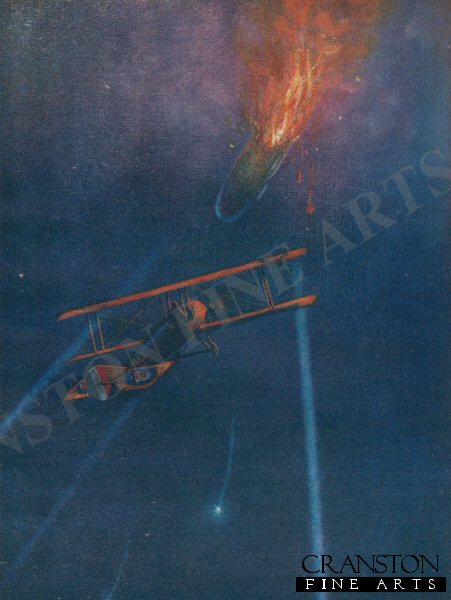
Lieutenant W L Robinson Attacks an Enemy Airship and Brings it Down in Flames by W Avis (P) On the night of September 2nd-3rd 1916. Lieutenant William Leefe Robinson, of the Worcester Regiment and Royal Flying Corps, attacked an enemy airship under circumstances of great difficulty and danger, and sent it crashing to the ground as a flaming wreck at Cuffley, near Enfield. He had been in the air for more than two hours, and had previously attacked another airship during his flight. For this act of most conspicuous bravery he was deservedly rewarded with the VC. |
Knights of the Sky by Nicolas Trudgian The dramatic scene depicts an aerial dog-fight between Sopwith Camels and SE5A fighters of the Royal Flying Corps, and the bright red planes of Baron von Richthofens JG1 fighter wing. High over Northern France, the highly manoeuvrable fighters wheel and turn in the cauldron of close aerial combat, the artist bringing alive that evocative era when aerial combat first began. |
Mayhem at Vieille Chapel by Ivan Berryman. (PC) No text for this item |
|
Contact Details |
|
Sign Up To Our Newsletter!
This website is owned by Cranston Fine Arts. Torwood House, Torwoodhill Road, Rhu, Helensburgh, Scotland, G848LE Contact: Tel: (+44) (0) 1436 820269. Email: cranstonorders -at- outlook.com
|
|
|