|
|
|
|
|
 |
|||
|
|
|
|
|
|
|
|||
| Click Here For Full Artist Print Indexes | Aviation History Archive |
|
Aviation Art Prints  Countries Germany Aircraft Index Countries Germany Aircraft Index  Fokker Dr.I Fokker Dr.I |
[UP] - Me109 - Fw190 - Me262 - Fokker Dr.I - Ju87 Stuka - Me110 - More Aircraft |
| Navigation | |
| Page 1 of 2 | Page 1 .. Next |
|
|
|
|
|
|
|
|
|
|
|
|
|
|
|
|
|
|
|
|
|
| Navigation | |
| Page 1 of 2 | Page 1 .. Next |
| Text for the above items : |
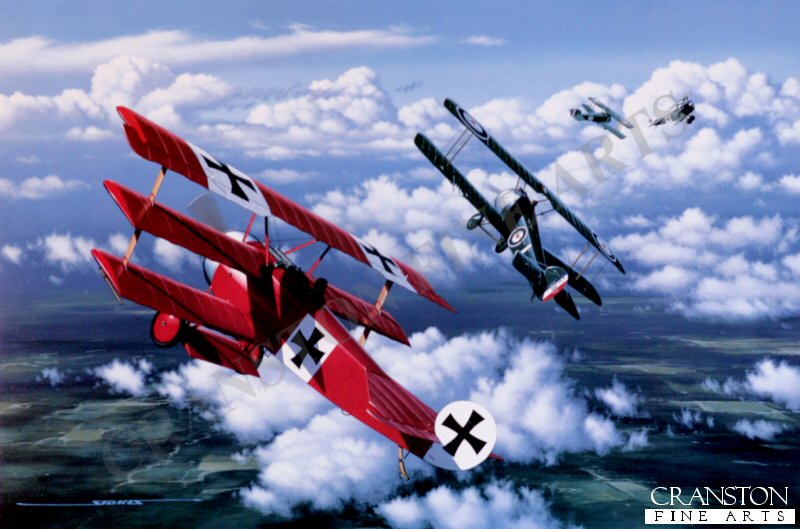
Dawn Dog Fight, Mick Mannock VC by Graeme Lothian. High above the trenches in April 1918, 74 Squadron engage the famed JG 1 led by the renowned ace baron von Richthofen in his distinctive bright red DR 1. Edward Mick mannock flying a SE5.a diving down top engage another Fokker Dr1 as the red baron flies past momentarily catching each others eyes. The new CO of 74 squadron, major Grid Caldwell MC (bar) New Zealands top ace can be seen above entering the dog fight. But it would be Mannock who would go on to great fame. with 61 confirmed victories and to win the VC, DSO (bar) and MC (bar) After 74 squadron he replaced Billy Bishop of CO 85 Squadron on the 3rd July 1918, scoring 46 victories in the Se5.a He was killed by ground fire near Lestram, France on the 26th July 1918. his Victoria Cross being gazetted on the 18th July 1919. The red baron CO of the Richthofen's Flying circus didn't survive the month, also killed by ground fire on the 21st April, he was buried by the Allies with full military honours. |
Alone in a Winter Sky - Fokker Triplane DR1 by David Pentland. Rittmeister Karl Bolle Commander Jasta 2 early 1918. |
In For The Kill by Ivan Berryman. Von Richthofens Fokker DR 1 Triplane (Serial No 425/17) in company with his wingman in a Fokker D.VII over the fields of the Western Front early in April 1918, peeling off to attack a flight of three British fighters. |
The Final Curtain by Ivan Berryman. On the 20th of April 1918, just one day before his death, the legendary Red Baron, Mannfred von Richthofen, claimed his final victory. His famous Flying Circus was engaged in battle by Sopwith Camels of No.3 and No.201 Squadron. Claiming his 79th victory, he had shot down Major Richard Raymond-Barker earlier in the dogfight - the British pilot being killed in the resulting crash. However, it is his 80th and final victory that is depicted here. In the centre of the painting, the Sopwith Camel of David Lewis has been brought into the firing line of von Richthofen, and is about to be sent down in flames from the sky - Lewis was fortunate to survive the encounter relatively unscathed. Meanwhile the chaos of the dogfight is all around this duel, with aircraft of both sides wheeling and diving in combat. The other pilots depicted are Weiss, Bell, Riley, Steinhauser, Mohnicke, Hamilton and Wenzl. |
Final Days by Ivan Berryman. Fokker DR.1 Triplane 425/17 of Manfred von Richthofen, accompanied by a Fokker. D.VII wingman, swoops from a high patrol early in 1918. 425/17 was the aircraft in which the Red Baron finally met his end in April of that year, no fewer than 17 of his victories having been scored in his red-painted triplane. |
Last But One by Ivan Berryman. In the skies just west of Amiens on 20th April 1918, the celebrated German ace, Manfred von Richthofen, the Red Baron, flying his famous all-red Fokker DR.1 Triplane 425/17 and accompanied by other DR.1s of his notorious Flying Circus, encountered Sopwith Camels of No.3 and No.201 Squadrons and a fierce aerial battle ensued. Two Sopwith Camels were to fall to the Red Baron's guns that day, the first of them being Major Richard Raymond-Barker, shown here flicking his aircraft to the right to avoid the German's fire. Raymond-Barker was almost immediately shot down, his burning aircraft being consumed by fire on impact. Just minutes later, Second Lieutenant David Lewis was caught and despatched, these two British scouts being the last ever victims of Baron von Richthofen. |
Richthofens Flying Circus by Nicolas Trudgian. Nicolas Trudgians dramatic painting recreates a scene near Cambrai, Northern France on the morning of March 18, 1918. Aware of a build-up of forces for a massive German offensive, many RFC squadrons attacked the German positions at very low altitude. Responding with as many squadrons as they could muster, including Richthofens JG1 wing, there followed one of the largest dog-fights of the entire First World War. Seen in the foreground are a Fokker Triplane and an Albatros, having winged a Sopwith Camel from 54 Squadron, as another Camel, and a Bristol fighter of 11 Squadron RFC turn to engage the German fighters. |
Tribute to Manfred von Richthofen by Ivan Berryman. The legendary Red Baron would score 80 confirmed victories in World War One, making him the conflict's top Ace. It was in a Fokker Dr.I - as depicted here - that he scored his final two victories, claiming two Sopwith Camels on 20th April 1918. It was in the same aircraft on the following day that he was shot down and killed. There are few pilots who gain such cultural significance as the Red Baron, still widely known more than a century after the events that gave him fame. |
Leutnant Josef Jacobs by Ivan Berryman. Germays greatest exponent of the Fokker Dr1 Triplane, Leutnant Josef Jacobs is depicted chatting with colleagues of Jasta 7 before a sortie in the spring of 1918. His black Triplane became well known to allied pilots, not least because of his formidable kill rate. By the end of the war, still aged just 24, Jacobs had claimed 48 enemy aircraft destroyed. The unusual practice of applying the black cross to the upper sides of the lower wings was to counter friendly fire from other German aircraft who frequently mistook the Dr1 for a Sopwith Triplane. |
Leutnant Wolfram von Richthofen by Ivan Berryman. The aerial battle of 21st April 1918 was notable for involving two young novice pilots, each from opposing sides, and their part in the events that followed was as significant as it was tragic. Both William Wop May and Wolfram Ulf von Richthofen had been instructed to stay out of trouble, to remain on the very outskirts should a battle occur and simply get used to being in the sky with so many other aircraft. Delighted to have been assigned to Jasta 11 under the custodianship of his older, eminent cousin, Manfred, Wolfram was eager to cut his teeth and show that he, too, could get the job done. Both he and May kept a watchful vigil over proceedings from a safe distance as battle was joined between the red-nosed Fokker DR.1s of Jasta 11, the green-tailed Albatrosses of Jasta 5 and the RFC Sopwith Camels of 209 Squadron. Somehow, whether through carelessness or the adrenalin rush of the moment, Wolfram flew his Fokker tantalisingly close to Mays Camel who immediately gave chase, sensing that an easy first kill might just be a possibility. May quickly realised that all was not well, however, finding his guns jammed and unable to fire. He quickly broke off the attack and swooped away, but his actions had caught the attention of Manfred von Richthofen who, although engaged in a battle of his own, had been keeping a watchful eye over his young charge. The red Triplane now latched onto the tail of Mays helpless Camel and a lurid chase began along the Somme River, a chase from which the Red Baron would not return. The young Wolfram went on to become an ace, scoring all of his eight victories in the closing months of the war, was awarded the Iron Cross 1st and 2nd and survived to be a major force in Hitlers Luftwaffe in World War Two. He was eventually taken prisoner and spent his last months in an American PoW camp where he died of a brain tumour in 1945. |
Ltn Fritz Kempf by Ivan Berryman. The Fokker DR.1 Triplane (213/17) of Fritz Kempf swoops on a pair of unsuspecting Sopwith Camels whilst on patrol over the Western Front in 1917. Kempfs practise of having his name painted across the top wing of his aircraft was supplemented by the taunt Do You Remember Me? on the mid wing. His aircraft is depicted in the colours worn by Jasta Boelcke of the Imperial Air Service. |
The 79th Victory by Ivan Berryman. For Manfred von Richthofen, the air battle in the skies west of Amiens on 20th April 1918 was to yield a final two victories to add to the seventy eight with which he was already credited. But these were to be his last, the Red Baron finally succumbing the following day. Just moments before Second Lieutenant David Lewis' 3 Sqn Sopwith Camel fell to the German's guns (the young pilot surviving to tell his story of being the Red Baron's final victim), Major Richard Raymond-Barker was not so lucky, his aircraft burning furiously until it hit the ground in a fireball near the Forest of Hamel. |
Leutnant Paul Baumer by Ivan Berryman. Shown in the colours of Jasta Boelke and carrying Baumers personal red / white / black flash on the fuselage, Fokker DR.1 204/17 was the aircraft in which he scored many of his 43 victories. Although the Sopwith Triplane had been withdrawn from service, German pilots frequently found their DR.1s being mistakenly attacked by their own flak batteries and, sometimes, by other pilots. For this reason, in march 1918, Baumers aircraft bore additional crosses on the centre of the tailplane and on the lower wings to aid identification. For some reason, his rudder displayed what appeared to be an incomplete border to the national marking. Nicknamed Der Eiserne Adler -The Iron Eagle - Paul Baumer survived the war, but died in a flying accident near Copenhagen whilst testing the Rohrbach Rofix fighter. He is shown in action having just downed an RE.8 while, above him, Leutnant Otto Lofflers DR.1 190/17 banks into the sun to begin another attack. |
Deadly Partnership - Captain W E Staton and Lieutenant John R Gordon, Bristol F.2b by Ivan Berryman. The Bristol F.2b (or Bristol Fighter, as it was more popularly known) first entered service with the RFC in March 1917 and quickly established itself as a useful and reliable fighting machine in the capable hands of the crews who quickly exploited its many attributes. The teamwork between pilot and gunner / observer yielded many success stories, both in the roles of air combat and ground attack. Here, Captain W E Staton has a stab at a Fokker DR.1 during an intense battle in April 1918 in the skies above France, whilst his pilot, Lieutenant John R Gordon keeps their 62 Squadron machine out of harms way. The combination of Gordon and Staton scored a total of 9 confirmed victories, 1 shared destroyed and 5 out of control. |
The Rittmeister by Ivan Berryman. The greatest ace of WW1, Manfred von Richthofen, the Red Baron is depicted here flying Fokker Dr.1, serial No 425/17, in its final guise following the introduction of the Balkenkreuze. This was the only Triplane flown by the Rittmeister that was painted all red and was also the aircraft in which he lost his life on 21st April 1918, the celebrated ace having scored a confirmed 80 victories against allied aircraft over France. |
Captain Roy Brown engages the Red Baron, 21st April 1918 by Ivan Berryman. Mystery still surrounds just why Manfred von Richthofen risked so much in chasing the novice pilot Wilfred Wop May into Allied-occupied territory on the morning of Sunday, 21st April 1918, but it was to be his last flight, this error of judgement costing him his life. Von Richthofen had broken from the main fight involving Sopwith Camels of 209 Sqn to chase Mays aircraft, but found himself under attack from the Camel of Captain Roy Brown. All three aircraft turned and weaved low along the Somme River, the all red Triplane coming under intense fire from the ground as well as from Browns aircraft. No one knows exactly who fired the crucial bullet, but Manfred von Richthofens aircraft was seen to dive suddenly and impact with the ground. The Red Baron was dead and his amazing run of 80 victories was over. The painting shows Mays aircraft (D3326) in the extreme distance, pursued by DR.1 (425/17) and Browns Camel (B7270) in the foreground. |
Brief Encounter by Gerald Coulson. Royal Flying Corps SE5As of 56 squadron engaged in air combat with flying circus Fokker Dr1s commanded by the great German ace Baron von Richthofen, France 1917. |
The Ringmaster by Stan Stokes. Born in Prussia to wealthy aristocratic parents, Manfred Freherr von Richtofen, The Red Baron, was to become the top ace of World War I, with 80 confirmed kills, and probably another 40-50 which took place over enemy lines and could not be confirmed. Richtofen was originally a cavalry officer, but with great persistence he was transferred to the air arm. After a brief period on the eastern front Richtofen was transferred to the western front in August 1915. His first confirmed victory was recorded in September 1916 and by November he recorded eleven kills, including Major Lance Hawker, the top British fighter pilot. With his keen reflexes and eyesight he quickly ascended, and by June 1917 Richtofen took control of a unit near Coutrai. This unit became known as Richtofens Circus. By July the ringmaster had his fifty-seventh victim. Despite his successes Richtofen shunned publicity and became increasingly withdrawn. Richtofen was wounded in combat and spent three weeks in the hospital recuperating. After his return to duty Manfred became a vocal proponent of the Fokker triplane. The bright red paint scheme utilized on one of Richtofens aircraft is what earned him the nick-name, The Red Baron. Richtofens brother, Lothar, was also an ace with forty victories to his credit. By April of 1918, aided by Americas entry into the War, Germany was facing overwhelming numbers of enemy aircraft, and many with performance capabilities the equal to, and in some cases superior to, their own. The Germans mounted a final desperate offensive, and on April 21,1918 The Red Baron finally fell victim to the perils of combat. Although there is considerable controversy over the Red Barons demise, it appears that Richtofen was either killed by Captain Arthur Brown, a Canadian flying with the RAF, or was shot down by Australian machine gunners while evading Captain Brown. Richtofen was provided a full military funeral by the Allies, and on the evening following his funeral a single RAF fighter dropped a small package containing photos of the funeral onto the Circus headquarters. By Wars end the Circus was credited with the destruction of 644 aircraft, but 56 of its airmen had been killed, 32 seriously wounded, and 6 captured. Richtofen is pictured in July of 1917 tangling with Sopwith Camels in the skies over Belgium. Flying his beloved Fokker triplane, the infamous Red Baron is shown positioning his aircraft for yet another victory. |
Von Richthofens Flying Circus by Ivan Berryman. No World War 1 pilot is better known than Manfred Von Richthofen, the Red Baron, and few pilots were greater exponents of the little Fokker DR.1 Triplane in which he scored nineteen of his eighty victories. In fact, only one of the DR.1s flown by von Richthofen was painted all-over Red. In April 1918, 127/17 was his mount, this machine being depicted here shortly after take off in company with other Jasta 11 pilots of his notorious Flying Circus. Among this formation are: Ltn Eberhardt Mohnicke, Ltn Hans Joachim Wolff, Rittm Manfred von Richthofen and his brother Ltn Lothar von Richthofen. The Flying Circus soubriquet was appended by the British and Canadian forces and was never used by von Richthofen or Jasta 11 themselves, but the sight of the red-nosed Triplanes as they joined battle in the skies above France signaled to Allied pilots a tough battle ahead. |
Rittmeister Karl Bolle by Ivan Berryman. Formidable commander of Jasta Boelcke, Karl Bolle, breaks off the attack on a 73 Sqn Sopwith Camel as its fuel tank begins to ignite - another undeniable victory in a career which saw him take an eventual 36 confirmed kills. The yellow band on the fuselage paid homage to his former unit, flanked by the black and white Prussian stripes Bolles Fokker DR.1 also sported an Oigee telescopic gunsight mounted between the guns. he survived two World Wars and died in Berlin in 1955. |
The Greatest of Them All - Manfred von Richthofen by Ivan Berryman. Arguably the best known of all World War 1 fighter aces, Manfred von Richthofen, the 'Red Baron', is depicted here flying Fokker Dr.1, serial No 425/17, in its final livery following the introduction of the Balkenkreuze, early in 1918. Contrary to popular belief, this was the only Triplane flown by the Rittmeister that was painted all red and was also the aircraft in which he lost his life on 21st April 1918, the celebrated ace having scored a confirmed 80 victories against allied aircraft over France. |
Fokker Dr.I |
|
Contact Details |
|
Sign Up To Our Newsletter!
This website is owned by Cranston Fine Arts. Torwood House, Torwoodhill Road, Rhu, Helensburgh, Scotland, G848LE Contact: Tel: (+44) (0) 1436 820269. Email: cranstonorders -at- outlook.com
|
|
|